• This forum is the machine-generated translation of www.cad3d.it/forum1 - the Italian design community. Several terms are not translated correctly.

better solution to close a surface.

  • Thread starter Thread starter panormus
  • Start date Start date
because my intention is to create the whole fuse and then intersect the same with the horizontal tail plane, then apply fittings to the edges generated by the intersection, it seems to me the most natural thing.
By doing so you force yourself to create a complex portion of surface that little has to do with the simple allusion of the fuselage in the tail, then you will have to apply fittings between vertical, horizontal and fuselage. I don't work with the surfaces, but surely that "ract" that in the enclosed photos I highlighted in purple, I would do it after just because it deviates a lot from the shape of the fuselage.
probably the fuselage should create it with two separate surfaces. one for the sides and the lower part which includes all the sections up to the last, and the other for the upper part that will end on the last section (f14a)
 

Attachments

  • altra coda su26_color.webp
    altra coda su26_color.webp
    12.5 KB · Views: 10
  • altra coda su26_color_2.webp
    altra coda su26_color_2.webp
    72.8 KB · Views: 6
What do you mean you don't have orders? in the file su26mx_4of4.dxf (part of which I posted back) , there are sections of the fuselage from the engine cap to the tail. to make a model for educational use suffice and advance.

It seems to me that the main difficulty is in the proper use of surfaces, as others have already pointed out that the surfaces use them.

Sorry, I'm not aeromodellist and I don't have the original designs of sukhoi su26.
I'll do it again with the ordered ones. (I didn't consider them, because the dxf in the catia doesn't report the curves... in reality they see if I enlarge a lot).
on the difficulty of working the surfaces, well, I would like to understand how I should do with catheism to behave near these angles.
in previous lightning posts and helmets definitely gave me directions, but ahimé can not follow/understand exactly how to do.
thank you I will update you.
I hope in the meantime that someone can give me the explanations I need.

greetings
 
just to show you. .
 

Attachments

  • Cattura72.webp
    Cattura72.webp
    183.4 KB · Views: 11
  • Cattura73.webp
    Cattura73.webp
    58.1 KB · Views: 8
I'll do it again with the ordered ones. (I didn't consider them, because the dxf in the catia doesn't report the curves... in reality they see if I enlarge a lot).
It seems obvious to me that you will then have to create orderly curves to get the surfaces based approximately on those of the dxf.
on the difficulty of working the surfaces, well, I would like to understand how I should do with catheism to behave near these angles.
in previous lightning posts and helmets definitely gave me directions, but ahimé can not follow/understand exactly how to do.
I see it hard to learn how to deflect with the surfaces starting from the modeling of an airplane; it would be like to think of learning to fly starting, looking down, from a sukhoi on-26 instead of from a quieter partnavia p66. .
if you look on the tube there are a myriad of tutorials on the surfaces and the shortcomings to take into account while working are really many. fulvio and baskets have indicated some but I think it is impossible to find out how to proceed from the end, i.e. by correcting surfaces that are probably not to be corrected but to be remade.
I would have placed here a nice step with the main curves on the three floors, equal as they were from the dxf, then I would have asked how to proceed, starting from the construction of beautiful curves on the blueprint in dxf (which has a horrendous geometry), passing from the choice of which (and why) main superifci build (see post#5 of fulvio), in which order and of what type (sweep, loft, blend etc.).
iho, fasting or almost surface, was a more rational and productive way to proceed.
 
Well, who says I'm fasting? look on the wooden tube and look at my designs.. I don't feel like fasting. :-) and the problem was pumped... even the parallel on-off. .
 
I'd like to add something to what marcof says.

in the vast majority of cases failing to draw a surface does not mean not knowing the command, or the technique, or the procedure. very often the reason is not to have understood how that surface is made.
No wonder, it's a very common thing. Look at a surface and it seems obvious, then take paper and pencil and cannot draw it. And yet you know how to use the pencil, but you just can't understand a certain surface as it turns.
without false modesty, I have been working with the surfaces for more than ten years, yet some time ago I went into deep crisis trying to draw the inorgo of a wave piercing (see photo). After an hour of trying unsuccessful, I quit my pc and clarified my ideas by fighting with the pencil. at the end returned to the pc, the surface came out in a flash. And yet, man, it looks like a trivial surface!
 

Attachments

  • HSC-Catamaran-in-the-world-112m-wave-piercing-catamaran.webp
    HSC-Catamaran-in-the-world-112m-wave-piercing-catamaran.webp
    20.5 KB · Views: 9
  • HSC-Pescara-Jet-High-Speed-Catamaran-wave-piercing-catamaran-Photo-John-Byrne.webp
    HSC-Pescara-Jet-High-Speed-Catamaran-wave-piercing-catamaran-Photo-John-Byrne.webp
    17.6 KB · Views: 10
time ago we helped a guy to draw a playstation joystick... but I can't find the discussion. . .
even if there the modeling technique is completely different, it could be interesting to give a reading.
 
I'd like to add something to what marcof says.

in the vast majority of cases failing to draw a surface does not mean not knowing the command, or the technique, or the procedure. very often the reason is not to have understood how that surface is made.
No wonder, it's a very common thing. Look at a surface and it seems obvious, then take paper and pencil and cannot draw it. And yet you know how to use the pencil, but you just can't understand a certain surface as it turns.
without false modesty, I have been working with the surfaces for more than ten years, yet some time ago I went into deep crisis trying to draw the inorgo of a wave piercing (see photo). After an hour of trying unsuccessful, I quit my pc and clarified my ideas by fighting with the pencil. at the end returned to the pc, the surface came out in a flash. And yet, man, it looks like a trivial surface!
pure curiosity, was the line of intersection with the surfaces that did not come as you wanted?
 
pure curiosity, was the line of intersection with the surfaces that did not come as you wanted?
No. the surface in red must obviously be a unique surface from which to "draw" the narrow curve that is missing. so I make the surface, project in profile the curve, and it is made.
at the bow of that narrow 'v' is easy to draw the inner profile of the hulls, but at that point (blue fields in the other hull) you find the hull that comes from the bow and that it has to continue to stern, and the inorgo* that comes from above. becomes a very complicated point.
I don't remember very well, but I think I resolved by drawing a water line up to that edge, so much to fix ideas, and I rested on that other surfaces. working with sections, as you normally do, doesn't come out.

(*)
the insorgo is the area between the central and the lateral hull, the one where in traditional catamarans is compressed the air that gives bearing to the structure, and that instead in the wave piercing has the task to start the flows towards stern limiting to the minimum the coanda effect.
 

Attachments

  • HSC-Pescara-Jet-High-Speed-Catamaran-wave-piercing-catamaran-Photo-John-Byrne.webp
    HSC-Pescara-Jet-High-Speed-Catamaran-wave-piercing-catamaran-Photo-John-Byrne.webp
    21.4 KB · Views: 10
I'd like to add something to what marcof says.
in the vast majority of cases failing to draw a surface does not mean not knowing the command, or the technique, or the procedure. very often the reason is not to have understood how that surface is made.
I think you're right. reflecting my observations so far came from the considerable discrepancy I observe between the forms created by panormus and those deductible from the printscreens and especially from the photos of the real aircraft.
we dwelt on the tail, but also the whole front of the fuselage is not correct... too cylindrical.
 
Well, who says I'm fasting? look on the wooden tube and look at my designs.. I don't feel like fasting. :-)
Okay, it'll be as you say you're not fasting on surfaces.
I simply based on what you posted here, where problems are there and not only concern the correctness of forms but also the cleaning of the surfaces, so there is something wrong with the method of creation. also looking at the model of the p51 and the piper, where it is delicate soperfici like the fuselage, to me jump to the eye already from the sun shielded of the cad in shade several magagne on the forms. idem for the car model.
and the problem was pumped... even the parallel on-off. .
I don't see pumps. .
As for the parallel between the use of the two aircraft (su-26 vs p66) I don't know what you meant I wanted to say about so eclatating that you use a "addition".
I try to repeat myself by changing: learning how to model the surfaces starting from the realization of a aircraft is how to do school driving on a f1. Maybe now I've been clearer.
 
You're right, I agree with marcof. but the tail or the hood are just a didactic example to understand how you work when you have corner spots.
As soon as I can turn the step and show me how to do it. greetings
 
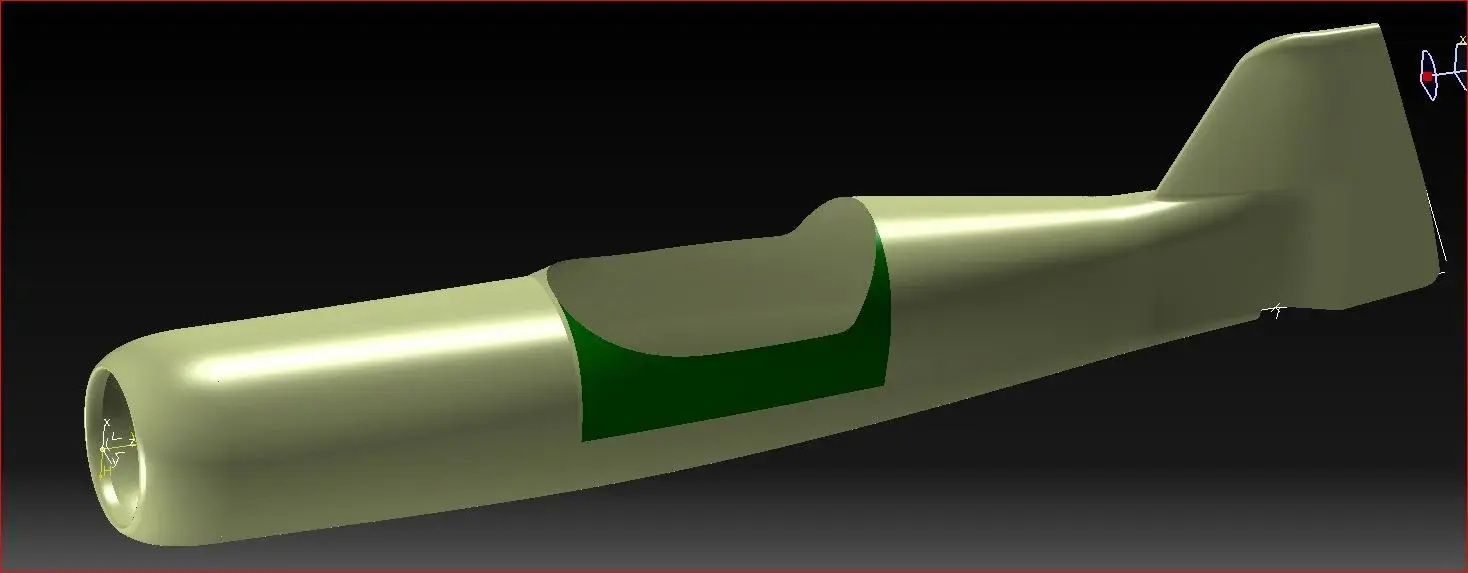
I would like to know from those who understand of surfaces how it would make the green colored area.

Thank you.

ps looking for solutions and not problems, to find faults enough me. :biggrin:
 

Attachments

  • Cattura.webp
    Cattura.webp
    19.4 KB · Views: 16
  • step-fuso.7z
    step-fuso.7z
    289.6 KB · Views: 5
to me already jump to the eye from the sun shielded of the cad in shade several magagne on the forms. idem for the car model.
were tutorials, not models to be presented at piper or Audi :wink:
and as self-taught I feel very satisfied today. This does not take away that I want to do better. n'est pas?
 
I would like to know from those who understand of surfaces how it would make the green colored area.
I have that green colored area doesn't come as you want because the surfaces around aren't well...

I use a little bit of the surfaces, but I allow myself to give up, apologising in advance with this noble :smile:, to indicate a little rough as I would have shaped the whole fuselage from which surfaces. see photo attached:
- before the violet surface of the flank.
- to follow the red in front of the roof and the blue behind the roof, made as you see, to be cut after with a surface or a curve on the surface to obtain the seat of the roof
- finally the lower part and the engine caps.

Maybe I'm wrong, but I just looked at the real heir and followed the riveting line, i.e. I spotted the fuselage elements.
ps looking for solutions and not problems
identifying problems also serves to find solutions
to find the defects just me. :biggrin:
It's not true, as you see from the thread if we give you a hand, you find many more than you look for them alone:wink:

p.s. is a sin that except fulvio can not participate also the other speakers previously in your threads, starting with rs4 working in the aeronautical field.
 

Attachments

  • Sukhoi___y.webp
    Sukhoi___y.webp
    304.6 KB · Views: 12
I have that green colored area doesn't come as you want because the surfaces around aren't well...

I use a little bit of the surfaces, but I allow myself to give up, apologising in advance with this noble :smile:, to indicate a little rough as I would have shaped the whole fuselage from which surfaces. see photo attached:
- before the violet surface of the flank.
- to follow the red in front of the roof and the blue behind the roof, made as you see, to be cut after with a surface or a curve on the surface to obtain the seat of the roof
- finally the lower part and the engine caps.

Maybe I'm wrong, but I just looked at the real heir and followed the riveting line, i.e. I spotted the fuselage elements.

identifying problems also serves to find solutions

It's not true, as you see from the thread if we give you a hand, you find many more than you look for them alone:wink:

p.s. is a sin that except fulvio can not participate also the other speakers previously in your threads, starting with rs4 working in the aeronautical field.
I apologize to the forum and to panormus but the time and what and::::::::::::::::: limited. .

I try to be the most present on the forum.. like for years.. I tried when I could make my contribution.

returning to the discussion design and a little different as some of you know I can only say that on flight surfaces there are years of study. .

Unfortunately I cannot post anything of surfaces I can tell you that they are usually in g1 or max g2 curvature hardly are pach but they are only piece, or better pach huge.. I speak of this already from the tenets of catia v3 and after v4.. the aircraft that you see around are all v3 and a little v4 example b777 qundi I let you imagine talking about excellent surfaces in g1 and good little curvature the necessary linear and clean on large dimensions

Hi.
 
returning to the discussion design and a little different as some of you know I can only say that on flight surfaces there are years of study. .
I guess
Unfortunately I cannot post anything of surfaces I can tell you that they are usually in g1 or max g2 curvature hardly are pach but they are only piece, or rather huge pach. .
It is not that you have to post confidential material, simply if you have time and want to illustrate how you would do those surfaces. It is a question of giving advice on modeling strategies, not to unveil industrial secrets :smile: . the same speech is valid for flaviobrio, ceschi & c., that with the surfaces we are living. because certain tips are untied by the specific cad could serve as useful guides to everyone to better understand how the surfaces are used.
It is therefore obligatory to quote the beautiful phrase that has in signature rs4: "a man of ingenuity knows he always possesses a lot, and he does not regret having to share it with others".
I let you imagine talking about excellent surfaces in g1 and great little curvature the necessary linear and clean on large dimensions
:confused: and a "as if he were antani" do you not put it? :tongue: jokes aside, you don't understand the perid, maybe "put a piece" [cit.]
 
:confused: and a "as if he were antani" do you not put it? :tongue: jokes aside, you don't understand the perid, maybe "put a piece" [cit.]
excuse me the concept a little abstract you are right, I wanted to say surface with great amplitudes in tangenza g1 and few patches, we do not talk about curvatures in g2 but the important and follow a clean profile

Hi.
 

Forum statistics

Threads
44,997
Messages
339,767
Members
4
Latest member
ibt

Members online

No members online now.
Back
Top