• This forum is the machine-generated translation of www.cad3d.it/forum1 - the Italian design community. Several terms are not translated correctly.

bolting exercise

  • Thread starter Thread starter Raffaele98
  • Start date Start date

Raffaele98

Guest
good evening to all, this is my first post on this forum, I was looking for help for an exercise on the size of bolts, more than one of your feedback.
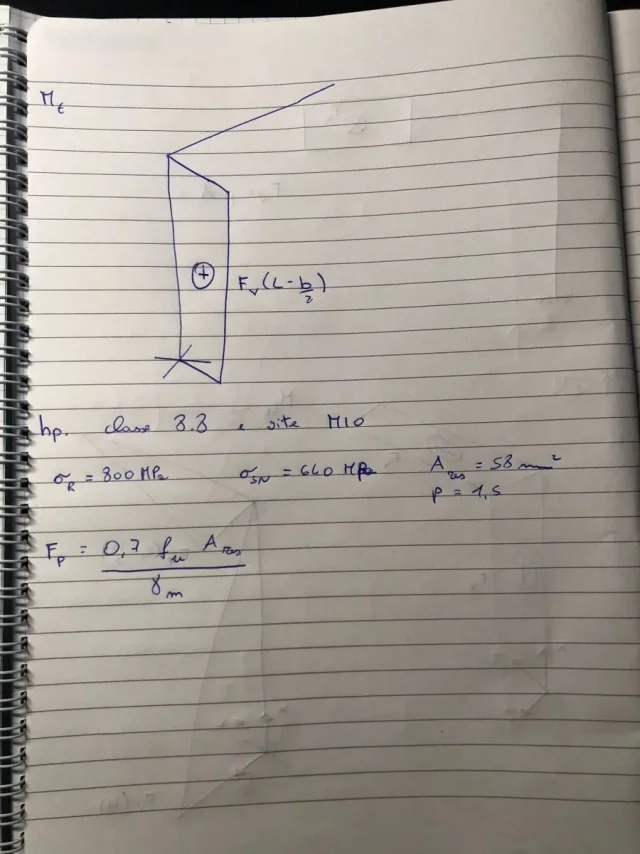
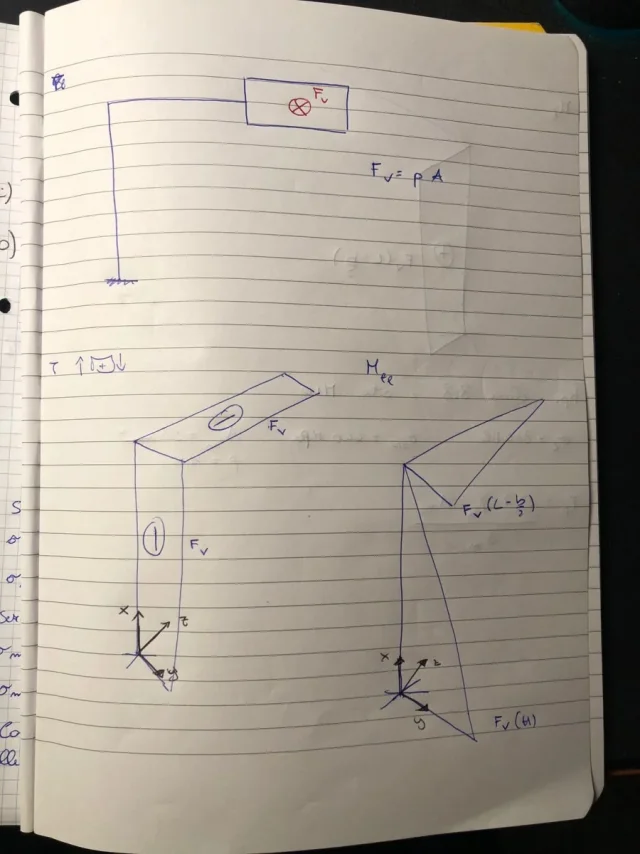
the problem is that I have doubts about the verification, for which I had thought of proceeding following the following formulas.WhatsApp Image 2019-07-08 at 12.49.21 (3).jpegWhatsApp Image 2021-11-19 at 19.30.58.jpegWhatsApp Image 2021-11-19 at 19.30.50.jpegScreenshot (76).webp
 
topic already treated, always do a research before opening a discussion
You could add some explanations about the reasoning you made.
 
I sincerely see a series of copies and pastes without explanations.
the development of what must be done includes:
- application forces on the simplified structure
- determination of ground reactions at the center of the base plate
- is not asked to dimensional the pipe of the pole
- for bolting to use uni en iso 1993-1-8 i.e. eurocode 3....other methods are not to norm and could only be academic (uni cnr 10011 or similar)
- it is important to evaluate how the base plate reacts and how you want to treat it (deformable plate or not)

just to give you an ambush... look at this debate where we talk about elastic method.

your screws will see different components and you have to hypothesize the center of every effect.

for eurocode 3 you have these cases for bolts:
wp_ss_20141221_0001-png.39118
 
exact, depends on how you deduce the neutral axis of the bolting pattern. You can take the deformable, indeformable plate, or, usually (for conservative reasons) you will find the neutral axis of the bolting pattern coincident with the symmetry axis of the same. bending, twisting, traction, cutting of bolting, verify the not detachment of the plate and then check according to norm.nothing prohibits that you can treat the plate as a deformable element, in this case you will have to match the static moment of the plate with that of bolting, to obtain the neutral axis. you have two unknowns in an equation, so proceed by iteration, or via programmable calculator.
 
thanks to all for the advice. I'll study the subject better. do you have what text to recommend? because in class they have not been treated as necessary.
 
thanks to all for the advice. I'll study the subject better. do you have what text to recommend? because in class they have not been treated as necessary.
There are many, I think of "design and calculation of mechanical systems", of baragetti and Terranova, or any text of construction of machines.
 
I sincerely see a series of copies and pastes without explanations.
the development of what must be done includes:
- application forces on the simplified structure
- determination of ground reactions at the center of the base plate
- is not asked to dimensional the pipe of the pole
- for bolting to use uni en iso 1993-1-8 i.e. eurocode 3....other methods are not to norm and could only be academic (uni cnr 10011 or similar)
- it is important to evaluate how the base plate reacts and how you want to treat it (deformable plate or not)

just to give you an ambush... look at this debate where we talk about elastic method.

your screws will see different components and you have to hypothesize the center of every effect.

for eurocode 3 you have these cases for bolts:
wp_ss_20141221_0001-png.39118
One thing is not clear to me when I do the verification I must also consider the precarious force, or just the cutting force? Moreover the verification I have to do only on the bolt most stressed right.
 
One thing is not clear to me when I do the verification I must also consider the precarious force, or just the cutting force? Moreover the verification I have to do only on the bolt most stressed right.
You must follow the rules. the laws and you will see that everything is explained well. the precarious is one thing. the strong load is another.
However if you want a screw to hold 100kg you must prevaricate it is 100kg otherwise it breaks off as soon as a force contrary to 0.0001kg over 100.
 

Forum statistics

Threads
44,997
Messages
339,767
Members
4
Latest member
ibt

Members online

No members online now.
Back
Top