• This forum is the machine-generated translation of www.cad3d.it/forum1 - the Italian design community. Several terms are not translated correctly.

calculates the "spinta" exercised by a wild boar falling - resumption of physics 2 (vengement)

  • Thread starter Thread starter reggio
  • Start date Start date

reggio

Guest
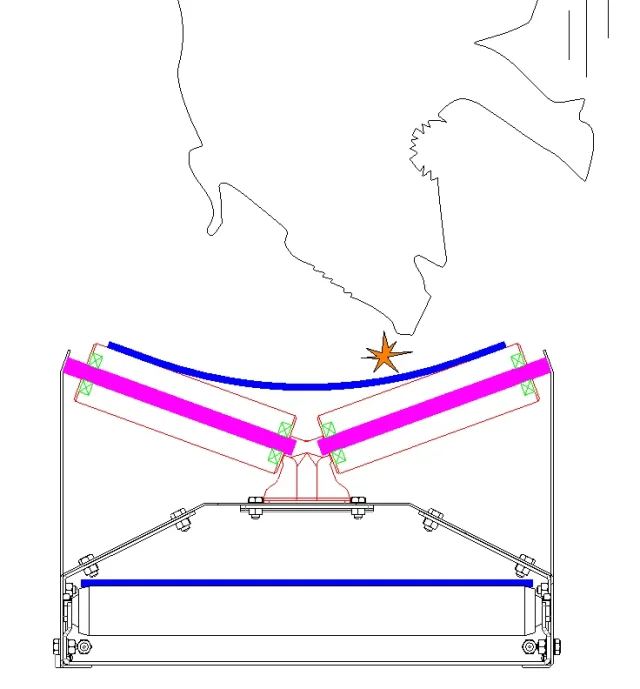
hello, we always happen singular requests, in this case from the france ask a quote for a conveyor belt suitable to move debris collected from channels and rivers where everything falls.
with a large rake lift the debris from the river and must be removed.

the material that is loaded on the conveyor belt is various: leaves, sprigs, cans, cans, but the heavier and/or sharp objects are carcasses of boars and trunks that are lifted up to beyond a "h" height " and left to fall from the opposite side on the conveyor belt.

what I basically have to do, is verify the single purple pin (roll axle) and dimension it, assuming that
- sooner or later the boar or trunk will fall at the tip, on one side of the tape, on one roller (on the less elastic point - maximum load)
- the falling body will be "medialy" rigid (and will stop in ... how do you estimate the stop time? )
- we neglect (if possible) the deformation of the boar or trunk and rubber coating roller (which I will definitely go to predict and add) not to complicate too much
- We consider one body in fall

I, already knowing of wrong, I would like to translate, the energy accumulated by the mass during the fall in kg and then verify the purple pin (or anything else will replace it) as if it was subjected to simple compression ..
However, in my head, I imagine putting on above a scale that can store the maximum weight during the impact and use that number as a reference.

I would kindly ask you for help
- understand and calculate the "weight" of the impact on "balance"
- understand and verify the roller ... with the correct method whatever it is

again, please try to explain how if I were a 7-year-old child, without taking anything for granted and explaining the various passages and reasonings :)
1686500124790.png
1686494235033.png1686494669715.png"I'm a wild boar, and I'm afraid they're feathers. "?
 

Attachments

  • 1686492998711.webp
    1686492998711.webp
    35.9 KB · Views: 21
there always happen special requests...Hello
I like the particular problems that differ from the norm and which force us to broaden our horizons and also to study something new.
we made an interesting discussion on an old forum for engineers on the calculation of the impact force of a weight falling from a certain height.
I do not want to go too far, therefore, after some essential explanation I immediately go to the solution.
- the solution is not found in the books of fiscia.
- the solution is found in some engineering books, in particular on the old masterpiece of odone bellluzzi "science of buildings" volume 4 p 261
- the impact force depends;
- from the weight of the falling object,
- from the rapport between the weight of the object and falls and impacted mass,
- from the fall height,
- from the elasticity of the impact point (to be considered as a
shock absorber),
- from the elasticity of the same body falling,
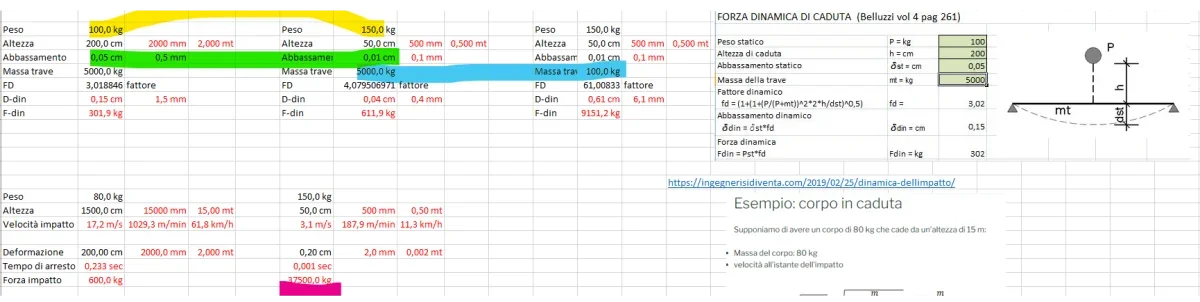
attached you find the calculation of a rigid body of 100 kg which falls from a height of 2.0 m.
calculation is strongly influenced by the elasticity of the impact point.
This elasticity is taken into account by calculating the elastic lowering of the body (100 kg) rested on the structure. in this case it is hypothesized 0.05 mm.
here is the calculation with the formulas used.
with that data a weight of 100 kg on that elastic system causes a force of 302 kg.
the interesting thing is that that formulation applies to any elastic system.
Therefore it is possible to calculate the impact force on any structure simply by calculating the elastic deformation of the weight in static conditions.
I couldn't write because the subject is more complex than it seems at first sight.
Hi.
forza-di-impatto.jpg
 
retracing physics with my son (3rd high school):
a body in free fall calculates the speed of impact with the energy balance
speed -> amount of motorcycle
with the impulse theorem, from the p you find strength, but, surprise, you need the time of the shock, that you do not know and you can not even hypothesize
then, as betoniera says, go to budget of cinematic energy and deformation energy (in 3rd high school you can not do) and take back the dear odone
I have always used the beton sheet (maybe adapting it), and never betrayed me
Hi.
 
ciao @betoniera , thanks for your time,
I searched for "odone belluzzi science of constructions volume 4" and found Here but on page 261 I don't find "fall dynamic force" maybe you could share your version or a screen shot?

Anyway, I copied your calculation on my excel sheet and I would have some doubt that I hope you can remove me:
- static lowering 0.05mm (or cm) is this about the deformation of my roller bumped by the boar?
What is that? change that value changes everything completely: (what is it? If it were the mass of my roller, it would be very low (5kg) and the value would clear up, but the roller is fixed on a frame, the frame on the ground, but the mass of the earth... in short, what is it?

with these perplexities I have searched and found something here impact dynamics – engineers become!everything seems sensible, but when I apply my values (trailing 150kg fell from 0.5mt) I get the "strange" values according to what I decide to make the roller flet (=deceleration)

... basically, I still have so much confusion, help me please1687287216049.png
 
Last edited by a moderator:
if it can affect the networks in anti-duty steel that are placed under the skylights are tested to support a lot of 50kg falling from a height of 1.2m (energy development of 600j).
the peculiarity of proof is that the sack is not a rigid body. Imagine a lot of potatoes or something with mass that can have substantially any shape.
serves to simulate the uncomposed fall of an operator from a short height.
search for the documentation of Cavatorta/copertec networks.
Maybe something can be obtained by analogy.
you have to look for, specifically, the document (if you put it in google jumps out):
agrément-tecnico-copertec-coperplax.pdf

There are also references to cable networks:
uni en 1263-1:2003: « Security networks - safety requirements, test methods ».
uni en 1263-2:2003: « safety networks - safety requirements for positioning limits ».

and finally there are useful references on the impacts (not from fall however) in technical norm ntc18 to point 3.6.3 even if in reality it deals with collisions of cars, trains or even of the classic mule that hits when it is full load. This is a bit different from what is required but could be useful to get an idea of the order of magnitude of the forces at stake.
 
Hello
allego here under the exercise 2199 of odone belluzzi
as you said the problem is more complex than it seems at first sight.
following the method indicated by belluzzi:
- lowering dst is the static lowering of the structure under the static weight of the cingial. the units of measurement must be consistent with the formula (cm).
- is then calculated the ddin "dynamic increase factor" which multiplied by the weight of the boar provides the static force equivalent to the dynamic impact.

but that formula, however very simple, indicated in exercise 2199 has a limitation:
(the structure has a negligible mass compared to that of p)
in your case is exactly the opposite.
for this reason the formulation that I applied differs from that exemplified of the exercise precisely to take into account the relationship between the masses.
on the problem of shocks we had made a long discussion in the old ingforum.
discussion that was lost when that forum was closed.
on the problem had made a very advanced contribution the user g.iara for which I had arrived to that formulation that, probably always comes from belluzzi but should be indicated in the general study of the problem.
I don't remember exactly where.
not to lose the result achieved I had created and maintained the spreadsheet I posted.
at the limit we can repropose this discussion to the new ingforum to see if there comes any advanced and interesting contribution.
Hi.
cinghiale.jpg
 
ciao @betoniera Thanks again:)

a last gift, you can stick it in my head because it changes if your beam is 5000kg (the boar lands against your truck) while my beam is 5kg? (the boar lands on my roller)

the deceleration and deformation thing comes back to me, i.e. I can imagine, an account if the boar lands on an elastic mattress and sinks for 50cm softening the fall. an account if it falls on my full titanium roller that does not move of a mm - if I too did the rubber feather roll, the boar would save - this is intuitive,
What about the mass of the beam? I mean, both mine and your beam, will be leaning on the planet earth somehow, at the bottom they will have both the "same mass" of the entire planet, what changes should be only the deformation e.g. you have put springs between boar and beam = great elastic deformation = long time of deceleration / while I cement and titanium = zero deformation and immediate stop ... the trick to beat you would just put more soft/cuscini )
I mean, did I get you my doubt? Can you take it off with a banal example?ingforum - user g.iara: yes, it would be nice to meet you :)
 
ciao @betoniera Thanks again:)

a last gift, you can stick it in my head because it changes if your beam is 5000kg (the boar lands against your truck) while my beam is 5kg? (the boar lands on my roller)

the deceleration and deformation thing comes back to me, i.e. I can imagine, an account if the boar lands on an elastic mattress and sinks for 50cm softening the fall. an account if it falls on my full titanium roller that does not move of a mm - if I too did the rubber feather roll, the boar would save - this is intuitive,
What about the mass of the beam? I mean, both mine and your beam, will be leaning on the planet earth somehow, at the bottom they will have both the "same mass" of the entire planet, what changes should be only the deformation e.g. you have put springs between boar and beam = great elastic deformation = long time of deceleration / while I cement and titanium = zero deformation and immediate stop ... the trick to beat you would just put more soft/cuscini )
I mean, did I get you my doubt? Can you take it off with a banal example?ingforum - user g.iara: yes, it would be nice to meet you :)
I'll try to answer you, see if @betoniera confirms the idea:

the mass of the beam you need because the shock boar/trave or tape will be an analistic bump then hypotizzi that you preserve the amount of motion:
[math]m_{cing}\cdot v_{cing}=(m_{trave}+m_{cing})\cdot v_{tot}[/math]
[math] e_{def} = \frac{1}{2} \cdot (m_{trave}+m_{cing}) \cdot v_{tot}^2 [/math]given the deformation energy that is stored by the beam you can find the deformation arrow. data the constraints you can find the rigidity of the beam and consider it as a spring, the deformation energy will be:
[math] e_{def} = \frac{1}{2}\cdot k \cdot \delta x^2 = \frac{1}{2} \cdot (m_{trave}+m_{cing}) \cdot v_{tot}^2 [/math]therefore[math] \delta x = \sqrt{\frac{(m_{trave}+m_{cing})}{k}} \cdot v_{tot} [/math]
 
Hello, Reggio, hello to all
I tried to retrace the subject but I couldn't find the generic formulation of the impact force (which takes into account the ratio of the masses).
In any case I propose the argument on ingforum with the same title to collect the possible contribution of other engineers.
Hi.
 
checking the mailed files I think there are some information that is necessary to define k, i.e. the rigidity of the beam.
in my formulation is considered the boar as a material point (indeformable) and the deformable beam (obviously in the elastic field).

in order to define k I hypothesized the beam supported between two supports and charged centrally, so we can get the value of k as follows:
[math]k=\frac{48\cdot e \cdot j_x}{l^2}[/math]missing then:

e --> module young material (although I imagine steel 205 gpa)
jx --> inertia of the section [mm^4]l --
 
Hello f-ingrasciotta

we hypothesize that the p load is placed in the middle of a support beam
static deformity is dst = p+l^3/(48*e*j) (see below)
the constant elastic k is the force necessary to have a unit shift and is expressed in kg/cm.
to apply formula 1690 of belluzzi you have to know dst.
but to know dst you have to know, of course, and, j, l.
but the power of that formulation is that I can replace the beam on which hangs with any elastic system.
so if I want to calculate the impact force of a weight falling on a frame, at any point, simply calculate the dst deformation of that force on the frame.
If I consider that frame as a shock absorber and want to calculate the shock elastic k, just impose deformation = 1 and calculate the force necessary to cause unit deformation.
the application is interesting and simple.
the problem is that if the mass of the shock is consistent that formulation is no longer valid.
Bye.
freccia.jpg
 
Hello f-ingrasciotta

we hypothesize that the p load is placed in the middle of a support beam
static deformity is dst = p+l^3/(48*e*j) (see below)
the constant elastic k is the force necessary to have a unit shift and is expressed in kg/cm.
to apply formula 1690 of belluzzi you have to know dst.
but to know dst you have to know, of course, and, j, l.
I understood perfectly that those data that I considered "mancanti" were used to calculate static deformation, but not being explicit I did not understand how the latter was calculated (hypotized? ).

As for the calculation of k you reported exactly what I had written in the post, just do the trivial relationship between force f and arrow f, I admit I wrote a l^2 instead of a l^3.

regarding formulation 1690 of belluzzi at the moment I couldn't find a correlation with what I wrote.
but the power of that formulation is that I can replace the beam on which hangs with any elastic system.
so if I want to calculate the impact force of a weight falling on a frame, at any point,
simply calculate the dst deformation of that force on the frame.
this is true if the two systems have an equivalent rigidity.
the problem is that if the mass of the shock is consistent that formulation is no longer valid.
on this point I have to study better, I am going to memory and I do not remember the reason why the formulation is no longer valid.
in the first hypothesis I had simulated the weight of the beam as applied in the half-works, in fact it is possible to make a distributed load, the concept of the shock and preservation of the q.m. should remain valid in case of anaelastic shock (if not mistaken is the completely anaelastic one that does not preserve nor energy).
 
I should like to thank the rapporteur for his work.
do for valid formulas posted .
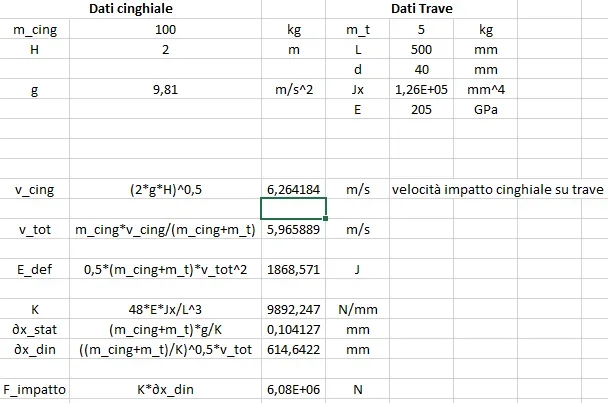
If it is said that the roller / beam has a weight of 5 kg , and I mean 50 n , imposing the width of the support and assuming the material (things that should be known ) I can think of determining the actual static arrow.
I attach my calculations to you even if the result seems excessive.
What do you think?
 

Attachments

Yes, I agree with what I said:
1_ equal kinetic energy to deformation energy
2_the rigidity of the beam is 48ei/l^3 and I find the shift of the beam
3_recording force (p)

in formulas:
1/2.1.2
2_(l^3 mv^2)/(48ei)^1/2=x
3_ ec/x=p
 
Annotazione 2023-07-03 151155.webp
I should like to thank the rapporteur for his work.
do for valid formulas posted .
If it is said that the roller / beam has a weight of 5 kg , and I mean 50 n , imposing the width of the support and assuming the material (things that should be known ) I can think of determining the actual static arrow.
I attach my calculations to you even if the result seems excessive.
What do you think?
hi, I tried to use your data but I'm not with the definition of the jx (pi/64*d^4) that I have 2 smaller orders of magnitude.

Regardless of this it seems that energy conservation is not applicable because the dynamic delta goes outside the elastic field.

Can anyone see if there's anything that doesn't come back in the formulation?
 
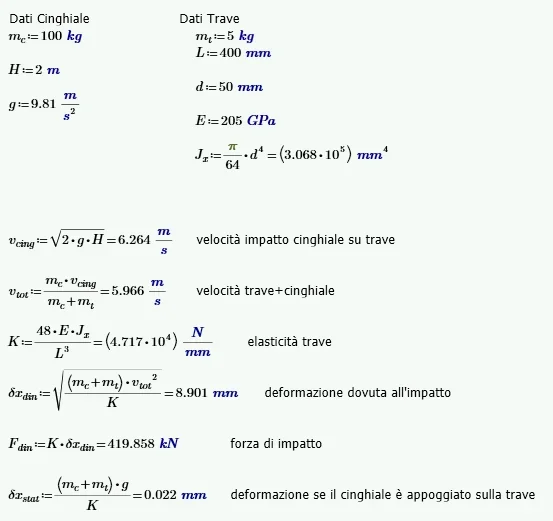
Annotazione 2023-07-04 085227.webpI corrected the spreadsheet by moving me to another program in order to avoid possible errors on the units of measurement, as can be seen the dynamic deformation is only about 9 mm, compatible with the theory of small deformations.
News the formulation you have proposed does not take into account the mass of the object on which the boar is stacked, but it is comparable to what I proposed until the beam begins to have a consistent mass.
 
View attachment 68669I corrected the spreadsheet by moving me to another program in order to avoid possible errors on the units of measurement, as can be seen the dynamic deformation is only about 9 mm, compatible with the theory of small deformations.
News the formulation you have proposed does not take into account the mass of the object on which the boar is stacked, but it is comparable to what I proposed until the beam begins to have a consistent mass.
I don't understand why you include the mass of the beam.
impact force equal to 419858 kn does not seem realistic!
because you consider the anelastic shock.
 
Last edited:
I don't understand why you include the mass of the beam.
impact force equal to 419858 kn does not seem realistic!
the impact force is 419.8 kn considering that it starts from a static force of 100kg*9.81=0.9 kn.

the mass of the beam I consider it because I consider the impact between the body 1 (straw) and body 2 (trave) anaelastic and therefore preserve the amount of motion. the speed of the boar of an instant before the impact, equal to (mgh)^0.5 cannot be equal to that at the moment immediately following the impact in which I have the maximum kinetic energy of the trave+ belt system and energy stored by the beam nothing.
 
the impact force is 419.8 kn considering that it starts from a static force of 100kg*9.81=0.9 kn.

the mass of the beam I consider it because I consider the impact between the body 1 (straw) and body 2 (trave) anaelastic and therefore preserve the amount of motion. the speed of the boar of an instant before the impact, equal to (mgh)^0.5 cannot be equal to that at the moment immediately following the impact in which I have the maximum kinetic energy of the trave+ belt system and energy stored by the beam nothing.
You're right. Good reasoning. Good.
 

Forum statistics

Threads
44,997
Messages
339,767
Members
4
Latest member
ibt

Members online

No members online now.
Back
Top