• This forum is the machine-generated translation of www.cad3d.it/forum1 - the Italian design community. Several terms are not translated correctly.

compression spring sizing

  • Thread starter Thread starter Moric-One
  • Start date Start date

Moric-One

Guest
Good morning to all,
I write because I would like to help with the sizing of a spring (see drawing). following the manual of mechanics the following formula for compression springs with circular section: f=(π*d3)/(16*r)*τam
for custom-made springs are bound to a maximum diameter of 20mm wire. according to the table of the manual for steels type b the τam (admissible tangential voltage) depends on the section, but the table comes only until diam. 12. it seems however that for that value the curve approaches 390. with the following data I should be able to find the radius of the r spring but it does not seem correct:
27500(f)=(π*203)/(16*r))*390--> 27500=(8000π/16r)*390--> 27500=(25133/16r)*390-->27500=612617/r--> r=612617/27500=22.3 mm ? having performed workshop tests with a 700mm long spring, with wire diameter 20mm and If someone with experience could give me an example, I would be grateful. I thank you so much for the time you can devote!
 

Attachments

  • Fmolla.webp
    Fmolla.webp
    59.6 KB · Views: 56
the formula you find on the manuals is as follows:Immagine 2022-12-20 190612.webporImmagine 2022-12-20 190720.webpwith n number of spires and f arrow.
 
Good morning to all,
I write because I would like to help with the sizing of a spring (see drawing). following the manual of mechanics the following formula for compression springs with circular section: f=(π*d3)/(16*r)*τam
for custom-made springs are bound to a maximum diameter of 20mm wire. according to the table of the manual for steels type b the τam (admissible tangential voltage) depends on the section, but the table comes only until diam. 12. it seems however that for that value the curve approaches 390. with the following data I should be able to find the radius of the r spring but it does not seem correct:
27500(f)=(π*203)/(16*r))*390--> 27500=(8000π/16r)*390--> 27500=(25133/16r)*390-->27500=612617/r--> r=612617/27500=22.3 mm ? having performed workshop tests with a 700mm long spring, with wire diameter 20mm and If someone with experience could give me an example, I would be grateful. I thank you so much for the time you can devote!
I honestly didn't understand the design.
Are you a compression spring manufacturer?
the springs are defined with wire diameter, spring inner diameter, useful coil number and if the ends are approached and/or molated.
If you put all the calculation in excel you will see that it will be easier even if you go to attempts.

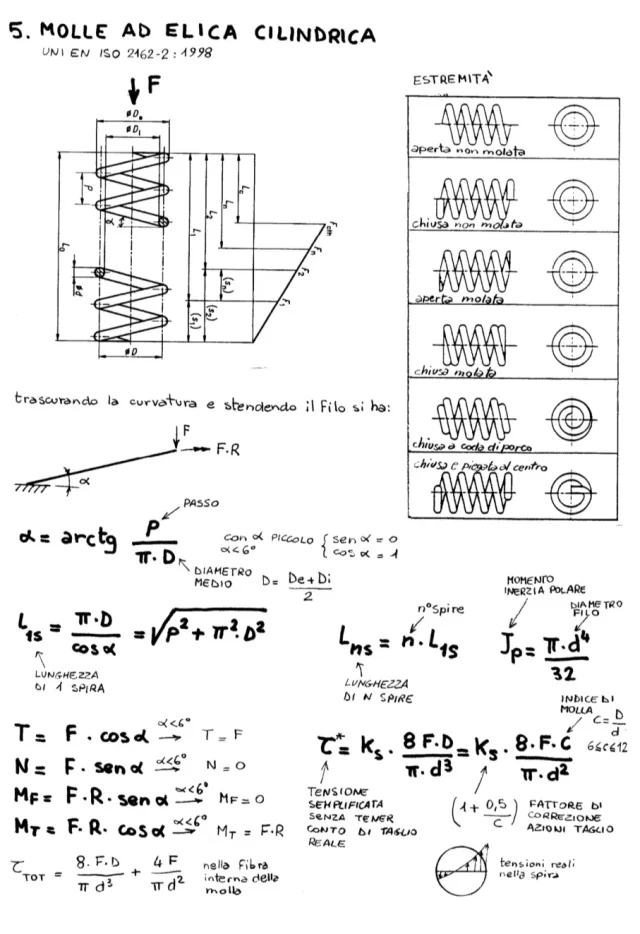
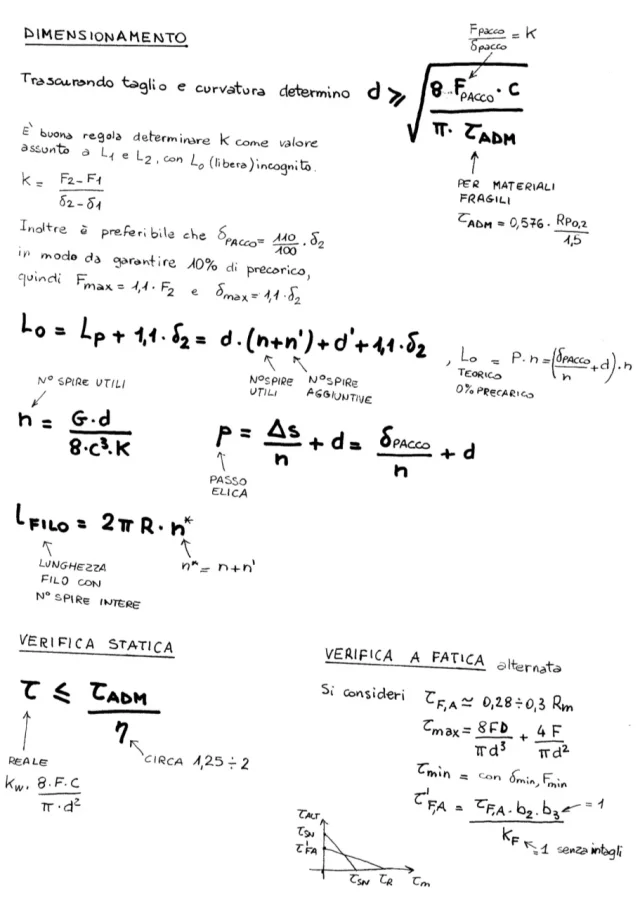
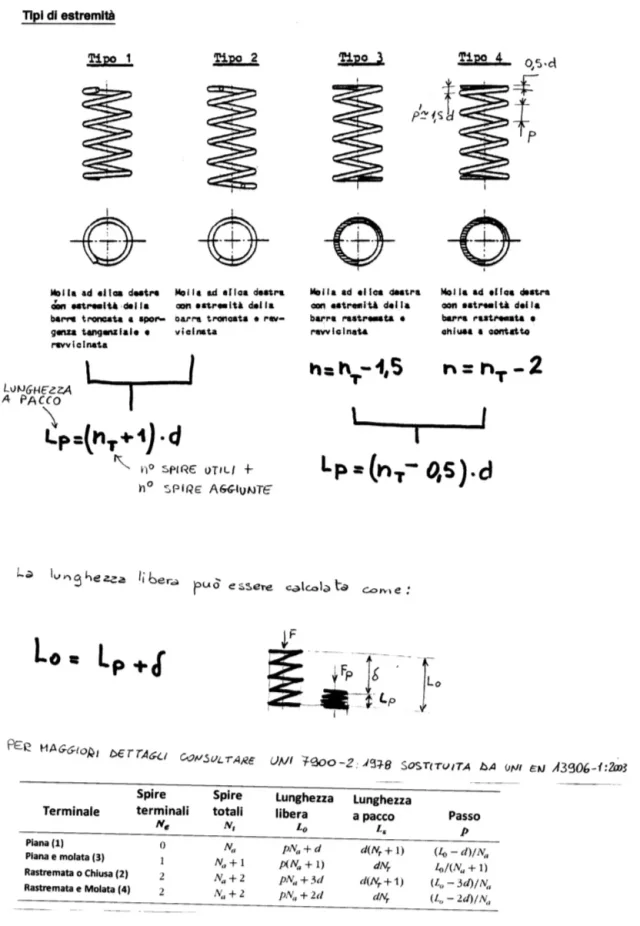
I'll take my full notes for the size of cylindrical wire compression springs:Screenshot_20221220_232018.webpScreenshot_20221220_232038.webpScreenshot_20221220_232100.webpScreenshot_20221220_232123.webpwith these formulas you can build the springs and have true values.

for the characteristics of the steels to be used I give you this table:Screenshot_20221220_232722.webp
 
However the spring you are trying to build, you have to tell us how many useful spurs you have, if there are spurious pulls together and how many, if you move or not and what deflection race you make them work.

Still, you're making a spring that pushes too much. you are obliged to do a few spurs if you want to keep diameter 200 and this causes a thread break when you buy it.

I attach you the negative verification calculation of the spring you can have built. If you've done a lot more spires you'll get a very low load.
Screenshot_20221220_234321.jpgkeep in mind that a 20 mm diameter wire cannot have the same mechanical characteristics as a 6mm diameter wire.
 
just because it seems to me that you looked in the wrong place, the rule din 17223-1 for a diameter 20 mm in class b defines a tensile breaking load between 1020÷1150mpa.
Screenshot_20221220_235827.jpgthen depending on the wire supplier certificate you will have more centered values.
 
Good morning to all,
Thank you for the answers! to answer mechanicsmg, no, fortunately I am not a spring manufacturer. recently worked for a company that produces road barriers and we were asked to produce a variable length barrier for the joint zones of the bridges that remains raised 30 mm from the ground (the spring serves this) and can be extended according to the values detected during an earthquake of a few years ago. I will now begin to distract myself between your most exhaustive answer, although I think it will take me a while. attached you can see the formula I was following taken from the manual of mechanics and. hoepli. For now we've done the evidence with warehouse remains, so I don't have any information about the type of tested spring material. I would like to know if you would be able to support the weight of the barrier with a spring that does not exceed the outer diameter 200 (limit of my encumbrance). Thank you for the time you lost!
 

Attachments

  • mmc.webp
    mmc.webp
    77.7 KB · Views: 33
I agree that I didn't understand much from your initial design.
Basically:
1) How much weight should your spring bear?
2) what max excursion must make your spring?
if your excursion is not excessive.. you can use the mug springs or better called bauer
1671622374030.webp
 
in the drawing I showed the moment exercised on the horizontal pin, which is the product of the weight of the barrier for the arm. therefore the formula m=fxb allows me to know the f to be applied on a shorter arm (at least so I seem to remember, should be a proportional ratio).
thanks victorious for the answer, we are actually considering propio to use cup springs since we have 50-60 mm running.
 
so fast:
a 2 rings stacked cup spring (image type a) ø200 external ø102 internal thickness 8mm arrow 4.5
total rings =30
Free length =324mm
race =67mm
power = 160630n
 
Last edited by a moderator:
certainly with a compression spring, think in 60 mm about to make within a diameter 200 the specified force I would say that it is not possible with that wire diameter. you definitely need a type of spring that has a higher elastic constant. the cup springs could give good results.

I understood a little more the design but it's not clear yet.

the fixed barrier is the right. the mobile one is the one of the left that weighs 430kg.

if there are no external forces applied, if you want to move it horizontally you have to win the weight multiplied the friction coefficient. but this is much smaller than what you indicate as a force to win.

here I don't understand what you apply where and what. I see some sort of hinge and I think the true trait is the two arms of rotation....but not knowing and not knowing your mechanical application I can't help you if you don't clarify with a simple pattern.

I think it is a scale that rotates around the hinge and you balanced weight multiplied horizontal arm with spring force multiplied small vertical arm.

4300n•1.55m=f•0,24m from which I had f=4300•1,55/0,24=27,7kn ....if it is so ok.

for calculating the cup springs you can try to make series/parallel packages to ensure strength with the ride.

if the packages are several, i.e. more than a dozen springs, usually the spring builders recommend to switch from their technical office because they may not flow properly or require special guides or particular diameters.

with an optimized cup spring package you could do the following training:Screenshot_20221221_195327.webpat 51mm you have your strength of 27.7kn.
definitely you can do differently, mount smaller springs to series/parallel packages.
 
we have been required to produce a variable length barrier for the joint zones of the bridges that remain lifted 30 mm from the ground (the spring serves this)
How does a spring parallel to the ground hold the barrier 30mm from the ground?

I try to give my interpretation of the question that is very far-reaching: the spring does not serve to push the barrier, but it serves as a shock absorber for the telluric shocks. the spring instead has to support all the weight of 430kg of the barrier that is 1550mm long; consequently this barrier will be upside down with a tip bending and will be subject to a maximum run of 60mm.
 
certainly with a compression spring, think in 60 mm about to make within a diameter 200 the specified force I would say that it is not possible with that wire diameter. you definitely need a type of spring that has a higher elastic constant. the cup springs could give good results.

I understood a little more the design but it's not clear yet.

the fixed barrier is the right. the mobile one is the one of the left that weighs 430kg.

if there are no external forces applied, if you want to move it horizontally you have to win the weight multiplied the friction coefficient. but this is much smaller than what you indicate as a force to win.

here I don't understand what you apply where and what. I see some sort of hinge and I think the true trait is the two arms of rotation....but not knowing and not knowing your mechanical application I can't help you if you don't clarify with a simple pattern.

I think it is a scale that rotates around the hinge and you balanced weight multiplied horizontal arm with spring force multiplied small vertical arm.

4300n•1.55m=f•0,24m from which I had f=4300•1,55/0,24=27,7kn ....if it is so ok.

for calculating the cup springs you can try to make series/parallel packages to ensure strength with the ride.

if the packages are several, i.e. more than a dozen springs, usually the spring builders recommend to switch from their technical office because they may not flow properly or require special guides or particular diameters.

with an optimized cup spring package you could do the following training:View attachment 67177at 51mm you have your strength of 27.7kn.
definitely you can do differently, mount smaller springs to series/parallel packages.
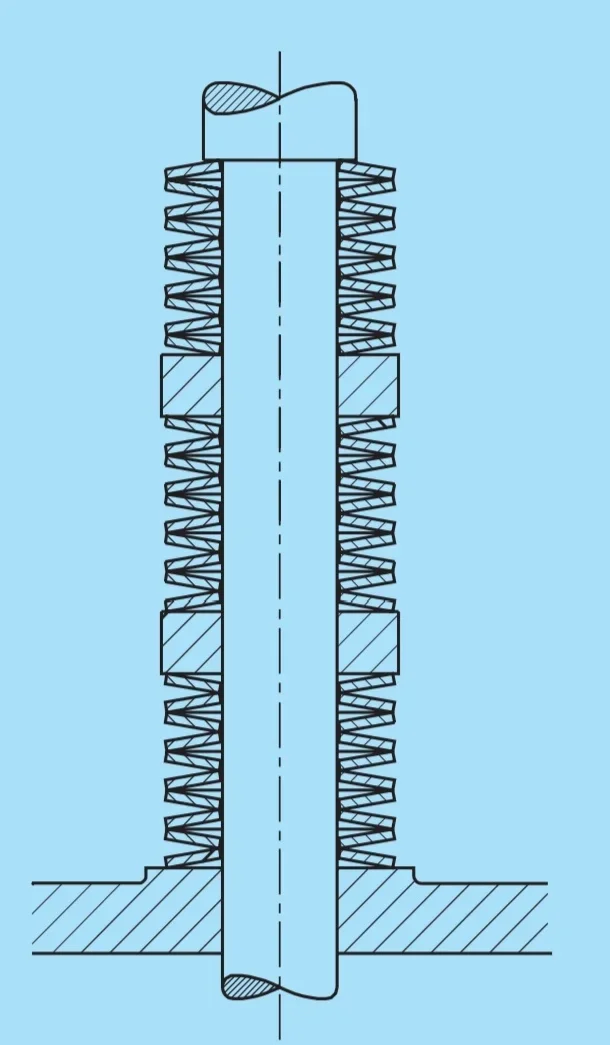
just to give you an idea, you will have three packages of springs placed reversely and each package will be separated from a spacer often. each package is good that it does not exceed 10 springs. in our case will be 6 springs for each package.
Screenshot_20221221_211950.jpgyou will make a special oil and grease dough and will be spread over each spring before inserting it on the rod.

the diameter of the stem must be at least 1 mm less than the nominal hole of the cup spring so that it remains guided and does not fall on the stem.
 
so fast:
a 2 rings stacked cup spring (image type a) ø200 external ø102 internal thickness 8mm arrow 4.5
total rings =30
Free length =324mm
race =67mm
power = 160630n
look that our applicant needs 27,7kn not 160kn.
it is not necessary to use packages with two springs to appear because the strength of a spring is sufficient. need softer head/ground < < > < > > < > > < > < > < > < > > < > < > < > < > < > < > < > < > < > > < > < > > < > > > > > < > > > > > > < > > > > > > > > < > > > > > > > > > > < > > > > > > > > > > > > > > > > > > > > > > > > > > > > > > > < > > > > > > > > > > > > > > > < >
 
Yes, he took out his request talking about a 200-diameter spring. I didn't even understand his design. I only recommended cup springs in case of short runs and posted an example
 
Yes, he took out his request talking about a 200-diameter spring. I didn't even understand his design. I only recommended cup springs in case of short runs and posted an example
ah ok. I thought you were suggesting a certain assembly/size. at least we clarified it otherwise maybe you pick up a lot of springs and then you play freesbee.
 
Hi.
thank you all for the answers! I attach a new image to better understand the operation. the fixed details with the spring are at the ends of the barrier, will be fixed to the ground and to the new concrete jersey.
 

Attachments

  • vlb.webp
    vlb.webp
    40.1 KB · Views: 35
Mechanicalmg, thank you for attaching the spring calculation page, I think that's what we need! You could re-enclose the image to a slightly higher quality, or enlarge on the values obtained, so I can't read the text. if you can upgrade to a force of 30 kn (the barrier has undergone modifications). you vanza na bira! (I owe you a drink)
 
Mechanicalmg, thank you for attaching the spring calculation page, I think that's what we need! You could re-enclose the image to a slightly higher quality, or enlarge on the values obtained, so I can't read the text. if you can upgrade to a force of 30 kn (the barrier has undergone modifications). you vanza na bira! (I owe you a drink)
Bye. I attach the pdf so you have no problems with loss of visual quality.
I do everything with a smartphone. . .
and then the images at times fade.

Keep in mind that then the friction between the various springs should be evaluated and therefore you may lose 5% strength. so I recommend you when you are coming to realize to consult or a supplier of cup springs or to use the calculate bossard for cup springs and check the yield with frictions.
 

Attachments

Forum statistics

Threads
44,997
Messages
339,767
Members
4
Latest member
ibt

Members online

No members online now.
Back
Top