• This forum is the machine-generated translation of www.cad3d.it/forum1 - the Italian design community. Several terms are not translated correctly.

design cutting moulds (by step)

even on my manuals there is a relationship between the diameter of the centerpiece and the plates to be drawn

 
What are you talking about, exactly? Are they too exiled to have threaded holes?
you can do whatever you want, the imported is that it makes sense, be feasible, and functional and costs the minimum necessary: I mean, bazzeccole.
 
Then, from what I understand, the punches go anyway in a container hooked to the top plate called the pinnacle. and here we are.
If a threaded hole can be made in the punch, can we put screws and thorns?
 
a step back: if a punch has enough space for screws (and thorns when necessary) without being weakened, no need for the pin holder.
At my house we only use it if the punches are "magri" and there are no vines. so that they remain "full" and we inflate the upper edge because they set up. or you could brag them to a head, or make them side holes and have pins that work to cut when the mold goes up.
Usually, with the molds with primer I can avoid the pin holder.
or use it to shorten too slender punches compared to the general height you need for the mold: 10÷20mm less in some cases are essential.
Greetings, reborn.

When you get to the bottom, will you show us something?
 
The punches are born with the hat. rounds or squares or shaped according to the type or screwed if rough, big, short and does not weaken.

those not screwed are mounted in the pin holder and containment plate.
 
Then, from what I understand, above the upper plate, nothing can be hooked, so everything can be attacked only below.
Now: if I have a punch with the head wide enough to put at least two screws and two thorns, this should be hooked to a plate, which in turn is hooked at the bottom of the upper plate, right?

ps.: reborn, I hope to combine something:)
 
Hi gigi: Does this mold have the 3rd plate, which mounts the rod guides, and "winned" to the columns?
the punch parades, in the ski lift, at the pms, from the guidepunzoni?
if the prma is yes e* the second and no, that punch doesn't need thorns.
and if you push him on the small plate, you should also plug this to the top plate, otherwise it is like not having it plugged at all. If you can, avoid this extra plate.

*: "e"is a logical "and".
 
Sorry, everyone, but I still have questions to ask about the punches and the like.
Then.
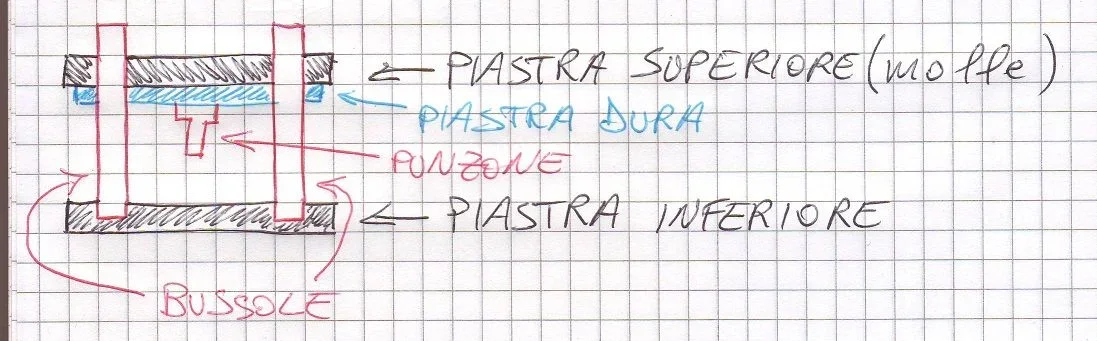
I read that in case of slender punches, it takes a "hard" plate to attach to the top plate of the mold, in order to avoid a digging of the upper plate itself. I take it by good, in the sense that I would always put a plate "hard" in each mold (mal does not...). So said this, the "during" goes barbed and fixed to the upper plate.
advice or objection? ? ?

Thank you.
 
Usually I used to make punching molds always made the tempered plate to put in contact with the heads of the punches, avoiding to recrow the plate in s275jr of the stash holder.

plug it doesn't need anything because it has no reference. is only hard and rectified, so only screwed
 
Well, if punches and pins are attached to the hard plate, would that be plugged to keep all the references of the pieces or not? otherwise when they mount the mold in the workshop, the hard plate could be moved and unchange all references. . .
 
Well, if punches and pins are attached to the hard plate, would that be plugged to keep all the references of the pieces or not? otherwise when they mount the mold in the workshop, the hard plate could be moved and unchange all references. . .
I think you have no idea what pasta we're talking about. where the underhead of the punch is guided, that is, the cylindrical diameter in tolerance is done in the soft dough. then on you put on the plate hard and on there is still the pasta stampo. the first with the last. the hard one can have the widest holes of the thorns.
 
but this flash plate you say (that in manuals is never depicted), how is it made? It's a plate like the others, but maybe it's on top?
 
but this flash plate you say (that in manuals is never depicted), how is it made? It's a plate like the others, but maybe it's on top?
ok, maybe I'm going to say something wrong or too simplified, but: often the "soft" series of plates that fix the hardened pieces. then the "higher lightning plate" is the "higher plate of the lightning rod". and on this staff I. and I don't believe there's no manuals.
is not tempered because: you would attack a tangle, with its central screw, to this hard plate, subjecting it to traction and compression at the fixing point, with the certainty of splitting something short term? I suppose not.
the "during" plate interposed between the head of the smaller punches and the upper plate absolves to the sole purpose of preventing the punzones with a small contact area get in the castle, because of the blows, etc. and never does it even as a doorman, if you get the temptation. . .
and not always put it, because it is a cost: if the mold is intended to cut aluminum from 1 mm with d10 punches, what would it make? and commercial round punches that fix with a grain directly in the top plate how do they work?
do not exaggerate with minuities, risk losing yourself in detail and not see the panorama (I often happen to me).
Good work, reborn.
 

Forum statistics

Threads
44,997
Messages
339,767
Members
4
Latest member
ibt

Members online

No members online now.
Back
Top