• This forum is the machine-generated translation of www.cad3d.it/forum1 - the Italian design community. Several terms are not translated correctly.

design engine 2 hours

  • Thread starter Thread starter antopippo
  • Start date Start date
Good job, good job.
a couple of questions: The exhaust duct, if I understand correctly, does it have the axis on the same plane as the engine shaft? so the entry into the pump casing is at 90° compared to the exhaust duct?

the 3rd travase is at 180° from the exhaust light and its fluid vein you lose it immediately from the discharge, even if you can make a well arranged expansion chamber, but you know it well. If I can afford it, you should raise the lower edge of the third travase to improve the flow from the main beams.
I see a very thin traversine and, even if it is exposed to the fresh gases, it is a very "risky" point, so you should definitely work a bit on the fittings of the corners of the beam lights, otherwise....you always hold a couple of fingers on the clutch! ? ah no... you said that the engine goes on a kart. when "sail" the wonderful two times of the bike went on the ground. karting is a little less dangerous. ...
I don't know how you're doing the carter, but when you have something you want to share faces, maybe we can give you a few tips. the volume you call the carter's harmful, obviously depends on how you draw the engine shaft and the carter itself, but assess the volume change for each shaft rotation board is not difficult, you can also do it with an excell sheet. I would design first biella and piston, then the carter (and its volume variations) comes accordingly
a last curiosity: did you put the candle at the center of the burst chamber?
no discharge is not perpendicular to the axis of the piston. The candle is in the center. and thanks for the advice on the 7 travase. Now I finish the whole project first and then I change it because I am tight with the times for viqs of many checks. but I don't know how to calculate the harmful volume. I know how much it must be and how to calculate it though having the carter and using a liquid. How do I do theoretically?
 
Good job, good job.
a couple of questions: The exhaust duct, if I understand correctly, does it have the axis on the same plane as the engine shaft? so the entry into the pump casing is at 90° compared to the exhaust duct?

the 3rd travase is at 180° from the exhaust light and its fluid vein you lose it immediately from the discharge, even if you can make a well arranged expansion chamber, but you know it well. If I can afford it, you should raise the lower edge of the third travase to improve the flow from the main beams.
I see a very thin traversine and, even if it is exposed to the fresh gases, it is a very "risky" point, so you should definitely work a bit on the fittings of the corners of the beam lights, otherwise....you always hold a couple of fingers on the clutch! ? ah no... you said that the engine goes on a kart. when "sail" the wonderful two times of the bike went on the ground. karting is a little less dangerous. ...
I don't know how you're doing the carter, but when you have something you want to share faces, maybe we can give you a few tips. the volume you call the carter's harmful, obviously depends on how you draw the engine shaft and the carter itself, but assess the volume change for each shaft rotation board is not difficult, you can also do it with an excell sheet. I would design first biella and piston, then the carter (and its volume variations) comes accordingly
a last curiosity: did you put the candle at the center of the burst chamber?
Now I'm having problems with the design of the biella because in class the prof did not finish the topic and immediately passed to the flyers. for the tip load the thing is simple but since I have to do also check to die-flaxion I should know the mass of the biella(which I do not know what value to put) to use its thirds in the alternate masses of the inertia force and I should also know the weight of the piston and pushbut I do not know. other cksa that I don't know is the omega coefficent for 2nicrmo2 and that safety coefficient to use.
 
Now I'm having problems with the design of the biella because in class the prof did not finish the topic and immediately passed to the flyers. for the tip load the thing is simple but since I have to do also check to die-flaxion I should know the mass of the biella(which I do not know what value to put) to use its thirds in the alternate masses of the inertia force and I should also know the weight of the piston and pushbut I do not know. other cksa that I don't know is the omega coefficent for 2nicrmo2 and that safety coefficient to use.
ah another problem is that I don't know how to find the maximum pressure at the pms . I looked at charts and according to a little wide of medium sleeves you have a pressure of 50 mpa and in square position 1÷1,5mpa. ah the section of the biella I would like to make it rectangular (although the double t is recommended) with at the extremes a very beveled triangle thick that makes me guide for flows towards the travase pockets.
 
because a complete cfd simulation of a motor is not simple, it is matter from specialists, and from how you wrote it seemed I had not well appreciated the difficulty of work (without taking away from your preparation). Anyway I want to try and help you: I am not specifically a designer of two times but I have "touched" the motor industry. take as below as a guideline: it is not necessary to resort to sophisticated simulation software to make a preliminary sizing.

1. the compression ratio of an eight motor hardly exceeds 10-12 for an aspirator, otherwise it is likely to run into detonation. you have taken 14, from what I know we are really borderline with fuel: you need a special gasoline in my opinion, and you will often travel with detonation, especially low regimes and high loads (which in a racing engine should not occur often...but I do not know the rapportation you want to give to change);

2. first I would fix the c/d ratio (race/alesage): within 2t fast is held around 1. your 125 monocylinder will therefore have for example c=d=54 mm (rounded, displacement equal to 124 cm3);

3. placing a compression ratio of 14 therefore, you have a combustion chamber volume of about 9.5 cm3;

4. At this point, you make a nice excel sheet where degree by degree, for an entire rotation of the shaft, instant shift calculations (and volume) of the piston, its speed and its acceleration (will serve you for what comes next). find reports on any applied mechanical text;

5. We start from speed. if we go to see 2t fast, we see that they are placed, like average speed piston u to the max power regime (u = 2cn, with n rpm), around 18-20 m/s, with 25 m/s for motors eight aspired by thrust competition. taking 22 m/s (I realized that you want to pull this engine!), we have n = 12200 rpm (approximately), which is a value however quite in line with this type of 2 note: in a motor, the average piston speed is much more indicative of the speed of rotation, as at the first are proportional the inertial forces, the mechanical losses for friction, the fluid dynamic losses and any sonic times, i.e.

Now, for the calculation of the power, we lack "only" the filling coefficient of the motor and its performance, both of difficult theoretical determination. the first is especially for the two times at cross/reflecting currents such as these, considering the complex fluid dynamics of the washing (a part of the cool short-circuit charge to the unloading, a part remains in the cylinder, and a part of combustion gases remains in the cylinder): it is a difficult to model, but it can be estimated. what you can calculate is the product between performance and filling coefficient, starting from the pme value (effective mean pressure) of similar engines. the pme is the second (after u) of the main parameters of comparison between motors (there are another pair), and it complies in a single parameter the care of fluid dynamics (suction, exhaust), combustion and the lost power for friction. higher, the more the engine "fills well" and "burns well" the mixture. the greater the pme, the greater the its pair, among other things (and also the mechanical loads on the manovellism). for 2t engines of this type, an indicative value of the maximum pme is 15 bar.

6. as mentioned above, the pme is maximum about the maximum torque regime. from the expression of the pme (you find it everywhere) we then calculate the pair considering our displacement: in the example above there is about 30 nm. also this is quite in line with engines of this type;

7. always from the knowledge of the max pme, from the calorific power of the fuel (benzina, 44 mj/kg), from its mix ratio (14, suppose stechiometric operation even if not always will be so) and the suction density (air motor with a little load losses in the ducts, 1.1 kg/m3), we obtain (always from the expression of the pme) the product yield x max filling coefficient to the to couple regime

just return (they are out for work) we can try to hypothesize a typical filling coefficient and check area and beam lights, and then see if it gives us a realistic power.

the objective is to calculate both the performance but above the limit cycle, so to then rise to the gas pressure degree by degree and then to the gas forces (the inertial revenues starting from the masses of the 3d models that you are drawing, but let's say that you can neglect them at this stage) and then make the verification of the tavellism. it could be enough to calculate the maximum combustion end pressure (the one that ends compression you can calculate already).

p.
I recommend, for the basis of the design of the beams and the light areas of a 2t, "internal combustion engines", ferrari: that part is done quite well.
I read and I have to say that I'm a little lost because many of these things I didn't do at school but I read books where only theoretically speak of returns etc. I am having numerous difficulties precisely for the design of the biella. Isn't that one day we could call? So I understand better. always if she goes obviously.
 
because a complete cfd simulation of a motor is not simple, it is matter from specialists, and from how you wrote it seemed I had not well appreciated the difficulty of work (without taking away from your preparation). Anyway I want to try and help you: I am not specifically a designer of two times but I have "touched" the motor industry. take as below as a guideline: it is not necessary to resort to sophisticated simulation software to make a preliminary sizing.

1. the compression ratio of an eight motor hardly exceeds 10-12 for an aspirator, otherwise it is likely to run into detonation. you have taken 14, from what I know we are really borderline with fuel: you need a special gasoline in my opinion, and you will often travel with detonation, especially low regimes and high loads (which in a racing engine should not occur often...but I do not know the rapportation you want to give to change);

2. first I would fix the c/d ratio (race/alesage): within 2t fast is held around 1. your 125 monocylinder will therefore have for example c=d=54 mm (rounded, displacement equal to 124 cm3);

3. placing a compression ratio of 14 therefore, you have a combustion chamber volume of about 9.5 cm3;

4. At this point, you make a nice excel sheet where degree by degree, for an entire rotation of the shaft, instant shift calculations (and volume) of the piston, its speed and its acceleration (will serve you for what comes next). find reports on any applied mechanical text;

5. We start from speed. if we go to see 2t fast, we see that they are placed, like average speed piston u to the max power regime (u = 2cn, with n rpm), around 18-20 m/s, with 25 m/s for motors eight aspired by thrust competition. taking 22 m/s (I realized that you want to pull this engine!), we have n = 12200 rpm (approximately), which is a value however quite in line with this type of 2 note: in a motor, the average piston speed is much more indicative of the speed of rotation, as at the first are proportional the inertial forces, the mechanical losses for friction, the fluid dynamic losses and any sonic times, i.e.

Now, for the calculation of the power, we lack "only" the filling coefficient of the motor and its performance, both of difficult theoretical determination. the first is especially for the two times at cross/reflecting currents such as these, considering the complex fluid dynamics of the washing (a part of the cool short-circuit charge to the unloading, a part remains in the cylinder, and a part of combustion gases remains in the cylinder): it is a difficult to model, but it can be estimated. what you can calculate is the product between performance and filling coefficient, starting from the pme value (effective mean pressure) of similar engines. the pme is the second (after u) of the main parameters of comparison between motors (there are another pair), and it complies in a single parameter the care of fluid dynamics (suction, exhaust), combustion and the lost power for friction. higher, the more the engine "fills well" and "burns well" the mixture. the greater the pme, the greater the its pair, among other things (and also the mechanical loads on the manovellism). for 2t engines of this type, an indicative value of the maximum pme is 15 bar.

6. as mentioned above, the pme is maximum about the maximum torque regime. from the expression of the pme (you find it everywhere) we then calculate the pair considering our displacement: in the example above there is about 30 nm. also this is quite in line with engines of this type;

7. always from the knowledge of the max pme, from the calorific power of the fuel (benzina, 44 mj/kg), from its mix ratio (14, suppose stechiometric operation even if not always will be so) and the suction density (air motor with a little load losses in the ducts, 1.1 kg/m3), we obtain (always from the expression of the pme) the product yield x max filling coefficient to the to couple regime

just return (they are out for work) we can try to hypothesize a typical filling coefficient and check area and beam lights, and then see if it gives us a realistic power.

the objective is to calculate both the performance but above the limit cycle, so to then rise to the gas pressure degree by degree and then to the gas forces (the inertial revenues starting from the masses of the 3d models that you are drawing, but let's say that you can neglect them at this stage) and then make the verification of the tavellism. it could be enough to calculate the maximum combustion end pressure (the one that ends compression you can calculate already).

p.
I recommend, for the basis of the design of the beams and the light areas of a 2t, "internal combustion engines", ferrari: that part is done quite well.
wowww nice work! thanks for sharing!
 
Now I'm having problems with the design of the biella because in class the prof did not finish the topic and immediately passed to the flyers. for the tip load the thing is simple but since I have to do also check to die-flaxion I should know the mass of the biella(which I do not know what value to put) to use its thirds in the alternate masses of the inertia force and I should also know the weight of the piston and pushbut I do not know. other cksa that I don't know is the omega coefficent for 2nicrmo2 and that safety coefficient to use.
I would say that piston and spindle, as well as biella are still to be modeled and parameterized, so as to have an initial plausible value with which to deal with the calculations and subsequently, following verification, to retouch the measurements. An excel will help you.

for calculation of the tip load you are not obliged to use the omega method....guard here..

in this image is summarized the whole:
screenshot_20200408_205858-jpg.57108
 
ah another problem is that I don't know how to find the maximum pressure at the pms . I looked at charts and according to a little wide of medium sleeves you have a pressure of 50 mpa and in square position 1÷1,5mpa. ah the section of the biella I would like to make it rectangular (although the double t is recommended) with at the extremes a very beveled triangle thick that makes me guide for flows towards the travase pockets.
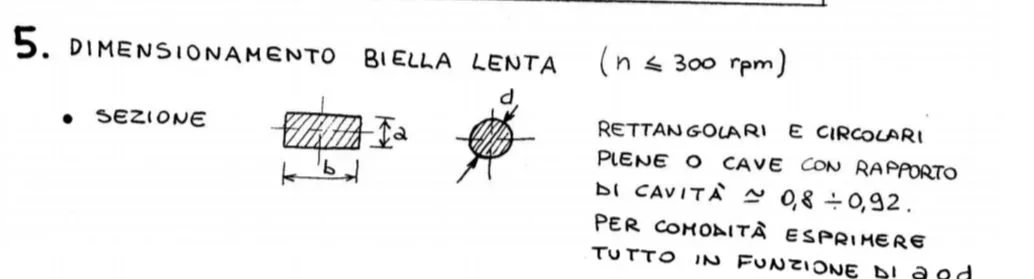
if you do rectangular waste a lot of mass that only helps to add inertia and lose in acceleration of the same, without really favoring the tensile strength and bending of the biella.
a good post where there are also spreadsheets find it in This is what debate.

the checks on fast biellas, they normally do so:
Screenshot_20210427_204225.webpScreenshot_20210427_204238.webpI would say that for each component there is a lot to calculate and to check, so having everything parametric both with excel and with a parametric cad can help you converge to solution for iteration.
 
if you do rectangular waste a lot of mass that only helps to add inertia and lose in acceleration of the same, without really favoring the tensile strength and bending of the biella.
a good post where there are also spreadsheets find it in This is what debate.

the checks on fast biellas, they normally do so:
View attachment 61894View attachment 61895I would say that for each component there is a lot to calculate and to check, so having everything parametric both with excel and with a parametric cad can help you converge to solution for iteration.
I finally solved after I send photos. I made rectangular because then I would like to rake the ends to improve fluid dynamics
 
just because maybe you want to use the omega method for calculating the tip load, I'll attach the formulas to get omega.
Screenshot_20210427_210551.webpclearly you need to go looking for critical sigma....
 
I finally solved after I send photos. I made rectangular because then I would like to rake the ends to improve fluid dynamics
Rectangular however it is made only for slow machines, it is the story that teaches it.

if you turn less than 300rpm is slow biella and inertia is influential on performance.
Screenshot_20210427_211018.webp
 
I read and I have to say that I'm a little lost because many of these things I didn't do at school but I read books where only theoretically speak of returns etc. I am having numerous difficulties precisely for the design of the biella. Isn't that one day we could call? So I understand better. always if she goes obviously.
I hope to continue developing the subject in the week, I'm a little bit taken with other things...
I am available at a call, but if you want to deepen some concepts write here as well, so maybe others can contribute.

When I said that the thing seemed a little complicated for a high school student I was just saying this;) to rationally set the project and determine the loads on the brain, they need a little specialist knowledge! Obviously it is possible to bypass all this part and take pressure values (of fine compression and fine combustion) that can be found in literature, and to hypothesize the indicated cycle (from which determine the loads) without making too many calculations.
 
I hope to continue developing the subject in the week, I'm a little bit taken with other things...
I am available at a call, but if you want to deepen some concepts write here as well, so maybe others can contribute.

When I said that the thing seemed a little complicated for a high school student I was just saying this;) to rationally set the project and determine the loads on the brain, they need a little specialist knowledge! Obviously it is possible to bypass all this part and take pressure values (of fine compression and fine combustion) that can be found in literature, and to hypothesize the indicated cycle (from which determine the loads) without making too many calculations.
I am doing many sections but I don't understand one thing. the inertia force gets me bigger than that of the gas at the pms so I have to do a check not more compression but extension. I therefore thought of studying the strength to the pmi in which I only have the force of inertia but I find myself a lower value of the total force to the pmi than that at the pms so I have to study the system by force to the upper dead point. the problem is that I can't find a section that guarantees me a high degree of security.
 

Attachments

  • 16199484828914288668920565229792.webp
    16199484828914288668920565229792.webp
    116.3 KB · Views: 28
  • 16199485318352658284224208562175.webp
    16199485318352658284224208562175.webp
    168.5 KB · Views: 28
  • 16199485858007457957566551652169.webp
    16199485858007457957566551652169.webp
    183.8 KB · Views: 26
the inertia force is so high for the high number of laps (14000) and therefore the highest acceleration caused by a very high angle speed. for the gas force I used a pressure at the pms of 50 bar or 5 n/mm2
 
in a 2t the biella should not generally work traction, if not possibly at low loads and high regimes, i.e. in release (in the 4t instead you have the phase of crossing valves in which actually the biella always goes in traction).

that alternate masses you have (pistons, bands, pushbutton, bearing and alternating biella - the latter is about 1/3 of the mass of the biella, if you do not want to do the precise accounts with the baricentro)?

what r/l ratio (brain/long stretch) have you adopted?

edit: the alternate part of the biella you don't really need right now: the masses of the alternate parts are enough
 
I have a crank radius of 55 and an interasse of the rod of 110. as alternate masses I took of fixed 125g of the piston and 30 of the spindle. for the biella depends because for every section I hire I find myself with a different weight. a question, I wrote in the notebook that as alternate masses I must take that of the piston that of the spinotto and 2/3 of the biella. Is it right 2/3 or 1/3?
 
excuse but if it is a 125 cm3 how does it have crank radius 55 mm? If you took c=d that will be the race according to me...and the radius of crank 27,5 mm if anything...or not? Moreover, does not lack the bearing of foot in the alternate masses? It is not negligible. . .

for the calculation of the dynamics of the biella (i.e. what we are doing) you can lead to the biella formed by two masses: a one with only alternating motion and placed in correspondence of the foot, and a one with only rotary motion and placed on the crank pin. the value of these two masses revenues it with the balances to the rotation of the biella, knowing the mass m, the length l and the position of the baricentro from the head xb (made a sheet excel, do not write by hand everything....):

ma = alternating mass = m*xb/l
mb = rotary mass = m*(l-xb)/l

Usually the centerpiece is much closer to the head than to the foot (small xb), since the head has a higher diameter bearing: so but is smaller than mb. a common proportion is 1/3 in the foot and 2/3 on the head, but may vary (1/2+1/2 in the case of perfectly symmetrical biella). the correct formula that comes from balance to rotation around the center of gravity is the one above (you can prove it).
 
excuse but if it is a 125 cm3 how does it have crank radius 55 mm? If you took c=d that will be the race according to me...and the radius of crank 27,5 mm if anything...or not? Moreover, does not lack the bearing of foot in the alternate masses? It is not negligible. . .

for the calculation of the dynamics of the biella (i.e. what we are doing) you can lead to the biella formed by two masses: a one with only alternating motion and placed in correspondence of the foot, and a one with only rotary motion and placed on the crank pin. the value of these two masses revenues it with the balances to the rotation of the biella, knowing the mass m, the length l and the position of the baricentro from the head xb (made a sheet excel, do not write by hand everything....):

ma = alternating mass = m*xb/l
mb = rotary mass = m*(l-xb)/l

Usually the centerpiece is much closer to the head than to the foot (small xb), since the head has a higher diameter bearing: so but is smaller than mb. a common proportion is 1/3 in the foot and 2/3 on the head, but may vary (1/2+1/2 in the case of perfectly symmetrical biella). the correct formula that comes from balance to rotation around the center of gravity is the one above (you can prove it).
What a mistake. I've written race 55, and I've always put it as a ray. Helpful. I'll take care of it. so as alternating mass I take 1/3 the mass of the biella starting from the biella foot?
 
so as alternating mass I take 1/3 the mass of the biella starting from the biella foot?
try using the above formulas, which are the precise ones (so you get used not to reason for axioms)! find the centerpiece and the mass of your biella with mounted bearings and their correct mass from the cad. then try to update all the calculation of inertial forces and let us know ;)
 
excuse but if it is a 125 cm3 how does it have crank radius 55 mm? If you took c=d that will be the race according to me...and the radius of crank 27,5 mm if anything...or not? Moreover, does not lack the bearing of foot in the alternate masses? It is not negligible. . .

for the calculation of the dynamics of the biella (i.e. what we are doing) you can lead to the biella formed by two masses: a one with only alternating motion and placed in correspondence of the foot, and a one with only rotary motion and placed on the crank pin. the value of these two masses revenues it with the balances to the rotation of the biella, knowing the mass m, the length l and the position of the baricentro from the head xb (made a sheet excel, do not write by hand everything....):

ma = alternating mass = m*xb/l
mb = rotary mass = m*(l-xb)/l

Usually the centerpiece is much closer to the head than to the foot (small xb), since the head has a higher diameter bearing: so but is smaller than mb. a common proportion is 1/3 in the foot and 2/3 on the head, but may vary (1/2+1/2 in the case of perfectly symmetrical biella). the correct formula that comes from balance to rotation around the center of gravity is the one above (you can prove it).
but how do you mean the distance between the axis of the biella foot and the centerpiece?
 

Forum statistics

Threads
44,997
Messages
339,767
Members
4
Latest member
ibt

Members online

No members online now.
ciao
Back
Top