
• This forum is the machine-generated translation of www.cad3d.it/forum1 - the Italian design community. Several terms are not translated correctly.

drawing of a tree of a reducer

  • Thread starter Thread starter J ax
  • Start date Start date
:eek: all these machines together I have never seen them!!! :eek:


You know what my university lab was?
I went back from university on Friday and went to my friend who has a mechanical workshop. I explained to him the theoretical piece and he explained it to me from a practical point of view.:smile:


Do you know how many times I've been in the lab at unification? two/three for a maximum of 4 hours in 5 years.

What a shame! !
the laboratories are actually there, but they are "monopolized" by professors to do the facts to them.

only one professor made us do 2 lessons in the lab (among others one of the best professors I've ever had). ..this case had come out of the mit.
It is normal to make a drawing course of machines without even taking in the hands a screw, a nut, a bearing. ..without ever seeing the split of a piece without ever seeing a toothed wheel etc.? ?
 
instead for the questions that are asked by those who have the return home I ask myself: or do not know anything about drawing, or do not reason, or on the book there is not enough explanation material. I want to understand
too much talk about that book, too many and few facts...here's the answer
 
As I said a month ago in a post, the university drawing course (1 and 2nd drawing exam) should be much more serious and advanced. like everything else, who has no knowledge takes repetitions. But if things were explained... in a semester you could see many aspects.
 
I confirm what was said about the chirone-torncasa. with difficulty I found 2 splits of gearboxes between the exercises.

I know only the diameter of the shaft and radius of the primitive. to represent the "scavate" dentate wheels in the middle part,
as in the 371 slide of this filehttp://dismac.isten.ing.unipg.it/common_files/disegno/_13_ruotedentate.pdfWhen there's that dig, that recess, how do I know how much I have to "go back"? I don't see tables that tell me
 
I confirm what was said about the chirone-torncasa. with difficulty I found 2 splits of gearboxes between the exercises.

I know only the diameter of the shaft and radius of the primitive. to represent the "scavate" dentate wheels in the middle part,
as in the 371 slide of this filehttp://dismac.isten.ing.unipg.it/common_files/disegno/_13_ruotedentate.pdfWhen there's that dig, that recess, how do I know how much I have to "go back"? I don't see tables that tell me
is the conventional representation of one 7282 = iso 2203. that discharge you see is a very useful lightening if done symmetrically in order to decrease the central inertia and leave it only in the outer part.

lightening should be dimensional to break and centrifugal force in reality. as long as a drawing remains, it represents itself at will.
 
...other of our "colleges" as well as "friends from beer" have experienced university experience as a right step to have in hand a sheet of paper. in fact they have no expectations, they are not motivated, they have no interest and even the most obvious things turn out to them unknown. Unfortunately they lower the level of the figure of the engineer. here is also the low pay....
with this phrase you just wrote enters among the people who "become" within the forum.

You had the courage to say something that I think, and that I never said for respect. There are my ex-colleges who are without ambitions and who settle for the bowl of rice. they reason in the following way:
"the piece of paper I have, the work from 1000 euros per month as well, I sit all day to make copy and paste on the drawings, which you want more from life? "

the guilt is also of these people who "was" first of all themselves and then their dignity.
 
It is normal to make a drawing course of machines without even taking in the hands a screw, a nut, a bearing. ..without ever seeing the split of a piece without ever seeing a toothed wheel etc.? ?
Dear Snaroz, everything is normal now. today is abnormal if they take you to the lab:biggrin:
 
Okay, then, since we asked a question about the seeger, too. the uni 7435 tells me that if the diameter of the shaft d1 is 50 I have to take a thick ring s=2 and I have to make a quarry thickness 2.15. So there would be a difference between these two values, while from the few drawings on these things that are on the book, it seems as if the ring is perfectly inside the circumferential quarry. So in my design is it okay if I make a quarry ring of thickness 2 and away?

ps in the next days I try to throw down a drawing completely and then I load it here
 
Okay, then, since we asked a question about the seeger, too. the uni 7435 tells me that if the diameter of the shaft d1 is 50 I have to take a thick ring s=2 and I have to make a quarry thickness 2.15. So there would be a difference between these two values, while from the few drawings on these things that are on the book, it seems as if the ring is perfectly inside the circumferential quarry. So in my design is it okay if I make a quarry ring of thickness 2 and away?

ps in the next days I try to throw down a drawing completely and then I load it here
if you are able to grasp the difference of 0.15 mm maybe even in scale 1:2 i.e. 0.075 mm you do it:biggrin:

it is good to represent it with only thickness of 2 mm
 
rest of the idea that my 3 volumes "from project to product - paravia" are much more detailed, moreover with the collection uni m1 (general and mechanical volume) and with "vademecum for designers and technicians - hoepli" and other manuals also in English language there is a wide overview to understand regulations, representations, examples.

.
caromg,
The book you're referring to is the caligaris fava tomasiello?
I quote you in full, while having both the chiron and the 3 volumes I found much more useful than you mentioned, much more "practical" and schematic.

@j ax having attended the faculty of ing to perugia it is possible that the professors give as exercises always the reducers!:eek:? Every year the same sulfa!!!

again: during the university years the prof took us to the workshop to see how a lathe works, a frieze once and for half an hour always said that he had very little time, must finish the academic program etc... I would have many other things to say but if they are too ot I pray the moderators to move the discussion with a new title
 
Okay, then, since we asked a question about the seeger, too. the uni 7435 tells me that if the diameter of the shaft d1 is 50 I have to take a thick ring s=2 and I have to make a quarry thickness 2.15. So there would be a difference between these two values, while from the few drawings on these things that are on the book, it seems as if the ring is perfectly inside the circumferential quarry. So in my design is it okay if I make a quarry ring of thickness 2 and away?

ps in the next days I try to throw down a drawing completely and then I load it here
As you need to draw it, it is correct to do so with the right height mm 2.15, but it is essential to complete the design of the quarry by inserting the correct tolerances both on the width and on the mounting diameter.
the tolerances found on one cited.
 
caromg,
The book you're referring to is the caligaris fava tomasiello?
I quote you in full, while having both the chiron and the 3 volumes I found much more useful than you mentioned, much more "practical" and schematic.
exactly those 3 volumes:smile:
 
As you need to draw it, it is correct to do so with the right height mm 2.15, but it is essential to complete the design of the quarry by inserting the correct tolerances both on the width and on the mounting diameter.
the tolerances found on one cited.
if you have to put the odds you, otherwise 0.15 mm does not see them handmade. Actually the quarry is 2.15 with tolerance. the concept is that by drawing a set by hand you can not reasonably show 0.15 mm except with a 10:1 or 25:1 magnification but has no relevance.
 
Since you have to draw it, it is correct to do so with the right size mm 2.15.
care not to mislead the boy who might misunderstand:biggrin:.
the fact that it is assign the correct quota and not to draw it very precise... also because I think the drawings do them by hand "with a ruler".
to remember always, for all those who approach technical design: those who "command" are only and always quotas, even on a random sketch.
Of course, even the graphic representation will be (must be) to the correct measures (at least for the nominal quota, then there are tolerances).

greetings
Marco:smile:
 
care not to mislead the boy who might misunderstand:biggrin:.
the fact that it is assign the correct quota and not to draw it very precise... also because I think the drawings do them by hand "with a ruler".
to remember always, for all those who approach technical design: those who "command" are only and always quotas, even on a random sketch.
Of course, even the graphic representation will be (must be) to the correct measures (at least for the nominal quota, then there are tolerances).

greetings
Marco:smile:
Of course I was referring to the cad, if everything is executed with the ruler I join your recommendations, never forget the necessary dimensional and geometric tolerances (where they serve).
 
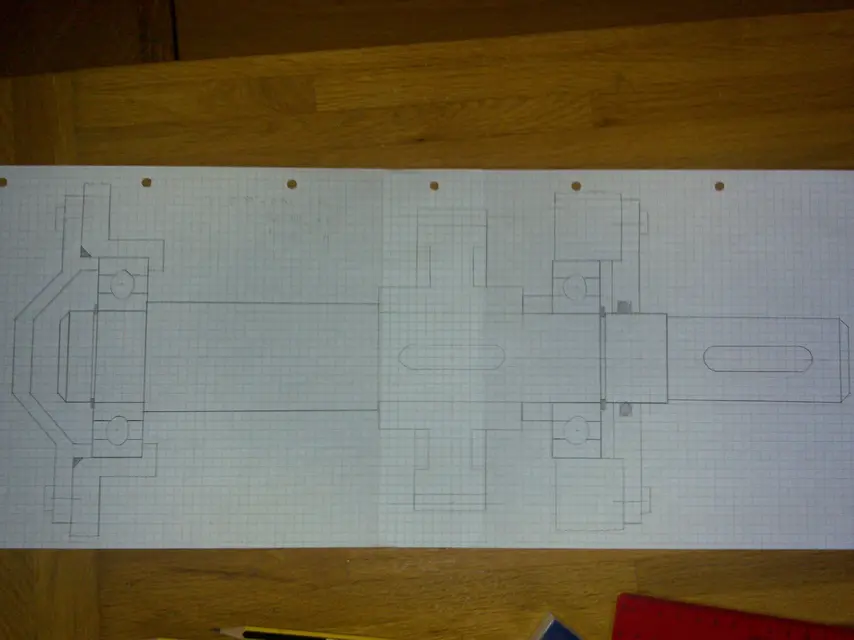
Here I am, I bet to post a picture of the gear shaft 3 of the gearbox I tried to make. is all in scale except the toothed wheel that I had to do with a diameter smaller than about 80 mm for reasons of space.
I put on a spacer, two elastic rings and two or rings.
So I wanted to know if in principle it can go well, or if I have to add some sort of other estates or if I was wrong to put those masses
 

Attachments

  • 07072011084.webp
    07072011084.webp
    463.8 KB · Views: 55
Here I am, I bet to post a picture of the gear shaft 3 of the gearbox I tried to make. is all in scale except the toothed wheel that I had to do with a diameter smaller than about 80 mm for reasons of space.
I put on a spacer, two elastic rings and two or rings.
So I wanted to know if in principle it can go well, or if I have to add some sort of other estates or if I was wrong to put those masses
But couldn't you do it in a decent scale on the sheet?? conceptually right. all sections are missing. missing the rest of the case. lack of axes in the sunbeds.
 
As for the sampling, I didn't do it because if something was wrong then I had to delete everything and become a pastrocchio.

For the rest of the case, do you mean which part of the case? because to do everything I should do the other 2 trees.

What do you mean by axes in the sunbeds?

the quarry for the tongue to connect the toothed wheel is right to do so "in the middle of the tree" or had to do it on the top in contact with the toothed wheel?(I don't know if I explained)
 

Forum statistics

Threads
44,997
Messages
339,767
Members
4
Latest member
ibt

Members online

No members online now.
Back
Top