RS4
Guest
scheda tecnica eurofighter 2000wingspan:10.95m
height:5.8m
length: 15.96m
wing surface:50m(q)
performance:
speed max:2 mach
takeoff / landing:500m
autonomy:3.200km(transfer)
range of action: over 1350km
propulsive system:
two Eurojet ej200 turbofans from 60kn(13.490 lb) dry 90 kn(20.000 lb) with post-burner
weapons
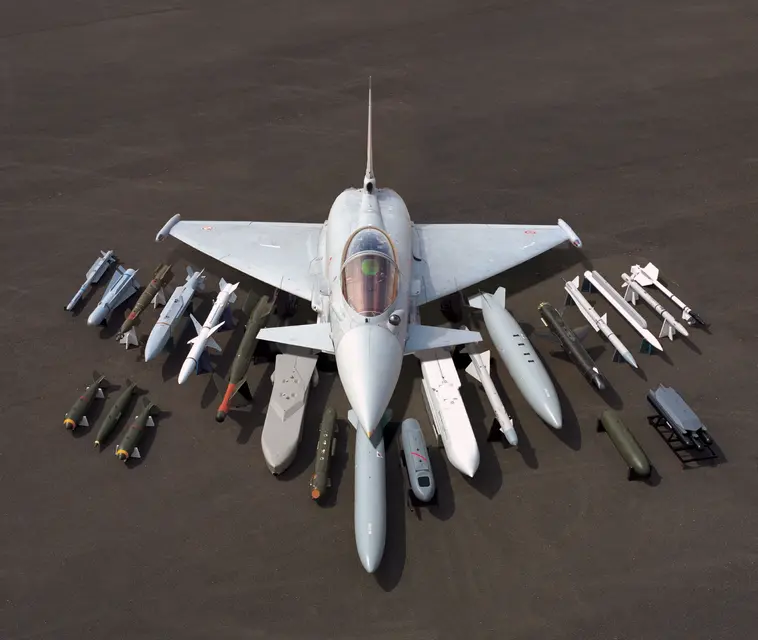
up to 6,500 kg of external loads (air-driven missiles radar and ir, tanks, etc.) a 27mm mauser cannon.
crew:
1-2 pilots
description:
is an aerial superiority hunt, ideal for air-air combat, can supply itself in flight, also performs ground attack missions, has a new generation radar and armament, has a very sophisticated avionic, including color multifunction screens, helmet with display, passive infrared search sensor, voice commands and self-protection equipment. the eurofighter typhoon, will change our aeronautics, and the way to carry out the aerial missions, these arei will mark the radical change of our and other aircraft. the a.m.(military air force)conta of having maximum 121, including a two-seater series of operational conversion. will carry a warload that includes: 13 external stations, 5 under the fuselage (of which an opzinal for the wet), and an optional "bagnata under the semial.
----------------------------------------------------------------------------------------------------------------------------------------------------------------------------------------------------------------------------------------------------------------------------------------------------------------------------------------------------------------------------------------------------------------------------------------------------------------------------------------------------------------------------------Technical specifications f35f-35a is a monomotor hunt, whose plant closely resembles that of the f-22.
the wing is high, with truncated delta plant, the air vents are two, sideways, the tail paddles are made up of two vertical stabilizers and two horizontal timones that are exhibiting considerably compared to the nozzle of the turbofan.
two internal holds on the sides of the fuselage allow to carry a significant armament (2 amraam missiles and 2 1,000 kg bombs) preserving the stealth characteristics.
the internal gun is a 25 mm Gauge-22/a.
version b (stovl) has a fuselage fan for sustenance, which acts in concert with the exhaust nozzle of the engine that can be rotated down to 110 degrees.
the presence of the sustenance system forced to renounce the internal cannon, which can be mounted in a central stealth design pod, as well as to limit the capacity of the internal holds (which are compatible with 500 kg devices and not by 1,000 kg). also the internal capacity of fuel is reduced compared to version a.
the shipped version has a larger wing surface, and the semials are foldable.
the fuel reserve is greater than version a, but also in this case the internal cannon was sacrificed in favor of the central external pod.
f-35 stealth features are very pushy. but not reaching those of the f-22, we talk of values less than 0.01 square meters. (by comparison a “normal” hunt like mig-29 or f-16 has a rcs in the order of 5 square meters).
for the drive is expected the possibility to choose indifferently between the p&w engine f135 and the ge/rolls-royce engine f136, but at the moment only the f135 has an insured future and will equip the first specimens, while the development of the engine f136, wanted mainly from the English, risks being erased.
In fact it makes little sense (and it is very expensive) to develop two practically equivalent turbofans, but the English do not intend to give up a motor in which the English industry is strongly involved.
the avionic of f-35 is extremely advanced, and uses a radar with aesa technology derived from that of the f-22.
the newest, however, is the application of the concept of “sensor fusion”.
in practice a series of cameras placed at various points of the plane, allows the pilot to see in every direction, as if the fuselage “did not exist”.
the images of the cameras are "fuse" along with those of the other sensors, such as radar, the irst, esm etc... providing the pilot with a complete awareness of the outside environment.
“sensor fusion” technology will be progressively implemented in the various manufacturing blocks.
partnership f35the f-35 is the least expensive and less performing sibling of the f-22 raptor (the hunting intended to replace the f-15 as a fighter from aerial superiority). Despite this is a fifth-generation hunting with stealth capabilities, it is designed for cas missions (close-air-support, close air support), tactical bombing and of course is able to use stand-off weapons (i.e. able to hit targets beyond the scope of engagement of the opposing defenses), and from aerial superiority (...beh for that we have the efa typhoon....). there are 3 different versions for this plane:
the f-35a is the version that I would dare to define standard with conventional take-off and landing
the f-35b version stovl (short take off and vertical landing) version with short takeoff and vertical landing perfect for v/stol aircraft carriers like our invincible class British cabling.
the f-35c is the version (still in the evaluation to tell the truth) that should replace the older f/a-18 hornet versions on conventional aircraft carriers.
Also interesting is the part of the international participation in this project, the United States are the leaders of the project followed by the great brine that is the only or partner of "level 1", with a contribution of 2,5 billion dollars, equal to 10% of the development costs. "level 2" partners are Italy, which contributes with $1 billion and low countries with a contribution of $800 million. The parners of "level 3" are Canada (440 million dollars), Turkia (175 million dollars), Australian (144 million dollars), Norwegian (122 million dollars) and Denmark (110 million dollars). israele and singapore participate in the program as "security cooperative participants".
Hi.
♪
height:5.8m
length: 15.96m
wing surface:50m(q)
performance:
speed max:2 mach
takeoff / landing:500m
autonomy:3.200km(transfer)
range of action: over 1350km
propulsive system:
two Eurojet ej200 turbofans from 60kn(13.490 lb) dry 90 kn(20.000 lb) with post-burner
weapons
up to 6,500 kg of external loads (air-driven missiles radar and ir, tanks, etc.) a 27mm mauser cannon.
crew:
1-2 pilots
description:
is an aerial superiority hunt, ideal for air-air combat, can supply itself in flight, also performs ground attack missions, has a new generation radar and armament, has a very sophisticated avionic, including color multifunction screens, helmet with display, passive infrared search sensor, voice commands and self-protection equipment. the eurofighter typhoon, will change our aeronautics, and the way to carry out the aerial missions, these arei will mark the radical change of our and other aircraft. the a.m.(military air force)conta of having maximum 121, including a two-seater series of operational conversion. will carry a warload that includes: 13 external stations, 5 under the fuselage (of which an opzinal for the wet), and an optional "bagnata under the semial.
----------------------------------------------------------------------------------------------------------------------------------------------------------------------------------------------------------------------------------------------------------------------------------------------------------------------------------------------------------------------------------------------------------------------------------------------------------------------------------------------------------------------------------Technical specifications f35f-35a is a monomotor hunt, whose plant closely resembles that of the f-22.
the wing is high, with truncated delta plant, the air vents are two, sideways, the tail paddles are made up of two vertical stabilizers and two horizontal timones that are exhibiting considerably compared to the nozzle of the turbofan.
two internal holds on the sides of the fuselage allow to carry a significant armament (2 amraam missiles and 2 1,000 kg bombs) preserving the stealth characteristics.
the internal gun is a 25 mm Gauge-22/a.
version b (stovl) has a fuselage fan for sustenance, which acts in concert with the exhaust nozzle of the engine that can be rotated down to 110 degrees.
the presence of the sustenance system forced to renounce the internal cannon, which can be mounted in a central stealth design pod, as well as to limit the capacity of the internal holds (which are compatible with 500 kg devices and not by 1,000 kg). also the internal capacity of fuel is reduced compared to version a.
the shipped version has a larger wing surface, and the semials are foldable.
the fuel reserve is greater than version a, but also in this case the internal cannon was sacrificed in favor of the central external pod.
f-35 stealth features are very pushy. but not reaching those of the f-22, we talk of values less than 0.01 square meters. (by comparison a “normal” hunt like mig-29 or f-16 has a rcs in the order of 5 square meters).
for the drive is expected the possibility to choose indifferently between the p&w engine f135 and the ge/rolls-royce engine f136, but at the moment only the f135 has an insured future and will equip the first specimens, while the development of the engine f136, wanted mainly from the English, risks being erased.
In fact it makes little sense (and it is very expensive) to develop two practically equivalent turbofans, but the English do not intend to give up a motor in which the English industry is strongly involved.
the avionic of f-35 is extremely advanced, and uses a radar with aesa technology derived from that of the f-22.
the newest, however, is the application of the concept of “sensor fusion”.
in practice a series of cameras placed at various points of the plane, allows the pilot to see in every direction, as if the fuselage “did not exist”.
the images of the cameras are "fuse" along with those of the other sensors, such as radar, the irst, esm etc... providing the pilot with a complete awareness of the outside environment.
“sensor fusion” technology will be progressively implemented in the various manufacturing blocks.
partnership f35the f-35 is the least expensive and less performing sibling of the f-22 raptor (the hunting intended to replace the f-15 as a fighter from aerial superiority). Despite this is a fifth-generation hunting with stealth capabilities, it is designed for cas missions (close-air-support, close air support), tactical bombing and of course is able to use stand-off weapons (i.e. able to hit targets beyond the scope of engagement of the opposing defenses), and from aerial superiority (...beh for that we have the efa typhoon....). there are 3 different versions for this plane:
the f-35a is the version that I would dare to define standard with conventional take-off and landing
the f-35b version stovl (short take off and vertical landing) version with short takeoff and vertical landing perfect for v/stol aircraft carriers like our invincible class British cabling.
the f-35c is the version (still in the evaluation to tell the truth) that should replace the older f/a-18 hornet versions on conventional aircraft carriers.
Also interesting is the part of the international participation in this project, the United States are the leaders of the project followed by the great brine that is the only or partner of "level 1", with a contribution of 2,5 billion dollars, equal to 10% of the development costs. "level 2" partners are Italy, which contributes with $1 billion and low countries with a contribution of $800 million. The parners of "level 3" are Canada (440 million dollars), Turkia (175 million dollars), Australian (144 million dollars), Norwegian (122 million dollars) and Denmark (110 million dollars). israele and singapore participate in the program as "security cooperative participants".
Hi.
♪