• This forum is the machine-generated translation of www.cad3d.it/forum1 - the Italian design community. Several terms are not translated correctly.

extraction of a particular from a set

  • Thread starter Thread starter Luka Imperato
  • Start date Start date
Luka imperato, I go a little off-topic but I feel like I congratulate you on your constructive, kind and educated approach to the discussion: It is a capacity that unfortunately seems to be losing but that remains very important, cultivate it, is precious. and, since so much off-topic are, compliments also to all those who continue stubbornly to spend a lot of their time to give competent advice in exchange for a (ham, too often occasional!) thank you. many things I learn/repex/mix better on fire reading here the various discussions and therefore... thanks to all (and apologize the off-topic)!
 
Here I am, thank you for the good words.

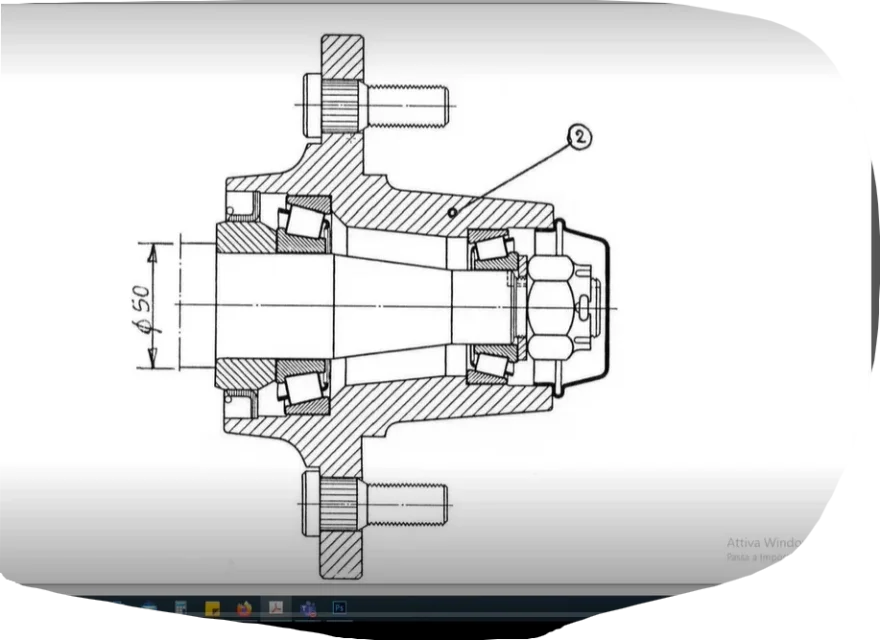
Meanwhile, finding myself in difficulty with the quotation of that particular, I tried to carry out another similar exercise, the particular to be extracted is the 2, I hypothesized it to be a flange equipped with 4 holes in which also in this case will be planted columns.

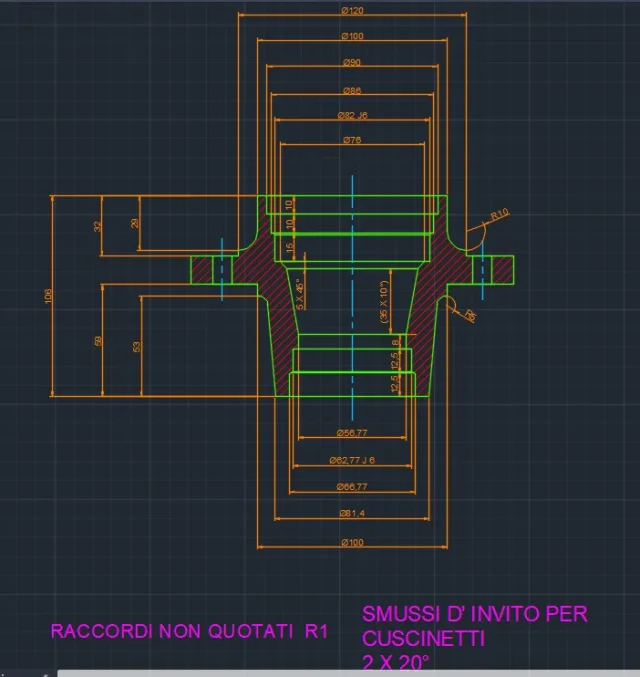
I have implemented a quotation that I think can provide all the dimensions that allow an operator to implement:
turning (for the processing of the external surface) ,ipotizing that the particular rough is a cylindrical bar of diameter 170;
milling, to obtain the central holes. I considered that 35 x 10° be an auxiliary quota, as I hypothesize that the processing will consist in obtaining the 4 holes at the top and then the 3 holes at the bottom, then the "central" hole will be resulting from the previous processing.
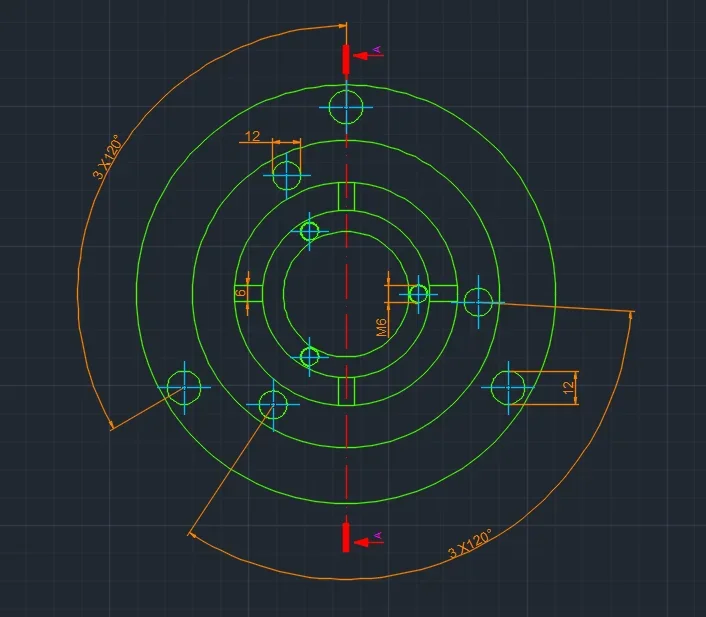
while in the view from above I indicated the necessary quotas to the realization of the holes in which the columns will be in summer.

I have also indicated the relative dimensional tolerances near the holes in which the bearings will stay, and I have also designated the presence of invitation bevels.


question, in the text of the exercise there is also written to correct any representation errors, the representation of the thread of the columns is an error, or is it thus indicated by convention?

ps. I went to another simpler exercise to understand if the reasonings are correct in relation to the processing processes, and then return to the quotation of the other particular.

thanks for the attention
 

Attachments

  • Prova d esame.webp
    Prova d esame.webp
    39 KB · Views: 33
  • Immagine 2022-03-01 133404.webp
    Immagine 2022-03-01 133404.webp
    28.9 KB · Views: 22
  • Immagine 2022-03-01 133440.webp
    Immagine 2022-03-01 133440.webp
    18 KB · Views: 22
35x10° what does that mean? are the 10 degrees compared to the axis or the opposite surface?
bad odds within the detail, you struggle to read them; where possible the quotas must be put external (12.5-12.5-8 lower zone and 10-10 upper zone)
write non-functional odds (56.77-66.77-81.4) obliges unnecessary control; Among other things I strongly doubt that the bearing has a share of 62.77 (although it was in inches). You must also use logic when you extrapolate a design.
the quota "dimension x degrees" is used on the bevels and never on the conicity; Moreover the conicity will not be a result because it must be made before the holes of the lower part.

I am preparing a very basic pattern of working cycle
 
processing will be manual and non cnc turning (excluding ø10 holes)
starts with a round of ø170
you take it on the spindle and you work the upper part (so imagine turning 90° clockwise having the spindle on the left)
we work the diameter 120 deep 32
you work the diameter 100 deep 29 (the radius is done by interpolation or making a depth of 19 and finishing with a radius tool 10)
we make the hole passing 57 (not 55,67)
diameter 82 (with light overmetal) deep 25 (10+10+15)
you work the diameter 86 deep20 (10+10)
we work the diameter 90 deep 10 (with light overmetal because it makes us a seal and must be tolerated)
you work the tapering (then you should quote the starting diameter without the bevel of 5x45° and also insert the share of conicacy)
the 5x45° chamfer is performed by touching the conical start edge and advancing 5mm (it is a workmanship that serves to download the diameter and to place the bearing only on the outer ring therefore it is not important and also a diameter of 77 or 78 would be fine equally)
ends the diameter of the bearing

now you turn the piece and you take it on the diameter 100 paying attention not to touch the radius
you work the head surface to bring it to 106
you work the diameter 100 deep 59
you work the external conicacy of which the corner is missing
we work the diameter 62 of the bearing (with light overmetal) deep 25 (12.5+12.5)
we work the diameter 57 deep 12.5
ends the diameter of the bearing

It is an analysis made to the good in which you can change some passages (for example to make the diameters progressively, 90x10, 86x10,.... and not to scale as indicated by me), but more than the accuracy of the passages the message I want you to arrive is that a method of this kind allows you to check if there are all the quotas that define the particular and if they are correctly indicated (e.g. length 8 of diameter 56.77 does not serve anything.
 
Good evening,
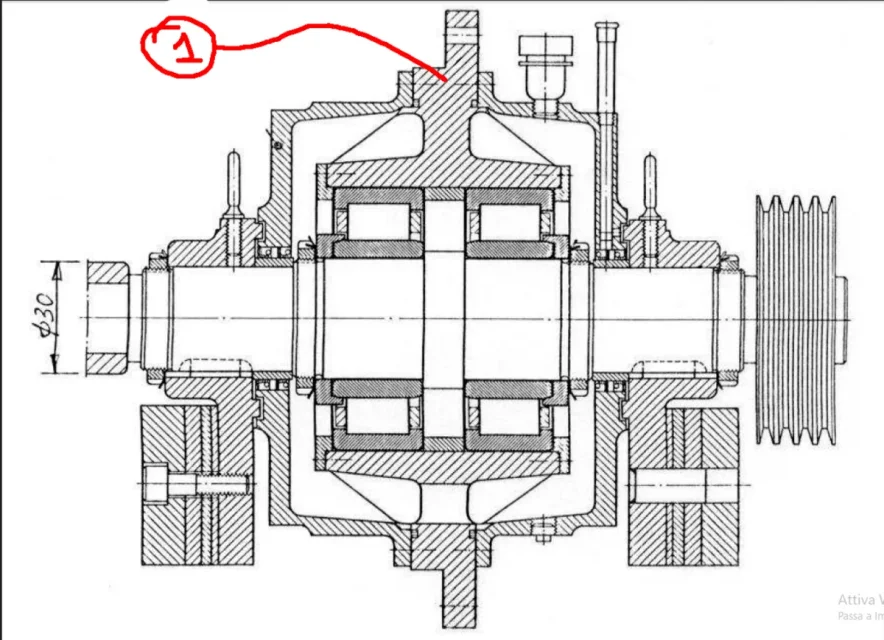
I took advantage of it to carry out another exercise, the text is always the same, and the detail to extract is the numbered one.

the exercise was treated in lesson but we only discussed the detail without representing it.
I hypothesized it to be a flange and represented the two views (as the prof said it was necessary to represent all 4 ribs) but I have some perplexity:
1 Why is the part I looked for in green not dissected while symmetrically it is all covered?
2 What are the blue circled elements, perhaps something inherent to lubrication?
3 holes circled in yellow are passed, unlike those circled in purple, thanks to which will be made a connection with screw bite with the other flange, correct?
4 I have placed the holes arbitrarily, is there anything that can make me understand how they should be arranged and how many should they be?
5 the two organs connected to the rotating shaft with rounded tab what are they?

thanks to the attention and all the indications, I am also trying to carry out a minimum of functional analysis of the axieme therefore I have asked questions concerning also to other details outside the one assigned, for now I hypotize that the motion is transmitted through a belt attached to the pulley, the tree in turn revolves the motion to the two organs thanks to the tabs; the bearings are lubricated by placing oil from the top cap, while the cap below is of drain.

thanks for the attention and for all advice.
 

Attachments

  • Immagine 2022-03-02 204353.webp
    Immagine 2022-03-02 204353.webp
    119.3 KB · Views: 22
  • Immagine 2022-03-02 204353.webp
    Immagine 2022-03-02 204353.webp
    127 KB · Views: 22
  • Immagine 2022-03-02 215114.webp
    Immagine 2022-03-02 215114.webp
    16.7 KB · Views: 18
  • Immagine 2022-03-02 215149.webp
    Immagine 2022-03-02 215149.webp
    30.5 KB · Views: 18
  • Immagine 2022-03-02 215240.webp
    Immagine 2022-03-02 215240.webp
    35.9 KB · Views: 21
2 What are the blue circled elements, perhaps something inherent to lubrication?
Lifting gulfs
3 holes circled in yellow are passed, unlike those circled in purple, thanks to which will be made a connection with screw bite with the other flange, correct?
in the yellow zone will be used a bolt (vite+sharp+dado) or screw + rosette if the hole of one of the semicarcases will be threaded threaded hole; in the purple zone will be used only one screw+rosetta. it is not thinkable to use a bolt to block the lids through the purple holes because there is no such long screw and drilling through the flange is uneconomical.
4 I have placed the holes arbitrarily, is there anything that can make me understand how they should be arranged and how many should they be?
no, but if you consider that the hole is seen both above and below you can hypothesize an even number; usually 4 or 6.
5 the two organs connected to the rotating shaft with rounded tab what are they?
difficult to say, but are the parts rotated by the rotation of the shaft that happens through pulley.
1 Why is the part I looked for in green not dissected while symmetrically it is all covered?
could be a lightening hole that is represented in a false section; But it is a very forceful hypothesis. These old drawings are always a mystery medium.
ipotizzo that the bike is transmitted through a belt attached to the pulley, the tree in turn rotating transmits the bike to the two organs thanks to the tabs; the bearings are lubricated by placing oil from the top cap, while the cap below is of drain.
correct analysis
 
the design is proportionally wrong. print the image and with a ruler take the measurements; beat one as a comparison measure (for example, decide that the hole is 50) and make the proportion for all the other rounding them.
if you represent the holes in the plant to quote them, put the diameter of interasses in order that those who will have to do it should not salt from one view to the other
you forgot the gorges for the sealing rings on the top (where the yellow screw goes)
Why did you use a numerical and non-standard tolerance like the other time? It is only curiosity, I believe that numerical tolerance should always be put, even when using classes it, because it facilitates the work of the operator who does not have to break the legislation.
Why did you do the staggered holes? if you do not know how they are arranged so much it is worth putting them in axis with each other; in the quotas define the angle of those from 12 on diameter 134 that being a central one also defines the other two, define the angle of those from 12 on diameter 95 but it is not known from where to start them, define the diameter from m6 those on diameter 55 but it is not known that the angle must have.

the section must be bought then represent also the holes, bevels...; The only axes can be used are in the axioms, although it was a practice due to the use of the tecnigraph and the saving of time.
 
perfect thanks for corrections.
if you represent the holes in the plant to quote them, put the diameter of interasses in order that those who will have to do it should not salt from one view to the other
I had initially done so, but a number of odds had occurred, so I opted for the other option.
Why did you use a numerical and non-standard tolerance like the other time? It is only curiosity, I believe that numerical tolerance should always be put, even when using classes it, because it facilitates the work of the operator who does not have to break the legislation.
because reviewing the explanations I noticed that the professor indicates them so, so not to be wrong I replied.
in the quotas define the angle of those from 12 on diameter 134 that being a central one also defines the other two, define the angle of those from 12 on diameter 95 but it is not known from where to start them, define the diameter from m6 those on diameter 55 but it is not known that the angle must have.
Okay, I understand, a solution in these doubtful situations could be to place the 4 holes in axle at 90° even to facilitate the quotation?
Why did you do the staggered holes?
I didn't understand, if they were, with the same section plan I wouldn't have to "seat them all" and then see the hole as it is and not just the axis? (I don't know if I could explain myself)
the design is proportionally wrong. print the image and with a ruler take the measurements; beat one as a comparison measure (for example, decide that the hole is 50) and make the proportion for all the other rounding them
I initially took the photo of the axieme on the sheet cad and from it I did all the proportions, but in this case I did (wrong) to the eye.
this choice is due to the fact that in the examination we will have 30-40 min to make the drawing, but currently I put a lot more.

Good evening.
 
I didn't understand, if they were, with the same section plan I wouldn't have to "seat them all" and then see the hole as it is and not just the axis? (I don't know if I could explain myself)
Yeah, you're right. I didn't pay enough attention. but lay them equally with criterion.
 
perfect, all clear.
Question , perhaps stupid, shouldn't there be also here (green) the presence of a fattener?
and in case it is not necessary, why?

thanks and good day.
 

Attachments

  • Immagine 2022-03-03 113852.webp
    Immagine 2022-03-03 113852.webp
    128.2 KB · Views: 20
the application is relevant; the two lids are symmetrical and the operating environment is the same for which the greaser should be expected also to the left.
I do not find a practical justification of his absence, probably present but not visible in this view.
a logical explanation can be that of the use of two equal but staggered lubricant covers of 90° to allow the lubrication of the lubricant without having to rotate the whole mechanism to position the caps vertically. with this solution you would have two load caps, two exhausts and two greasers.
 
35x10° what does that mean? are the 10 degrees compared to the axis or the opposite surface?
bad odds within the detail, you struggle to read them; where possible the quotas must be put external (12.5-12.5-8 lower zone and 10-10 upper zone)
write non-functional odds (56.77-66.77-81.4) obliges unnecessary control; Among other things I strongly doubt that the bearing has a share of 62.77 (although it was in inches). You must also use logic when you extrapolate a design.
the quota "dimension x degrees" is used on the bevels and never on the conicity; Moreover the conicity will not be a result because it must be made before the holes of the lower part.

I am preparing a very basic pattern of working cycle
size x degrees is used only and exclusively for bevel at 450. the norm explains that for different angles you will have to affix the quota length and angle separate..... you have no idea how many times I find it wrong.....
 
Good evening, thank you again for the valuable advice, while I found another exam track with the same type of exercise.

this time I think I have correctly extracted the particular, but I can't minimally imagine the operation of the overall, for the little I can understand I see:
1 the horizontal shaft (blue) at whose ends there is the presence of two holes (black) in which connection plugs will be in summer
2 the two pulleys (orange) covered by an external lid (green) , also on the pulleys there are threaded holes thanks to which screw the flanges (yellow) , two for pulleys, and then there are also seals, as well as the bearings. (I didn't tell you not to get too dirty)
3 at the center of the tree there is a hole in which the hook is grafted (pink), stuck against the flange thanks to the nut, flange that covers the bearing.

Here, for example, just that bearing, I don't understand what function it has, so I assume that somehow the bike will be transmitted to the central tree, I don't know how.

I'm sorry to say bad, thank you for your attention.
Good evening.

edit. rereading what I wrote and reanalyzing the overall I think I understand is a carrucola, because it is that I keep not understanding how it works.
 

Attachments

  • Immagine 2022-03-03 220938.webp
    Immagine 2022-03-03 220938.webp
    45.6 KB · Views: 19
Last edited:
1 the horizontal shaft (blue) at whose ends there is the presence of two holes (black) in which connection plugs will be in summer
serve as an antisvitation of the wrecks
2 the two pulleys (orange) covered by an external lid (green) , also on the pulleys there are threaded holes thanks to which screw the flanges (yellow) , two for pulleys, and then there are also seals, as well as the bearings. (I didn't tell you not to get too dirty)
you see two holes, but surely they are more (I have never seen a flange stuck with 2 screws only)
Here, for example, just that bearing, I don't understand what function it has, so I assume that somehow the bike will be transmitted to the central tree, I don't know how.
it is a handling mechanism; the pulleys allow the movement of ascent and descent, the bearing mounted above the hook allows this rooti and therefore can be manoeuvrable to facilitate the coupling. in the carter you have indicated in green you see a hole where passes the cable that moves the pulley
between the outer seal and the tree there is a spacer
the pulley has lightening holes
the tree in the upper part in the center has a small collar for bearing seat

I think we haven't used the vines on a straight cut. . .

instead of using drawings from the years of the industrial revolution, I put you a couple of links of more recent thingsplans with ciri (signs already quoted to practice with autocad)inventor wizard.be/nl - autodesk user group (draws in pdf where you have the design of the assembly from which to obtain the details and drawings of the same details that you can use to control the work done)

if you have to give the drawing exam I imagine that you will also have to insert geometric tolerances and especially roughness that so far you have not even sketched
 

Forum statistics

Threads
44,997
Messages
339,767
Members
4
Latest member
ibt

Members online

No members online now.
Back
Top