• This forum is the machine-generated translation of www.cad3d.it/forum1 - the Italian design community. Several terms are not translated correctly.

fill surfaces

  • Thread starter Thread starter gtsolid
  • Start date Start date
View attachment Modello Scalato.rarOkay, reset.

I leave the piece file attached, it is a wheel hub holder of a car.
I have to study the production for shell molding that includes metal shells that act as a model
to form the sand in which the alloy must be formed.
I need to create the cad model of the shells and I can't do it.
an idea that I had had consisted of creating two offset surfaces from all the surfaces of the piece that interest me.
the first distant something like 10 mm from the skin of the piece and the other distant something like 0.01 mm from the skin of the piece.
So, if I could fill the space between the two offset surfaces, I would have got the shell.
I would later split the shell into two parts, remodeled to have casting channel, mussels and other and thus obtained the cad pattern of shells.

What I ask myself is: is there a function in solidworks to fill the space between two surfaces?
obviously delimiting them and giving the appropriate constraints of the case
 
View attachment 43732I leave the piece file attached, it is a wheel hub holder of a car.
I have to study the production for shell molding that includes metal shells that act as a model
to form the sand in which the alloy must be formed.
I need to create the cad model of the shells and I can't do it.
an idea that I had had consisted of creating two offset surfaces from all the surfaces of the piece that interest me.
the first distant something like 10 mm from the skin of the piece and the other distant something like 0.01 mm from the skin of the piece.
So, if I could fill the space between the two offset surfaces, I would have got the shell.
I would later split the shell into two parts, remodeled to have casting channel, mussels and other and thus obtained the cad pattern of shells.
I don't deal with fusions, but from that very little I know your model, it must have the corners of disform that allow the extraction of formed sand. the attached file has no sform angle.
the shape is not simple those you need to find the division line along which the two parts of the mold are separated (but more than two parts may be needed). You have to find the division suspers.
the process of creating the offset surface and then filling it does not seem to me just the right one, because you could simply subtract from the two semisamps your model but you can do it after modeling it so that it is physically extractable from a mold.
there are some experts of molds and castings that will certainly give you more reliable indications than mines that are much less than a vague and superficial mention the process of designing a mold.

I opened the file and I have to confirm that it is modeled very badly.
first of all the fittings make almost always at the end. there is a cutting function that creates two passing holes that then closes with four surfaces. It seems to me that there is a continuous add and remove material as if you were working with a contextual cad.
sketch 10 is something hallucinating as well as its use in extrusion 10 which then modifies first with extrusion 13 and then with cut 18 to get a chce shape you could have directly in extrusion 10 if you had done the correct sketch.
extrusion 24 adds 2.5 mm of material that could be created by extrusion 9 (7 features first) if only you had made the right size sketch rectangle or at least had quoted it to change its size.
I stopped in control because it's really a mess.
There are in all 147 features and I think 120 are useless.
other thing is the underdefined sketches. It is impossible to make changes without risking to blow up everything.
Did you model that piece from a 2d design? If so, could you attach the design to understand how to model it more rationally?
 
Thank you very much, the speech does not bend.


Unfortunately, I didn't model the piece, I designed it and hand-sized, I gave the drawings to a second of the group with which I'm working that modeled it, then I had to put my hands back to fix other things and I'll have to remodel it to give it the corners of disform, the appropriate overmetals and everything.

the question of the surface of division for the model plates is blocking me all the work because if I do not correctly define that it makes no sense to start placing system of casting and materozze.
If I do not redesign everything from head, I certainly prone less the eyelet and try to make the piece more unformable. . .

I also wanted to edit my last message because I had expressed bad but from smartphone I could not: I first need to model the model plates (metallic) and then get the shells (pre-coated silica sand)

I realized in these hours that the solution of offset surfaces makes no sense.
I tried to get the shell with boolean operations but I still couldn't. . .

In the meantime, I do the calculations on the metallostatic spins, the cooling modules and the sizing of the channels...maybe I return to the dividing surface. . .

I open a discussion about this?

Thanks again
 
g
Unfortunately, I didn't model the piece, I designed it and hand-sized, I gave the drawings to a second of the group with which I'm working that modeled it, then I had to put my hands back to fix other things and I'll have to remodel it to give it the corners of disform, the appropriate overmetals and everything.
I'm in a hurry, and I'm only answering you for now. If you have to do even the slightest change to that model I highly recommend you do it again from scratch. departed from a new file. by now you know the shape perfectly, the measurements you have and excluding the fittings and the reforms I am convinced that they do not need more than a fifteen feature to make a stable and changeable model without problems. after you will have to work on line of division, surface of division angles of sform etc.
as it is done now you must continue to add and remove material because everything in the feature manager is really unmanageable. looks more like a piece shaped by an artist with clay (tools add, towels, no add, here is still a little...) than by a designer with a parametric cad.
even those fearful models and the various contextuals would dare so much :rolleyes:
 
Okay, maybe I stepped forward.
I have studied the directionality of solidification and the best solution for the shells remains precisely to divide with a surface rather than with a plan (to be put as then)
I modeled the plaques approximately so and Wednesday I bring them to the professor hoping (lively) that they will be fine.

But now I don't know where to put the materozza and how to structure the casting system.. .
Tipo.webpthe heat center is near the tree but are in a dedalo because:
I could think of putting a materozza to sky apert for example cylindrical orthogonally on the divider plane but in any position I think it becomes insformable.. Unless you put it right above the tree without restriction of section to the attack otherwise I am point and head with the subsquadro.
I could then think of putting it on the divider plane but then I have to either consider it blind or open-air but I have to school along the divider plane and orthogonally to the axis of the tree and to the greater side of the piece to understand us. . .

boh, do you have any advice?

I opened a new topic in the student section but out of 50 and passes people who viewed yet no one answered me. . .
(I'm sure I ask for foundry in a cad....)
 
I opened a new topic in the student section but out of 50 and passes people who viewed yet no one answered me. . .
(I'm sure I ask for foundry in a cad....)
ask the moderator to move the discussion in the forum dedicated to mechanical design. here on cad3d there is also someone who deals with foundry
 
What do you mean it doesn't work?
Isn't it activated?
does not correct the whole model?
leaves you surfaces?
Anything else?
screenshot, file...
 
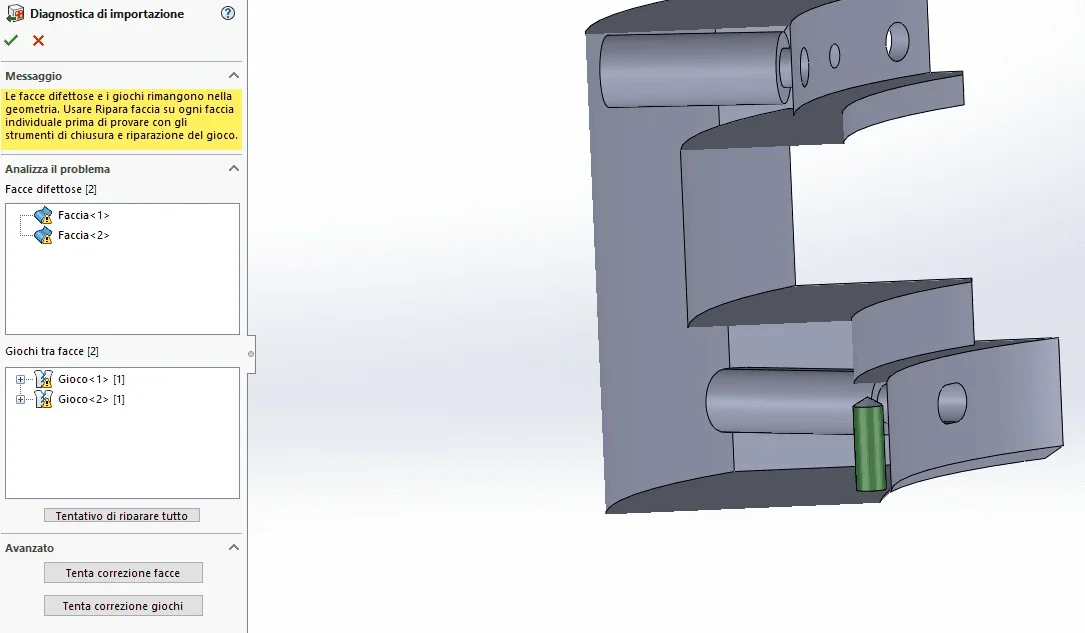
does not correct the errors he finds. I have a empty container. I cannot attach screenshots or file because it is a part of a patented machine. However, my main problem is that it does not sample a section in the table, which would then be what interests me. cmq, the initial screenshot of this discussion, perfectly makes the idea of the piece as I have it. empty inside and so remains. I tried both "will repair everything" and selecting the surfaces and games individually. I exported the file again from solid edge to parasolid instead of in step but same problem. I feel good even if there is a chance to make the sample appear in the table somehow.
 
if the problem is just having a sampling in the table, just do a manual sampling where you need to do it and solve the problem
 
I was hoping for something less slender because they are several details to do everything by hand. Anyway, thanks for the tip.
 
I also do not understand, as it is possible that it amounts bodies as surfaces, despite using the various import options before opening the step file...
 
I found a file I can attach the screenshot that has the same exact problem. the file is imported as a unique surface therefore, trying to use the command to join the surfaces tells me, rightly, that a surface cannot be combined with itself... .Cattura.webpCattura2.webp
 
try this way:
create a planar surface where there must be closure; create a plane matching the closure and with the convert entities select the edges and get the sketch, then launch the commandImmagine.webpwith oil command merge surfaces select the two surfaces and use the option creates solidImmagine.webp
 
Actually, the screenshot is a section, sorry if I didn't write it clearly. the piece is already closed, only that inside is empty.
 
Sorry, I attach the file I made the screenshot that has the same file problem that interests me.
 

Attachments

Forum statistics

Threads
44,997
Messages
339,767
Members
4
Latest member
ibt

Members online

No members online now.
Back
Top