
• This forum is the machine-generated translation of www.cad3d.it/forum1 - the Italian design community. Several terms are not translated correctly.

fillet seal

  • Thread starter Thread starter Guido
  • Start date Start date
always to throw it there that I don't have time... but 10011 sucks you as an approach to threaded collection? ! ?

p.s. the 3 laps refers to the 3 laps of the screw and not to the threads in the right grip?so it should be evaluated, knowing the step, how many threads in the grip there are...
cnr uni 10011 does not treat thread depths. is a rule withdrawn for eurocode 3. sure to carry out a verification of the connection by law is established if the type of connection, nominal diameter screw etc according to the applied forces is adequate or not. nothing is indicated on the depth of the threads and therefore of the real tear resistance of the threads.

3 spins of thread = 3 useful turns = 3 threads in socket --> as long as they say, it is years and years that it is said that "bastano 3 threads in socket to guarantee a threaded connection" ... clearly under the hypothesis of having certain conditions of resistance that have always been omitted.
 
with certain fairly short dimensions it is preferable to use a grain than a prisoner. the prisoners are partially threaded and cost more and not all keep them available in stock, while the grains are located everywhere and to tighten them is enough a brugola key (which the prisoners do not have).

probably if the customer makes an automatic assembly it is very convenient to feed/select/slide/slide a grain compared to a prisoner.

for the profodity attached to that by law and verify it with my vormula depending on the characteristics of the materials.
Sorry but I forgot to write about neglecting the economic factor and ease of assembly.
Thank you very much for the rapid response.
 
@meccanicamg
You are perfectly right, there is no need for Eurocodes as you can apply the basic theory of the agents efforts on the threads.
The juvinall demonstrates the same thing as you (it is actually the opposite;-) but to you the merit of "universifying" the formula taking into account different materials.

so much hat... I have already printed your sheet of notes and inserted into mine. =)

Thank you very much
 
... but to you the merit of "universifying" the formula taking into account different materials.

so much hat... I have already printed your sheet of notes and inserted into mine. =)

Thank you very much
I like pierarg, one day of sirà: "on mechanics there is evidence that..." ahahahahah who knows:biggrin:
 
Good morning, gentlemen, I take this discussion because I have had a similar problem.

a customer introduced me two aluminum pieces connected by a threaded grain m10.
a piece (full worked aluminum) has a blind threaded hole m10.
the other (aluminum die-cast) has a passing hole.
grain (steel) screws on the blind hole and then tightens with a steel nut.

the questions are two:
- for the connection length of the blind hole I would simply follow the recline equal to at least 1.5 times the diameter (perfected by the brilliant demonstration of mechanicsmg)

- The strange question I asked myself is this: "Why did you use a threaded grain?"I would have used a posonist. generally use the grains to fix/block.

Can you enlighten me?
Thank you.

p.s: I have no way to post a link pattern however is the classic piece1+piece2 link with piece1 (pass hole) and piece2 (threaded blind hole)
Maybe because it screws the qb grain, it keeps still with the caterpillar while it pulls with the fix.
Bye-bye.
 
for what I know, the poor resilience of steel used to normally build grains, makes these little resistant to bending and traction.

Hi.
 
for what I know, the poor resilience of steel used to normally build grains, makes these little resistant to bending and traction.

Hi.
As far as I know there are also the 14.9 uni 5927 grains and have very high mechanical characteristics.

grains are normally rough and printed hexagon, therefore according to the resistance class they are exactly as the screws. if you take poor material it is obvious that they work well only compression, there is for the purpose for which they invented the grains.
 
in this old discussion:http://www.cad3d.it/forum1/showthread.php?t=18891I posted the pages of the malavasi that treat the verification of the length of the threaded connection (and it is shown that the bending verification is more severe than the cutting one).
we always talk about complete threads, in a unified screw the initial part is conical for a length pairs to a maximum of two times the step, so if I screw the gulf for three threads I have to consider suremnete in taking only one, and the verification, to go on the safe, it is to be done on that only thread.
Hello, everyone.
good demonstration @meccanicamg... known that you take into account average and non-maximum voltages, in theory it is still a good basic formula.@radio Obviously it is more severe the bending dimensioning, but are we sure that it is necessary? I find the analytical method more correct @meccanicamg I ask you a question @radio : if you need to size a pin considering a shaft/hole coupling with tight tolerances h/h consider tau efforts from the cut or those given by the bending?
 
you could implement the formula I take into account the actual load (estimated) on the first 5 threads, which are those to which 90% of the work is attributed
 
if the gulf has the long thread and can be screwed only for a few millimeters, I highly recommend the use of a spacer between the plan of support and the underhead of the gulf, so as to redistribute the forces also in shooting other than the vertical one.
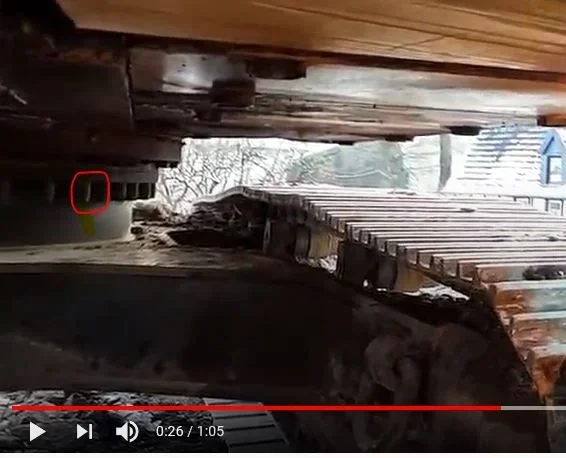
to confirmation of what is said by mechanicsmg, the expedient to mount long screws with space interposed between the flange is the counterflangia is a very used expedient in non-coaxial presence to the crown of the drilling, I apologize if I have explained badly, the most famous example that comes to mind is that of the ralla of the excavators.
for example in the figure below there is a c 323, one of the most popular in the world, perhaps the largest of the caterpillar wide less than 2440 mm, you notice well the spacers, even if in fact I remembered them much higher and obvious, perhaps I confuse with those of the rotary autogruents.
Distanzialini.webpbut returning to the main topic, when there are important loads to raise to me they have always made use of the so-called anchor points to weld, or the girevoli golfers, the classic gulfs have always made me avoid them.
 
@meccanicamg I was analyzing your formula. He doesn't take into account the axial force agent on the screw.
h min depends also on the axial force, so I propose you a simplification of your formula which considers maximum tau efforts in relation to the nominal diameter (this is only valid for the mothervite)... is a formula of first approximation that you want to be refined.
 

Attachments

@meccanicamg It is true that you check the pressure on the fillets.... it is a bit approximate.. I don't know how much spanne is more convenient to apply what I posted.
 
Please! This, like most of my notes, is the fruit of sleepless nights, where I go hunting for truths trying to prove everything with a logical sense.

You know what it is... with the classic manuals I don't find myself, instead if I Synthetic in my notes I have photographic memory and above all an extreme speed of consultation and application, all on a single source.
and already... .
from the mechanics dacci sti notes 100 euri to the key.....what do you say
I think after a few days you're retired.... .

with sympathy

Hi.
 
and already... .
from the mechanics dacci sti notes 100 euri to the key.....what do you say
I think after a few days you're retired.... .

with sympathy

Hi.
less than 1000 do I give them??? make the collection. with sympathy?
 
@meccanicamg I was analyzing your formula. He doesn't take into account the axial force agent on the screw.
h min depends also on the axial force, so I propose you a simplification of your formula which considers maximum tau efforts in relation to the nominal diameter (this is only valid for the mothervite)... is a formula of first approximation that you want to be refined.
at the end is the most restrictive one.
if however the mothervite is more durable.... your formula does not work.
 
Last edited:
at the end is the most restrictive one.
if however the mothervite is more durable.... your formula does not work.
the calculation is worth if and only if the mothervite has certain characteristics, as written in my note....however you could do the same thing for the vine... at least you consider the forces in play...what your formula does not contemplate.
as far as the restriction applies, it is sufficient to increase the degree of safety determined by the coefficient 0.5.
but we could make a lot of considerations, our forms apply for certain materials in certain conditions...if for example the materials of screws and mothers have a very different form of elasticity the thing is complicated and more generally is complex because the load is distributed unevenly on all threads.the problem exists specifically when the load is divided unevenly on the first 3/4 threads.
 
from the theory, by making the due approximations the length of coupling is calculated by rounding for excess according to the materials:
lmin >=0.47*d*k

conk = rsv/rsmv
rsv:
screw yielding loadrsmv: Maternal yielding loadd: nominal diameter screwTheater: minimum mating length

this applies to threaded holes made with minimum hole tip and with males for h6, i.e. with 75% of useful surface of cutting resistance of the coupling crests/wall thread.
if the gulf has the long thread and can be screwed only for a few millimeters, I highly recommend the use of a spacer between the plan of support and the underhead of the gulf, so as to redistribute the forces also in shooting other than the vertical one.
hello to everyone, I'll take this old discussion.
I searched on the net similar treats and found that more than someone over time made past copy of this same post written by @meccanicamg (this discussion is older than the others found on the net). @meccanicamg He's doing school! !

I remove it to understand where the 75% of useful surface of cutting resistance jumps. Can someone explain it to me with a sketch?

Thank you, hello!
 
the response of 75% of cutting-resistant area comes from basic formulas, where it says that applied a cutting force t on a circular section of diameter d and having area a, the cutting tangential voltage is calculated as:
\( \tau=\frac{4}{3}•\frac{t}{a}{a}=\frac{1}{0,75}•\frac{t}{t}{a}{a}{a}{a}{a}{a}{a}{a}{a}{a}{a}{a}{a}{a}{a}{a}}{a}}{a}{a}{a}}}{a}{a}{a}}{a}{a}{a}{a}{a}}{a}}{a}{a}{a}}{a}{a}{a}{a}{a}{a}{a}}}}{a}}{a}{a}}{a}{a}}{a}}{a}}}}}}}}}}}}}}}{a}{a}}{a}}}}{a}}{a}{a}{a}{a}{a}{a}{a}{ \)

the reverse of 4/3 is 3/4 i.e. 0,75 i.e. 75%.
 

Forum statistics

Threads
44,997
Messages
339,767
Members
4
Latest member
ibt

Members online

No members online now.
Back
Top