• This forum is the machine-generated translation of www.cad3d.it/forum1 - the Italian design community. Several terms are not translated correctly.

fold on sheet

  • Thread starter Thread starter vale79
  • Start date Start date
Thank you! when I was on the move the nickname was bend to 90 (so as not to go off topic from the sheet!) and were exactly 90° accurate! It was more time I was on the ground than I was on the move! And now in red there is only the account:).
cmq I gladly hold the ambush to the wolf x the rest:).
Thank you and soon!
That's right.
 
:tongue: I would do it more than willingly if I knew how:tongue:. As you can see, I'm more than in the beginning, but with some help, maybe I can:) in the meantime I tried with flange and then to do the corner, and I also found the page in the guide where there is exactly the image of what I'm doing, now I want to be able to do it too! without your advice I would never have found it.
do you mean that in the sheet form you do not proceed as in reality, contrary to that in environment parts? Is there any guidelines to follow in particular? Thank you thank you
the sheet metal environment is always a part environment, as is standard.ipt, (it is evident from the .ipt extension). in this module are created models of sheet metal and has typical functions used in the die-cutting. the concept of hybrid or integrated modeling in inventor must be managed by the designer (i.e. you)! es: we put the case you want to create a rectangular prism with the beveled edges, you can decide to use the integrated modeling, that is to create a rectangular sketch already beveled, or use the hybrid modeling creating a rectangular sketch, extrude the sketch and then apply the bevel as a feature on the already created solid. other software like catia v5, has commands that create independence between sketch and feature, inventor is a little more laborious!:wink:
 
I don't even know inventor (but a bit of sheet yes :biggrin:), but I think that more or less softwares "region" all in the same way and that is, following rules. and the sheet wants that at the crossroads there is a proper "scaric".
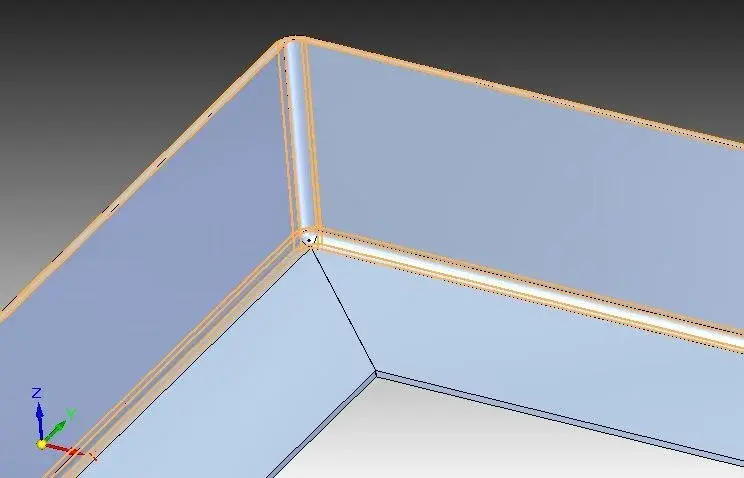
your piece is not flattened (and therefore no longer recognized as sheet) partly because you have worked in "mixed environment", then normal "solid cut" processing in the sheet metal module, but above all because you have not assigned a proper laceration of exhaust.
this discharge must go beyond the area of influence of the piego (beyond the lines of tangence between fitting and flat face) otherwise the fold will go to interest also the part that you want to remain flat "roining" (and this happens in reality).. and the program does not accept it and gives you the error.
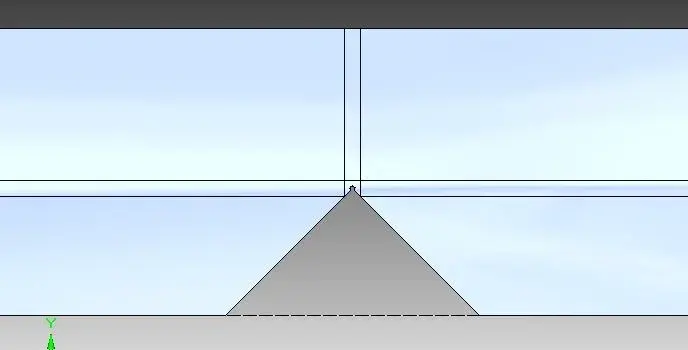
in your case the cut in the edge should rise more on the vertical.
I attach the image of your modified edge in paint with a development sketch as it should be:View attachment 17583that then in practice the width of the discharges can be even less (or nothing in some cases) and decided by the expert operator is another speech. but a software is programmed according to precise parameters that must be respected.. then in work we arrange:smile:

if I had done everything in the sheet module with the bending flanges and all related functions, the program would automatically allocate the right lacerations (for him) and the piece would be solved immediately.
in fact not always the solution provided is " aesthetically beautiful", with huge "holes" between the folds of edge.. often I happen to have to fix "hand" the dwg that will go to laser cutting, so I know that the folds in the car will come out well the same.

you can also use the "mista" procedure (at least, in swx it is possible.. I don't know inventor) but remembering that the cuts are made in a very precise way.

greetings
Marco:smile:
But you want to bend the detail with such an exhaust? but did you ever see a sheet metal bent like that?:eek:
 
I did not say that it does not need, but that it is too big, if the piece was stainless steel and you have to weld it to tig, the welder (at least where I work) makes you a tie with a gap (as you call it) so big.
if you have to weld you work on the size of the flanges giving the right gap! the welder should not know what the gap is, he just welds, but you have to be the one to put in condition the welder and who before him in the production cycle is interested in processing. many designers neglect many important elements, and the faults often fall on the workers who poor are the performers!
 
But you want to bend the detail with such an exhaust? but did you ever see a sheet metal bent like that?:eek:
Yes, sir! And without so much amazement. .

Obviously that is a cabbage sketch and a correction made with paint, the size is random.
the discharges can have various features, from a "intaglio" with the grinding wheel to a simple round hole with center to the intersection of the fold lines.
then as said with the experience there is not even need to make "precise" drawings; if you are not the "cutter" (and you do not have to do the developed templates) just give the operator the drawing with the quotas of the finished bent (and often it is better so not to incur in errors of interpretation and difference of parameters) than that immediately understands what and how to do it.
but in a cad program you must enter the data "as a rule" (and being aware of what you are doing).

It is you who have not seen much around (and it is not the first time you show it.:wink:).

greetings
Marco:smile:
 
if you have to weld you work on the size of the flanges giving the right gap! the welder should not know what the gap is, he just welds,
Look that "the welder" could teach you so many things that you don't even imagine.. Believe me. Get down to the workshop and learn from him, some problems wouldn't even arise.

try once to turn off the pc and do the same things using the head, paper and pencil.. if you know how to use the tecnigraph and apply the technology so much of earned.

greetings
Mar
 
Yes, sir! And without so much amazement. .

Obviously that is a cabbage sketch and a correction made with paint, the size is random.
the discharges can have various features, from a "intaglio" with the grinding wheel to a simple round hole with center to the intersection of the fold lines.
then as said with the experience there is not even need to make "precise" drawings; if you are not the "cutter" (and you do not have to do the developed templates) just give the operator the drawing with the quotas of the finished bent (and often it is better so not to incur in errors of interpretation and difference of parameters) than that immediately understands what and how to do it.
but in a cad program you must enter the data "as a rule" (and being aware of what you are doing).

It is you who have not seen much around (and it is not the first time you show it.:wink:).

greetings
Marco:smile:
you have spoken of interpretation and is wrong, he who will have a design will have to read it not to interpret it! I don't want to offend you, I'm sorry if you misinterpreted (I see you talk about interpretation)! I don't know what you do exactly, but if you have such a philosophy (as you wrote in this quote), give the impression of being a performer accustomed to enlisting, mola of here and mola of there! There are laser punching machines and cutting machines that do everything, unless you work in a company that does not own this machine capital!:cool:
 
Look that "the welder" could teach you so many things that you don't even imagine.. Believe me. Get down to the workshop and learn from him, some problems wouldn't even arise.

try once to turn off the pc and do the same things using the head, paper and pencil.. if you know how to use the tecnigraph and apply the technology so much of earned.

greetings
Mar
You see that you're always interpreting? I simply said that in the workshop people who work must not think more than they need to work in the right way, always if they have a designer capable!:finger:
 
And would you like to teach us this?
and don't take it bad every time you're discussing it! we discuss what goes and does not go, without being wicked! I don't want to be the person who has to teach you something, but if there is a discussion everyone has to say their!:finger:
 
I attach the images of a corner and relative development created with solid edge, I always do them so and in the bending, in the carpenters have never had anything to say.
 

Attachments

  • Scarico_01.webp
    Scarico_01.webp
    23.6 KB · Views: 13
  • Scarico_02.webp
    Scarico_02.webp
    5.1 KB · Views: 13
I generated a fight... cmq in the end I made it to make the piece, now I finish it and put it on the table, then I pass to the other 3 pieces. Thank you for everything. I agree that you have to work in a team, and also that the designer has so much to learn from the performers also to direct to the design "perfect" in which there is nothing to interpret. Thank you and soon.
That's right.
 
a council that I can give (as already mentioned in this discussion) is to go to the workshop to see when they fold and assemble the pieces that one drew. where I work when I want to see something I designed, even to understand the methods of bending and assembly, or on the design or on the shop I write to be called in the workshop to see and compare. Sometimes I compare myself even before drawing the piece with my colleagues in the fold department and that of carpentry, so once you agree all you hardly have feasibility problems.
 
a council that I can give (as already mentioned in this discussion) is to go to the workshop to see when they fold and assemble the pieces that one drew. where I work when I want to see something I designed, even to understand the methods of bending and assembly, or on the design or on the shop I write to be called in the workshop to see and compare. Sometimes I compare myself even before drawing the piece with my colleagues in the fold department and that of carpentry, so once you agree all you hardly have feasibility problems.
what you say, in part it's okay, but the current bending machines are already sold with numerical controls that simulate the fold sequences, already telling you what you have to do. As far as welds are concerned, there is no wonder what to see! I mean, I don't want to diminish what you said, but it's just carpentry! if you want to verify your job delivered to the operators is another pair of sleeves, but if you are sure of the fact you do not think you will go down to the workshop to check out laughter procedures! :cool:
 
what you say, in part it's okay, but the current bending machines are already sold with numerical controls that simulate the fold sequences, already telling you what you have to do. As far as welds are concerned, there is no wonder what to see! I mean, I don't want to diminish what you said, but it's just carpentry! if you want to verify your job delivered to the operators is another pair of sleeves, but if you are sure of the fact you do not think you will go down to the workshop to check out laughter procedures! :cool:
As far as welds are concerned, I could almost give you reason, sometimes there are things that cannot be expected.
As for the bending, it is true that the bending machines (modern) have cnc controls so to video you are indicated the bending sequences, but if you are wrong the construction of the piece because maybe you do not take into account the encumbrance, you can have the cnc you want but if you are not with the piece because you bang on the shoulder of the bending machine, then you feel the blasphemies of the bending.... and especially of the head.

my previous message was, however, for those who have just started to make the designer (even where I work) some of my colleagues do not want to go to see in the workshop, they are afraid to get their hands dirty, then they do shit.... that it would be enough to ask for advice that everything would be ok, at the end then the head and the resp. of the fold department if you take it first with the resp. of the mold. tec. (in this case I) then with the designer.
 
but if you miss the construction of the piece because maybe you don't take into account cnc, you can have the cnc you want but if you're not with the piece because you bang on the shoulder of the bending machine, then you feel the blasphemies of the bending machine.... and especially the boss.
it is so, but in the engineering phase of the product are taken into consideration all hypotheses and any problems! when the product has been started in the production cycle, leave the operators the productive task, and if maybe they have methodologies that will adjust your well come, but know that you will always have to employ methods regulated by the iso regulations, related to the sector!:cool:
 
it is so, but in the engineering phase of the product are taken into consideration all hypotheses and any problems! when the product has been started in the production cycle, leave the operators the productive task, and if maybe they have methodologies that will adjust your well come, but know that you will always have to employ methods regulated by the iso regulations, related to the sector!:cool:
maybe you work in a company where you make your own product, but I work in a company of third parties, laser cutting, fold and carpentry, so you never have a job equal to another, and I can assure you that customers only care about having the well-built, precise pieces and with excellent finishes at reduced prices.
 
a council that I can give (as already mentioned in this discussion) is to go to the workshop to see when they fold and assemble the pieces that one drew. where I work when I want to see something I designed, even to understand the methods of bending and assembly, or on the design or on the shop I write to be called in the workshop to see and compare. Sometimes I compare myself even before drawing the piece with my colleagues in the fold department and that of carpentry, so once you agree all you hardly have feasibility problems.
All true.
also to understand what you are doing, touch with hand "the matter", know the operation of the machines and the behavior of the materials. measure yourself the "ritiri" for various thicknesses and materials, so that you can then use the cad in the best way by providing the right inputs.
In short, to see applied the theory that you know. if you know it (and not always it is so) and understand how, how much and why you disconnect from the relay (which does not mean that the theory is wrong. . ).
What you say, part of it is good
No.
what he says always Good!

greetings
Marco:smile:
 

Forum statistics

Threads
44,997
Messages
339,767
Members
4
Latest member
ibt

Members online

No members online now.
Back
Top