• This forum is the machine-generated translation of www.cad3d.it/forum1 - the Italian design community. Several terms are not translated correctly.

fuse

  • Thread starter Thread starter panormus
  • Start date Start date
All your parts will be created in the absolute axle system....anywhere you will have to build a new axle system that will actually be the position of your part in the total. . .
can I do this for already created and imported parts in the general product?
then move the part into the new axle system using the command moves from axis to axis.... .
command moves axis? never seen.. I'll look for it.
Maybe I wasn't quite clear, but being through messages is really difficult. .
You're right, it can happen... mediate as soon as I'm in front of the pc. ;-)
 
all your parts will be created in the absolute axle system....anywhere you will have to build a new axle system that will actually be the position of your part in the overall... then move the part into the new axle system using the command moves from axis to axis.... .
Maybe I wasn't quite clear, but being through messages is really difficult. .
quoto, from my reminescences automotive industry I remember that we did so.

theoretically the first thing you have to do when you start drawing each component is to create a secondary reference system placed according to the position that the detail will have in total.

the procedure illustrated by hairy people did so when we did not respect the above.
 
quoto, from my reminescences automotive industry I remember that we did so.

theoretically the first thing you have to do when you start drawing each component is to create a secondary reference system placed according to the position that the detail will have in total.

the procedure illustrated by hairy people did so when we did not respect the above.
many times it is not possible to predict the exact position in the space of each part, indeed I would say almost always if you draw ex-novo.
 
Good question!! !
If you just want to do the things "do good"... and by all means I mean how to work at boeing, airbus, etc. when you realize every single component you never have to do it in the origin of the axes but you already have to take into account where it would be in the axieme.

In this way, when you assemble the various parts, they have all the matching tarts.


Please someone correct me if I said a cag@t@.

Thank you.
more or less you have approached the concept, but other local references and plans always referred to the aircraft axis with well-located skeleton etc...

I add a brief explanation to panormus
Hello, girl.
other question: how do I make sure that the reference system of each part coincides with the reference/terna of axes of the total product? :confused:

I'll get you an image to understand.

greetings
Hey, baby. .

the aircraft is divided into reference planes and related frames, designated as stations, water lines and
natica lines, measured by fixed reference points.
this serves for rapid identification and location of components, for the center of gravity and weight distribution.

Usually this division is defined in a skeleton model called centerlline general diagram, or local for first-level parts e.g. cl wing, cl horizontalr.. .
standard abbreviations and definitions
(1) body abbreviations

b sta
body station. a vertical plane perpendicular to body
centerline, located by its distance from point 90
inches forward of nose.

bbl
body buttock line. a vertical plane parallel to body
vertical centerline plane, bbl 0.00, located by its
perpendicular distance from body centerline plane.

wl
body waterline. a horizontal plane located by its
perpendicular distance from parallel, imaginary plane
wl 0.00, 91 inches below lowest body surface.

brp
body reference plane. horizontal plane, bwl 199.3, at
top surface of floor beams.
(2) vertical stabilizer abbreviations

fin sta
vertical stabilizer station. plane perpendicular to
centerline of vertical stabilizer rear spar. distance
is measured from fin station 0.00, intersection of
leading edge line extension and fin waterline 0.00.

fin wl
vertical stabilizer waterline. horizontal plane
measured parallel to a body waterline. fin waterline
9.65 is body waterline 366.5.

fin le sta
vertical stabilizer leading edge station. plane
perpendicular to vertical stabilizer leading edge,
measured from fin leading edge station 0.00,
intersection of leading edge line extension and
vertical stabilizer waterline 0.00.

rud sta
rudder station. plane perpendicular to rudder hinge
centerline, measured from rudder station 0.00,
intersection of rudder hinge centerline and vertical
stabilizer waterline 0.00.
(3) horizontal stabilizer abbreviations

stab sta
horizontal stabilizer station. plane perpendicular to
stabilizer chord plane and plane of stabilizer rear
spar, measured from stabilizer station 0.00,
intersection of leading edge and stabilizer buttock
line 0.00.

scp
stabilizer chord plane. plane through trailing and
leading edges of stabilizer airfoil.

stab bl
horizontal stabilizer buttock line. plane
perpendicular to stabilizer chord plane and parallel
to trace of body centerline. it is measured from
stabilizer buttock line 0.00, intersection of
stabilizer chord plane and body buttock line 0.00.

stab rs
horizontal stabilizer rear spar. a principal spanwise
transverse member of stabilizer structure.

stab le sta
horizontal stabilizer leading edge station. plane
perpendicular to horizontal stabilizer leading edge,
measured from stabilizer leading edge station 0.00,
intersection of leading edge line extension and
stabilizer buttock line 0.00.

elev sta
elevator station. plane perpendicular to elevator
hinge centerline measured from intersection of
elevator hinge centerline and stabilizer buttock line
0.00.


spero di essere stato chiaro


allego video ed img wing cl diagram per chiarire meglio il concetto

saluti

rs4
 

Attachments

panormus is right. Moreover there are parts used several times in different places, parts imported from other projects etc. etc.

quoti
"another question: how do I make sure that the reference system of each part coincides with the reference/terna of axes of the total product? "

question: why do you want them to match? What's bothering you?
Mar
 
many times it is not possible to predict the exact position in the space of each part, indeed I would say almost always if you draw ex-novo.
This was also one of the reasons why we had to proceed with the translation of the axes explained previously:finger:
 
I add other news not to make a single huge post:biggrin:
(4) wing abbreviations

mac
mean aerodynamic chord. chord of section of imaginary
airfoil on wing which would have vectors throughout
flight range identical to those of actual wing.

wrp
wing reference plane.

w sta
wing station. plane perpendicular to wing reference
plane and outboard rear spar extended inboard, measured
from intersection of extended leading edge and wing
buttock line 0.00.

wbl
wing buttock line. plane perpendicular to wing
reference plane and parallel to trace of body
centerline. it is measured from intersection of wing
reference plane and body buttock line 0.00.

fs or rs
wing front spar or rear spar. principal spanwise
transverse member of wing structure.

fss or rss
front or rear spar station. plane perpendicular to win
reference plane and plane of front or rear spar. (rear
spar station is same as wing station.)
(5) abbreviations

nac bl
nacelle buttock line. nacelle buttock line 0.0 for
inboard engines is 2 degrees inboard from wing buttock
line 470.0. nacelle buttock line 0.0 for the outboard
engines is 2 degrees inboard from wing buttock line
834.0.

nac wl
nacelle waterline. a plane inclined 2 degrees downward
from wing reference plane. the nac wl 89.0" (outbd),
93.5" (inbd) down from wing reference plane at nacelle
station 100 is nac wl 100.

nac sta
nacelle station. a vertical plane perpendicular to
nacelle centerline located by its distance from the
center of the forward engine mount.

tr sta
thrust reverser station is same as nacelle station.

trwl
thrust reverser waterline is same as nacelle
waterline.
(6) power plant abbreviations

p.p.s.
power plant station. a vertical plane perpendicular
to the engine center line and passing through the
center of the forward engine mount is designated

p.p.s.100.
all engine, nacelle, and thrust reverser
stations are vertical planes located by their distance
from this datum line.

p.p.w.l.
power plant water line. a horizontal plane which
coincides with the engine center line is designated

p.p.w.l.100.
all other water lines are located by
their distance from this datum line.

allego img del 747 per dare l'idea

chiedi pure !!! se hai confusione:finger:

ciao

rs4
 

Attachments

  • 747_STA.webp
    747_STA.webp
    40.1 KB · Views: 33
I'm afraid you made a mistake. if you models a series of tubes in one part (at least what I feel to understand from the pictures, the series of tubes are considered as a unique body for which it makes no sense to cut the elements.
you had to make a product where each tube was a part and then cut into the single part with the "cut".

Hi.
Does catia not have the concept of "multi-body" like swx or nx?
 
panormus is right. Moreover there are parts used several times in different places, parts imported from other projects etc. etc.
quoti
"another question: how do I make sure that the reference system of each part coincides with the reference/terna of axes of the total product? "

question: why do you want them to match? What's bothering you?
Mar
I was wondering if the problem is not due to these reference systems (which I had created and now removed)?
 
I add other news not to make a single huge post:biggrin:


allego img of 747 to give the idea

ask yourself!!! if you have confusion:finger:

Hi.

Clearly, simply the nomenclature of a quotation system referred to the sections, water lines and ordered.
I wonder now: to design an aircraft (say about 2m of aa with load of about 6/7 kq per 100 dmq of wing surface) type piper j3 cub is necessary such a priori subdivision? if yes why and possibly can I realize it later (how)?

Sorry if I'm not curious:)
 
Clearly, simply the nomenclature of a quotation system referred to the sections, water lines and ordered.
I wonder now: to design an aircraft (say about 2m of aa with load of about 6/7 kq per 100 dmq of wing surface) type piper j3 cub is necessary such a priori subdivision? if yes why and possibly can I realize it later (how)?

Sorry if I'm not curious:)
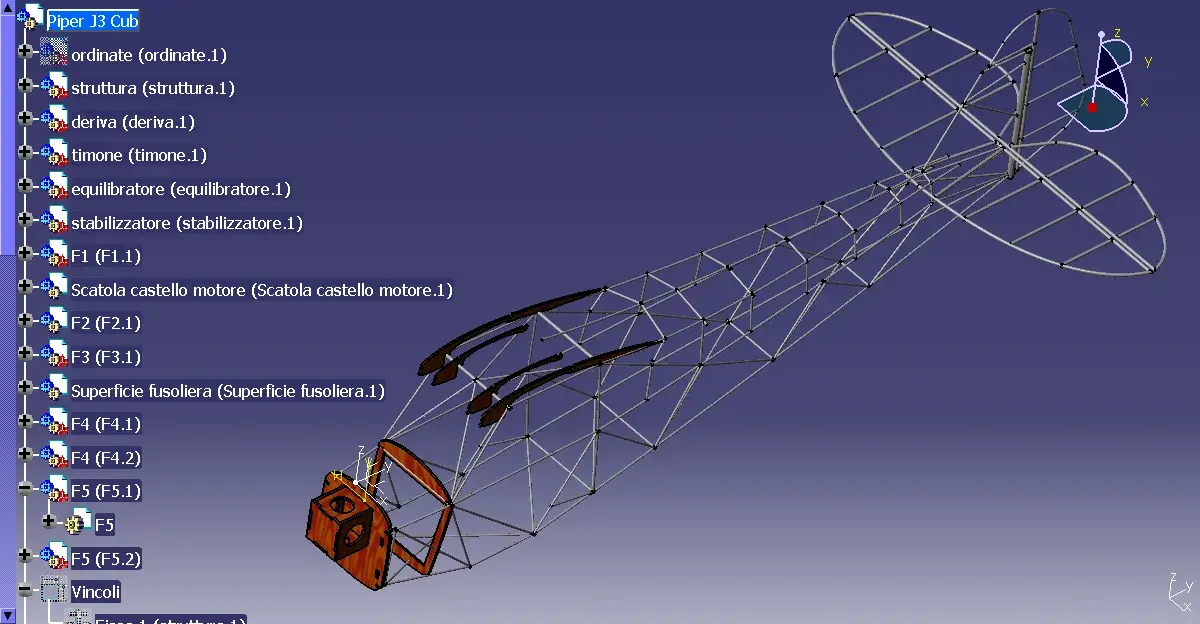
in the attached image you should notice how the ordered f3 in correspondence of what will be the future cockpit is not aligned with the transversal tube.
 

Attachments

  • F3 non allineata.webp
    F3 non allineata.webp
    96.6 KB · Views: 15
I'm sorry, can't you put her on the other side with a coincidence? and forget about the reference plans?
It seems to me that you would like to build all the parts referencing to the reference axes so that when you compose the axieme, automatically all the parts go to place. but then I ask myself: what would the constraints serve?
what would the command "existing component with positioning"?
composing a set I normally forget about the axes instead I hide them, and after fixing an element, I assemble all the others one by one.
Do I miss anything?
Mar
 
I'm sorry, can't you put her on the other side with a coincidence? and forget about the reference plans?
It seems to me that you would like to build all the parts referencing to the reference axes so that when you compose the axieme, automatically all the parts go to place. but then I ask myself: what would the constraints serve?
what would the command "existing component with positioning"?
composing a set I normally forget about the axes instead I hide them, and after fixing an element, I assemble all the others one by one.
Do I miss anything?
Mar
I don't know how to bind f3 to the circular section tube.
 
I add 4 ordered waiting for answers. :finger:
 

Attachments

  • traliccio-F1aF5-scatola castello motore.webp
    traliccio-F1aF5-scatola castello motore.webp
    79.8 KB · Views: 21
How long do you use catia? Have you done a course or self-learning?
Don't you know or can't bind?
If you email me all files I see to understand what your problem is.
Mar
 
How long do you use catia? Have you done a course or self-learning?
Don't you know or can't bind?
If you email me all files I see to understand what your problem is.
Mar
as soon as possible I will make it marcofa, thanks really for availability (and files via email). I did not do any course, I just bought a volume a month ago.
 

Attachments

  • traliccio-F1aF5-scatola-sup2.webp
    traliccio-F1aF5-scatola-sup2.webp
    74 KB · Views: 16
Then I realized everything.
you're creating non-existent problems, and they're conceptual problems of drawing approach.
the fundamental structure of catia is composed of part and product. the parts are assembled in the product, and the products so obtained can be assembled in a superior product. the parts are all designed independently and independently from the others (the need to manufacture the pieces individually designed).
the part or product inserted in a product are placed between them using the constraints: coincidence, contact, offset, angle.
in your case
ordered, structure, drift, rudder, balance, stabilizer, f1, f3, f4, f5 are part.
castle box, f2, fuselage surface are product.
all this is assembled in the top level product piper j3 through the constraints (which are not seen) contained in the logical tree constraints. always that you created them. forget the reference axes of the part.
Mar
 
Then I realized everything.
you're creating non-existent problems, and they're conceptual problems of drawing approach.
the fundamental structure of catia is composed of part and product. the parts are assembled in the product, and the products so obtained can be assembled in a superior product. the parts are all designed independently and independently from the others (the need to manufacture the pieces individually designed).
the part or product inserted in a product are placed between them using the constraints: coincidence, contact, offset, angle.
in your case
ordered, structure, drift, rudder, balance, stabilizer, f1, f3, f4, f5 are part.
castle box, f2, fuselage surface are product.
all this is assembled in the top level product piper j3 through the constraints (which are not seen) contained in the logical tree constraints. always that you created them. forget the reference axes of the part.
Mar
Marco, I thank you for this precise explanation, but, no offense, I understood the above and the constraints were created (angular, contact, coincidence, perpendicularity, parallelism,..) only that I do not know how to contact a solid quadrangular with the round surface of a circular section tube. I certainly have a world to know, but constraints are one of the first things I learned to use.

thanks always for your generous participation.
 
contact, select the two surfaces and in the window choose "inside" or "outside"
if in the tube you cannot, button dx > other selections > face
Mar
 

Forum statistics

Threads
44,997
Messages
339,767
Members
4
Latest member
ibt

Staff online

Members online

Back
Top