• This forum is the machine-generated translation of www.cad3d.it/forum1 - the Italian design community. Several terms are not translated correctly.

gd&t- localization tolerance

RAFFAELEI

Guest
Hello, good afternoon to all, I am a student of aerospace engineering taking a geometric modeling exam. I would have a doubt about gd&t, more precisely the tolerance of location,
Thank you in advance who helps me?.
My doubt concerns some table harvests in which I noticed that a localization tolerance is often expressed compared to 2 references.
to be able to locate in space a hole or a pin, I don't always need 3 floors: an orthogonal to the axis of the hole (or pin) and two more to loclase it in space? ?
how you can use a localization tolerance for a hole without using 3 reference plans.
I attach an example where the smaller hole (spine) is located only compared to a and b.
Thank you very much to those who help me.
 

Attachments

  • Immagine.webp
    Immagine.webp
    32.9 KB · Views: 141
If you have a hole that leans on a flat face to what do you need the location compared to its height?
rather in your example design:
missing the reference to,
linearity tolerance is cryptic,
the quota 10,34 is wrong because it is listed the thread bottom instead of the outside m12,
the size placed in that way are difficult to understand and out of standard
 
First of all thank you very much for the attention.
As for reference to, I forgot, and it would be the pin listed 10.344.
considering the reference to, would it be correct to quote the right hole (diameter 10), without using a third reference?
My doubt is, if it is correct to do what I just described, how do I place the hole along the vertical direction (considering the front view) ?
in figure I only gave, with quotas 43, a horizontal distance compared to the reference, but not a vertical.
Thanks again
 
the hole is placed on the face of the plate, can not be higher (in the vacuum) or lower (in the plate).
In my opinion before embarking on these arguments you must fully share the design and share it well, only after you have all the data to establish how and where to put dimensional and geometric tolerances.
to make you understand the paranoids you are doing now:
the plate (key x) from 8 the revenues from drawn or sheet therefore for that size will have the surfaces perfectly parallel
the pin at the top (y) will be welded on the plate x; you will have to give a perpendicularity between axis and x surface then put the quota between the top surface of x and the beginning of the m12 thread of y giving it a tolerance so you get the right distance of the 10 hole
the same procedure you will make for the lower pin (z)
Now based on the object function you can decide if:
put the datum to on the axis of the pin y and put a perpendicularity on x and a parallelism on z
put the datum to on x and a perpendicularity on y and one on z
 
but I by vertical direction did not intend to respect the view from above, I mean the front view (the one at the bottom), and therefore by high or low I meant anything else (a drawing allego).
I also can't understand this passage anyway: " then you will put the quota between the top surface of x and the beginning of the m12 thread of y giving it a tolerance so you get the right distance of the 10" hole. Are we quoting the right pin? how does the hole be spaced after this pin quotation operation?
 

Attachments

  • IMG_20201207_192206.webp
    IMG_20201207_192206.webp
    41 KB · Views: 109
but I by vertical direction did not intend to respect the view from above, I mean the front view (the one at the bottom), and therefore by high or low I meant anything else (a drawing allego).
2 references always serve you, in this x and y view; the third reference which should be?
you give a tolerance compared to b that is the surface on which the hole lies; how can that hole be moved by 0.1 compared to the surface?
I can't understand this passage anyway
this passage is related to the fact that I interpreted as front view the view at the top
I mean front view (the one at the bottom)
of practice dividing in dial a sheet is considered the dial at the top left front view, the dial at the top right side view, the dial at the bottom left view in the plant
 
You know, I think I understand. They're making us laugh.
One last thing, you need me to know if I understand:
it is therefore possible to locate the hole in the bottom left (referral c) with a position tolerance, using only with an exact quota than b, as I did in the attached drawing, I do not need other references to locate it, right?IM.webp
 
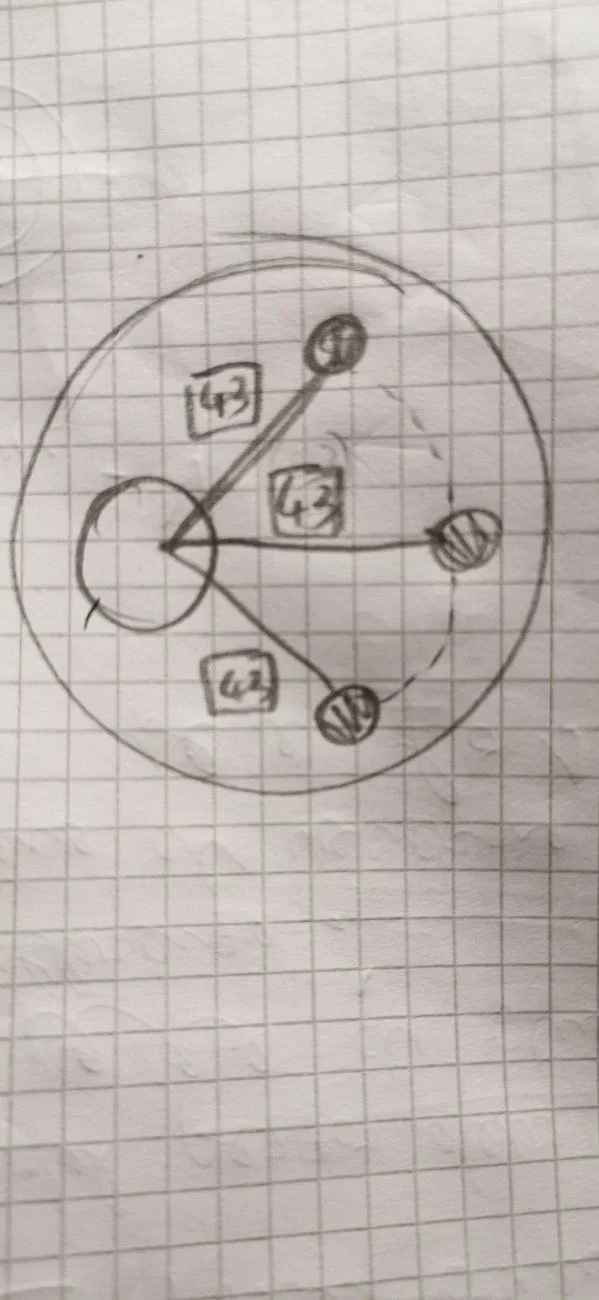
hi, if it can be of help I attach you this image that according to me clarifies the concept of localization toleranceIMG_20201207_192421.webp
 
it is therefore possible to locate the hole in the bottom left (referral c) with a position tolerance, using only with an exact quota than b, as I did in the attached drawing, I do not need other references to locate it, right?
you cannot use only one quota; need an angle or another linear quota.
Take the compass, use the hole as center, as radius 102 and draw a circle... the hole c can stand in one of the infinite points lying on that circle.

as indicated in the image attached by simon put two quotas and only position tolerance without reference
 
I agree with this speech of the compass, and it is exactly what I did and that I get to do even in case I had brought in example before.. for that I am not found.
 
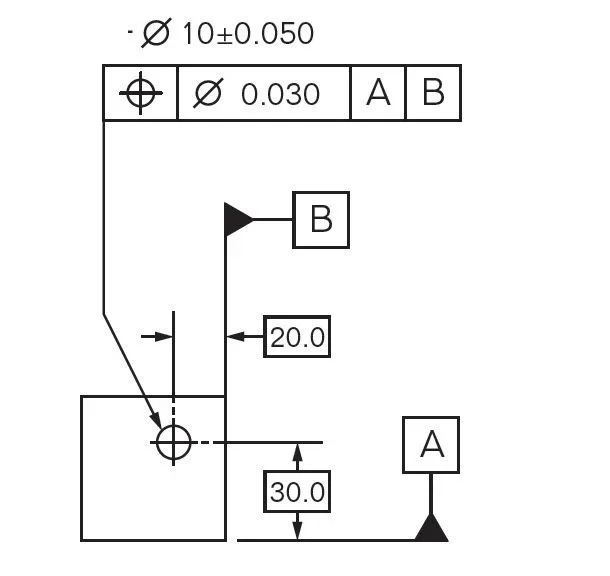
@massivonweizen : in the case of the example I mentioned we have only two datums given by the edges of the plan:02-True-Position-Drawing-Callout.jpgI've always stuck with these two datums about the edges on the floor.
I have reasoned : it is possible, in my opinion, to add a datum relative to the axis of the hole this to give absolute certainty that the hole is not oblique12-True-Position-Example-51.jpg03-True-Position-MMC-Drawing-Callout.jpgIMG_20201207_221941.jpgI think the third datum can be put to have control along the hole axis,
What do you think?

pictures with description I found here: https://www.gdandtbasics.com/gdt-symbols/
 
Last edited:
taking as reference the image you post raffaelei, I attach two similar quotation methods with regard to the quotation of concentric holes with respect, without dimensional or geometric tolerancesdisegno.webp.
 
I agree with this speech of the compass, and it is exactly what I did and that I get to do even in case I had brought in example before.. for that I am not found.
you don't find yourself because you don't fully share the particular.
a particular must be dimensionally defined, this means that each component from which it is composed must have all the dimensions in order to be produced to itself and possibly in relation to the surrounding components.
your post #12 design can be corrected if the only value to be respected is 43; however it is not real because by turning the hole position you get different details.
if pin and hole must be in line with the lower pin must be specified; if the pin and hole have to be in line between them but it is not important that they are with the lower pin should be specified.
you could put a linearity tolerance or flatness between pin and hole, but it would be a condition always satisfied in the example #12.
Do you understand where I'm going? you're decorating home when walls are still missing
 
I have reasoned : it is possible, in my opinion, to add a datum relative to the axis of the hole this to give absolute certainty that the hole is not oblique
Yes, it could be. I would prefer to put a datum on the surface and a tolerance of perpendicularity on the axis
I attach two similar quotation methods with regard to the quotation of concentric holes
That's what I meant in the previous post.
was defined the position of the pin (15) and on this side the position of the hole (43). Only at this point can geometric tolerances be placed.
if, hypothesize, you put a +/-0.05 tolerance on the linear quota 15 and then a localization tolerance on the hole and both are on the center axis of the flange you have defined completely the
 
wanting, as a style exercise, do it only with references and without quotas put a datum (d) on the connecting axis, which corresponds to the center of the flange, between pin and hole.
so with reference to define the horizontal and vertical position
 
@since 1996 basically it is good; to evaluate it better one should hypothesize a purpose.
2 small notes:
having put general bevels 0.5x45° the one present in the top view is redundant
general roughness 2.3 requires the closing line of the triangle
 

Forum statistics

Threads
44,997
Messages
339,767
Members
4
Latest member
ibt

Members online

No members online now.
Back
Top