• This forum is the machine-generated translation of www.cad3d.it/forum1 - the Italian design community. Several terms are not translated correctly.

i'll weigh

  • Thread starter Thread starter Jeffcott
  • Start date Start date
Forgive me the question, perhaps surprised. for the development of the cloth I limit myself to the sum of the diameter of a roller for the double of the [D(rullo)+Interasse x2] ?
how do you take into account the fact that the tape will be tense?
depends on the material and its thickness. This is a typical question to ask the supplier. ask that "elastic stretch" and that preload should work that tape (but on a minimum length as your variation will be irresistible). theoretically consider it "rigid", so the development will be fixed at the right tension to have the 2 branches "in floor" (on long and heavy tapes in the return branch there will always be a "spring" to support with crazy rollers, but it is not your case).
I usually use polyurethane (always with support base "in canvas") and calculate the average development (eye to the thickness, the outer diameters of the rollers are increased by half of this) with all the logs and mobile axes placed halfway, rounding then by defect. the race/position of the registers also depends on how you planned the assembly/disassembly of the carpet (if closed ring "saved").

I repeat, for safety I would show a wrapping scheme to the carpet supplier.. then made the first experience is acquired automatically.

greetings
Marco:smile:
 
thanks marco, but what do you mean when you say "...and calculate the average development (eye to the thickness, the outer diameters of the rollers are increased by half of this) with all the logs and mobile axes placed halfway, rounding then by defect..."? ?
 
I for the development of the tape take the inner one therefore 2* interchange+circumference roller. registers are always in half and rolled to 5 mm.
 
thanks marco, but what do you mean when you say "...and calculate the average development (eye to the thickness, the outer diameters of the rollers are increased by half of this) with all the logs and mobile axes placed halfway, rounding then by defect..."? ?
the "average development", that is half the thickness of the carpet; the diameters of the rollers consider them greater than the thickness to calculate the circumferences. I make all the sums and rolled by defect to the lower 5mm.
all this if and when I happen to do it "handed", otherwise normally the program immediately returns the developments automatically, I do only the final rounding for the order to the supplier.

but I repeat that for that tape so short (and I imagine very thin) you will not have appreciable length differences between external, internal and medium development; all stuff that you will easily recover with the registers.

greetings
Mar
 
..if you use autocad you can track the path of the tape as a polyline and the "your program" (:smile:) calculates the development/perimeter.

greetings
Marco:smile:
 
Forgive me for the unwilled absence :smile: obviously the tape goes for the best, has not yet been applied on the weigher but elsewhere, at least for the moment. As soon as I have time to upload the video. See you soon!
 
Hello, everyone! I take advantage of this discussion to ask for your help again. Who would give me directions on the design of pen ribbons? would you tell me about the guidelines to follow or at least some sites to be taken as a reference to study these types of tapes? I await your news and I thank you in advance.
 
Hello, everyone! I take advantage of this discussion to ask for your help again. Who would give me directions on the design of pen ribbons? would you tell me about the guidelines to follow or at least some sites to be taken as a reference to study these types of tapes? I await your news and I thank you in advance.
Hi, jeff.
I will tell you that on the basis there are no big differences with the "normal" tapes, except in the points of entry/exit where you have very little winding rays. important here is the choice of the carpet that must be of material and thickness suitable to withstand practically a "piega" (consulta always with the manufacturer/supplier).
the types of tapes I make are almost always so for the "minuteries" that I must carry and I never had any particular problems. arrival to make "rullini" from 6 mm in diameter.
pens can be fixed (smaller) or rotating. the first obtained from the edge of a perfectly rounded plate or a rounded rounded (and/or pointed) always against a plate. here the surface finishes must be excellent to minimize friction and stress for the carpet and the material/surfaces of high hardness to counter premature wear (the long-term fixed feathers are consumed forming steps to the sides).
above 10 mm you can use roller shells or small rollers specially built, short with many supports. then much depends on the width and load to which it will be subject, in that area the efforts are remarkable.
even more attention to alignment/center systems.
for the rest nothing you do a normal tape with "small rollers" at the ends. if you can minimize the winding on the feathers (reviving the carpet as soon as possible, just over 90°); I also do that they return to 180° for special requirements like tapes that "open" moving forward and backward, but with crazy rollers from 15mm up.
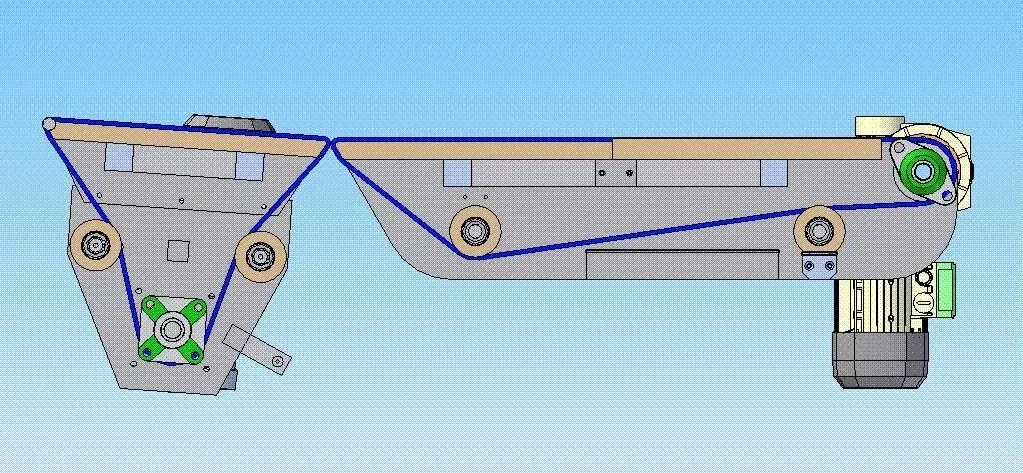
put an example and a pair of "regolettes" (research on the net that something you find):PENNE NASTRI.webp
PENNE NASTRI 01.webpIf I can and I have time I insert a strip pattern to openable/translating pens.

greetings
Mar
 

Forum statistics

Threads
44,997
Messages
339,767
Members
4
Latest member
ibt

Members online

No members online now.
Back
Top