• This forum is the machine-generated translation of www.cad3d.it/forum1 - the Italian design community. Several terms are not translated correctly.

irregular cruise vault with autocad

  • Thread starter Thread starter Cloe85
  • Start date Start date
doking I tried to copy everything in a new file, but it doesn't work that way. the joint command works only in 2 cases out of 4 (i.e. to join only for two nails the diagonal sides). Maybe on the new file it works because you tried exactly to join the segments that don't bother..? :eek:
 
of course I created a copy of the arches, in a first I joined the arches to create the x arches and in the second I joined to create the y arches
It seems obvious that if you join the 4 arches you will only get the necessary for the loft of two arches,
 
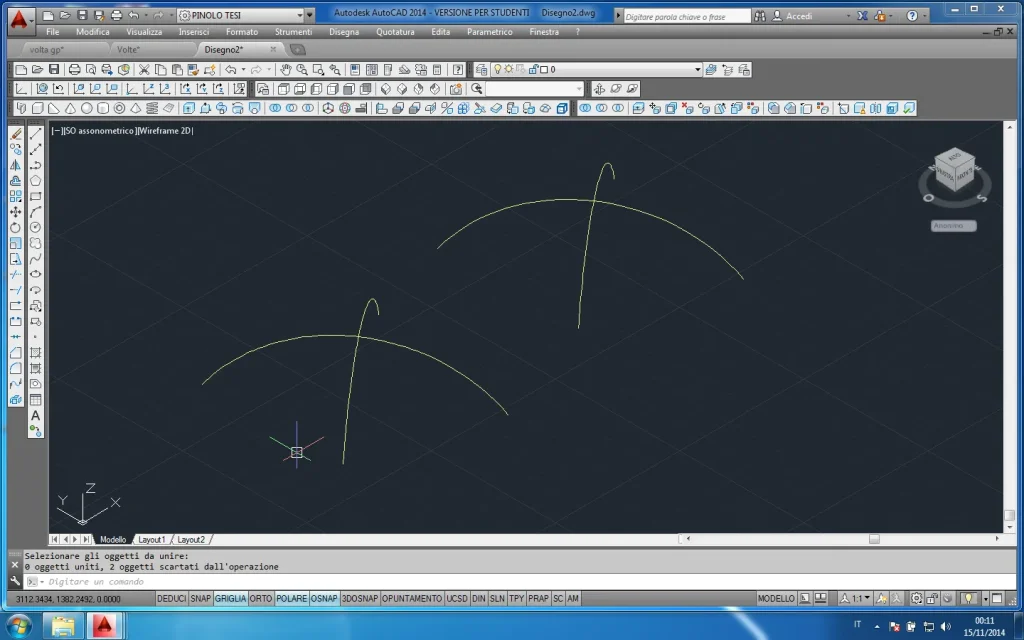
doking did not explain me well; I worked on two copies, not on one, but in one direction the command doesn't work. When I try to combine the splines on one direction, the program tells me "0 joint objects, 2 objects discarded by the operation". I also searched on the internet but most of the forums explain that it depends on the fact that the terminal points of the two segments that you want to join do not coincide. I set accuracy to 6 decimals and x,y,z coordinates of extreme points coincide!

spline that are not joinedSchermata 2014-11-15 alle 00.11.45.webpSchermata 2014-11-15 alle 00.11.52.webpspline that are joinedSchermata 2014-11-15 alle 00.12.04.webpSchermata 2014-11-15 alle 00.12.34.webp
 
Have you tried to join them so you could reform the bow, you're 90-degreed and break them again?
 
Doking thanks, so it worked! :finger:
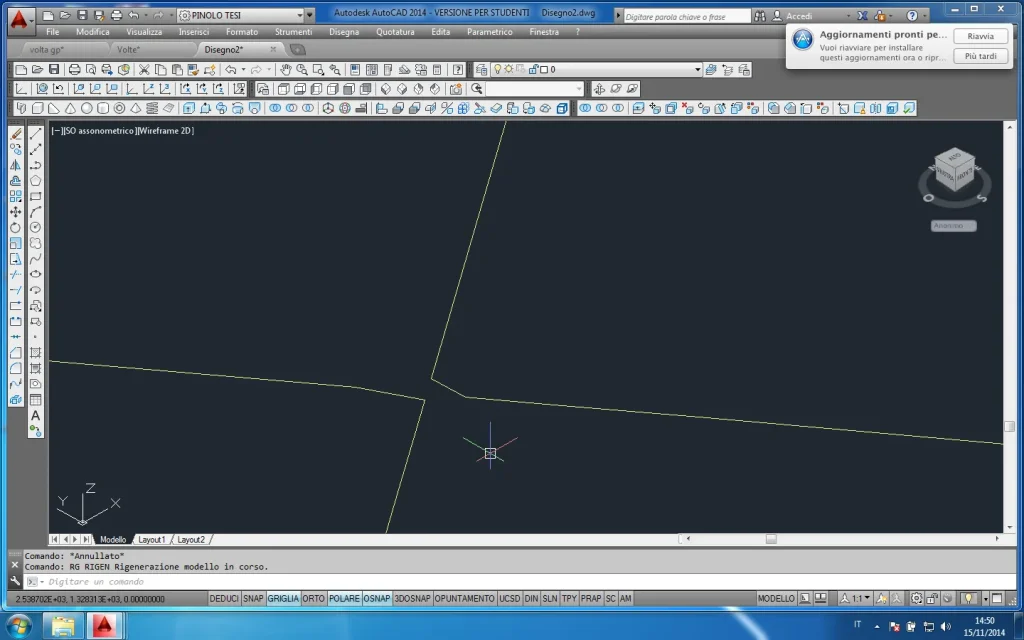
but is it normal that by zooming on the point of intersection of the diagonals once the splines are united they appear to me like this? Does it happen to you?
(I made it regenerate before printing the screen). Schermata 2014-11-15 alle 14.50.16.webpI still try to move on with the steps and look what's running out of it!
 
I went on and until the union of the nails in a single surface all ok. when I try to use the command thickens but this gives me the message "impossible to thicken 1 surface with the specified value. the object is self-intersecting." with thicknesses lower than those I need instead it works (I tried with 5 cm and the operation goes to good end, but already with 20 it does not work anymore); same with offsetsup.

despair.

:36_1_4::36_1_4::36_1_4::36_1_4:
 
I went on and until the union of the nails in a single surface all ok. when I try to use the command thickens but this gives me the message "impossible to thicken 1 surface with the specified value. the object is self-intersecting." with thicknesses lower than those I need instead it works (I tried with 5 cm and the operation goes to good end, but already with 20 it does not work anymore); same with offsetsup.

despair.

:36_1_4::36_1_4::36_1_4::36_1_4:
idem
gp. dove sei finitoooooooo hehehe
 
I didn't see you answering and I was ready to change thesis. :tongue:
I have been thinking about this problem for weeks, I put all my hopes on you! :36_1_1:
(I nevertheless know how to think about it, if there should be evolutions there should be)
 
you have tried to make an offset of the lines of the arches considering the measure that you need the finished solid, repeat all the operations so as to have a lower and upper surface that form the upper and lower face of the solid that you will get, create side surfaces that intersect with the sup and inf surfaces and then sculpt, you should get a solid at the end.... .
 
doking might be a good idea! I remember that I had tried to use the scolpiscisuperf command in one of my attempts and I had found something wrong, but having used a different procedure for the creation of surfaces can be that things change. I try.
 
in my first tests I used a relatively low height, for the diagonal it was possible to use also a bow, while with the height I saw in the dwg you post this is not good, it is more correct to use a spline.

the problem is that those derived from the loft on opposite arches are too different, as you notice from the image below:
519.webpI tried to write something to calculate the interpolating spline between the two to optimize the error and divide it between the two directions, so, little by little, I pushed more into the...
520.gifto keep in mind:

- display style must to be "wireframe2d"- the height non must be higher than half of the shorter side
- la base must to be irregular- the solid operation is very resourceful, could take some time.
- the latter could create some tiny squid at the central part of the ecstasy, unfortunately "experience" is used on the individual nails and then joined, because on the total surface autocad almost always gets angry
- the intradox is still correct
- you can only create surfaces, combine them to form a single one and try if you thicken or offsetsuperf works
- non It is said, however, that it always works... :tongue:
 

Attachments

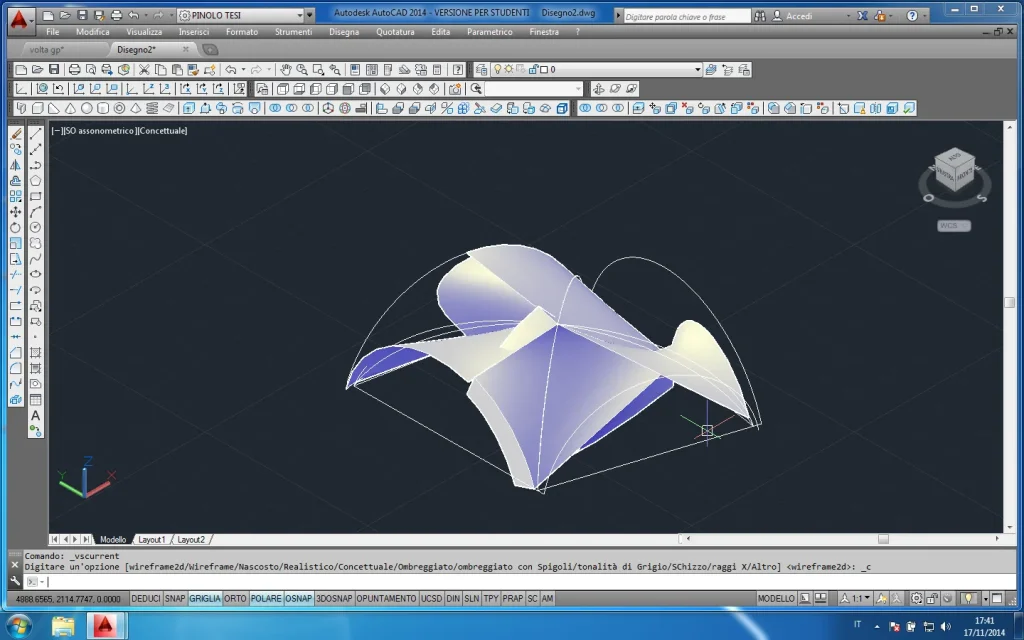
No vague. Thank you. I am feeling a total incompetent compared to you gp.! Maybe even because I tried to use the file and I ran out this...? (wireframe 2d mode and the rest is all verified)Schermata 2014-11-17 alle 17.41.09.webpI don't know how to thank you anyway. . .
 
...I run out of this...
...that is the way to build the times...:tongue::wink:

It's not about incompetence, the lisp works or doesn't work, the problem is that I don't know where to put my hands because a figure like that doesn't come out.
Have you tried the option for the single surface (without the hairstyle on the base)?

edit: Can you attach that dwg of the image (including what came out of it)?
 
you have tried to make an offset of the lines of the arches considering the measure that you need the finished solid, repeat all the operations so as to have a lower and upper surface that form the upper and lower face of the solid that you will get, create side surfaces that intersect with the sup and inf surfaces and then sculpt, you should get a solid at the end.... .
I am also trying so and for the side arches everything ok...the problem is that if I make offset of the two diagonal arches then they don't cross me anymore. I could try to do from the point of intersection of the diagonals in the plant a height of 140 cm (instead of 110, for all the side arches I made an offset of 30 cm) but I do not know where to go to finish to the sides my side arc. I don't know if it's because I'm getting stuck on this stuff, maybe I'm asking for something stupid. :rolleyes:Schermata 2014-11-17 alle 18.18.54.webpgreen= projection of time in plant
yellow= side arches to the intradox
red= side arches to the extremity (offset 30 cm)
white= diagonal arches to the intradox
 
...that is the way to build the times...:tongue::wink:

It's not about incompetence, the lisp works or doesn't work, the problem is that I don't know where to put my hands because a figure like that doesn't come out.
Have you tried the option for the single surface (without the hairstyle on the base)?

edit: Can you attach that dwg of the image (including what came out of it)?
incompetent compared to you producing lisp and processing solutions View attachment prova volte con lisp.dwgView attachment pianta con volte.dwgwith the same speed with which I cook a pasta dish.. :tongue:
I send you the file, I had tried with the surface but I got weird work out with that too.
can it depend on the fact that I have the lt version or possibly the fact that I am using windows on parallels? (I am ready to receive offenses... :cool:)
I also attach the plant of the environment, in which there are not 1, but 7 times to model. between once and the other there are arches and all must constitute a unique volume between itself and with perimeter walls. I'm just working it out, I think they asked me something not very feasible with autocad. appearance opinions.
 
the lt version does not have 3d modeling and cannot use the lisp, you are using the full version.

I tried the lisp on the dwg you posted, in some cases I had to indicate the thickness -30, I can not understand the logic for which sometimes the normal of the surfaces is reversed compared to the others, however it worked.
521.webpthe turn on the lower left has more accentuated angles than the others, I had to increase a bit the distance of the arc from the base line.
if you feel to try replace 10 with 15 in these lines of code:
Code:
(defun arco (#1 #2 #4 #3 / p5 p6 p7 p8 )
(setq p5 (polar #1 (angle #4 #1) [COLOR="#FF0000"][B]15[/B][/COLOR]))
(setq p6 (polar #2 (angle #3 #2) [COLOR="#FF0000"][B]15[/B][/COLOR]))
(setq p7 (mid p5 p6))
(setq p8 (list (car p7) (cadr p7) (+ (caddr p7) h)))))
(vl-cmdf "_ucs" p5 (list (- (car p6) (car p5)) (- (cadr p6) (cadr p5)))
(vl-cmdf "_arc" (trans p5 0 1) (trans p8 0 1)
(vl-cmdf "_ucs"")
(entlast)
)
if you want to create only surfaces do not set the hairstyle on the base line, otherwise thicken and offsetsuperf do not work well (already said).

I attach the dwg with times.
 

Attachments

the lt version does not have 3d modeling and cannot use the lisp, you are using the full version.

You're right, I didn't mean lt, I meant the licensed version for students.

I downloaded the file, it seems good! I try to see what happens when I expose the times on the seismic analysis program with the point at the crossroads of the diagonals on the extremity, I'll let you know!

Thank you very much.
 
look if a result like that can be useful.
the procedure, which comes from the cad used, is however long and repetitive.


View attachment 38817
I checked the file you have attached and unfortunately also with your you create problems in creating the mesh on the seismic analysis program (if you check the intradox, on the sides of the diagonals, the surfaces do not match).
same problem with the times created with the lisp. with those the program fails to create the mesh to the extremity, in the points of intersection of the diagonal arches.
At this point I believe that the best solution is really the one that suggested doking, that is:
-creation surface of the intradox
-creation of the surface of the extremity
-beam between the two surfaces and the side floors

in this way I think I can not get a constant thickness of the time, but if the discrepancy is a few cm prof. said it can go.

In essence what I understand is that it is better to have some small irregularities in the measures (not perfectly regular thickness of the time) rather than imperfections in the intersection between the surfaces. .
do you have any idea how to proceed to define the upper surface by the method I said above so that these imperfections do not occur? I have problems identifying diagonal arches as I wrote a few posts ago... :frown:

thanks to all the boys for the time you dedicate me, I will send you in the annex the dedication of the thesis that I will do if I can graduate.. . :redface:
 

Forum statistics

Threads
44,997
Messages
339,767
Members
4
Latest member
ibt

Members online

No members online now.
Back
Top