• This forum is the machine-generated translation of www.cad3d.it/forum1 - the Italian design community. Several terms are not translated correctly.

project reducer

  • Thread starter Thread starter picc
  • Start date Start date

picc

Guest
Hello everyone! I am a mechanical engineering student and we were given the task of designing a parallel axle reducer to two speed jumps. the data that I have been given are:
number of incoming turns: 900 rpm
Rated transmission ratio: 16
input power: 1700 w
fe: 315 n( the engine that feeds the reducer is connected via a pulley system, but for simplicity we were told that on the input shaft acts this force with a certain angle).

the pattern of the reducer is the one indicated in the annex. in tree 1 enters the pair, from tree 3 comes out.
First of all, the professor suggested that we focus on dimensionaling (at first attempt) the wheels with helical teeth. we assumed that the nominal transmission ratio was divided as:
i1-2=5
i3-4=3.2
from the relationship of lewis, inserting the torque c1 on the pinion, the coefficient of lewis y (referred from the number of virtual teeth equal to 17) 3.31, supposed angle of the propeller equal to 20 degrees, dic equal to 17, z1 equal to 15 (minimum number without interference, and admissible sigma equal to 286,66 mpa (having chosen a cemented 16mncr5 steel with a tooth foot resistance of 860 mpa); we got a module value of 1.15.
from this value we have therefore selected a value of the recommended table module of 1,25, and from the reverse formula of lewis we have again determined the number of teeth z1. we did the same procedure for the pinion 3. Note the numbers of teeth z1 and z3 we evaluated from the transmission ratio the number of teeth of the wheels conducted z2 and z4. Finally knowing the 2 modules of the two pairs of toothed wheels, we evaluated the primitive diameters to verify the dimensions that we must respect.
I would like to have some advice on the procedure adopted and on the choices as dic and the material, if they are correct. I also think that the chosen data is not good because as a result I got:


logically impossible to not have interference!
thank you so much for the attention and apologize for the length!
 

Attachments

  • WhatsApp Image 2019-03-22 at 13.01.14.webp
    WhatsApp Image 2019-03-22 at 13.01.14.webp
    122.1 KB · Views: 134
from the annex I did not understand how exactly things are because they schematize in a very different way the axes and gears.
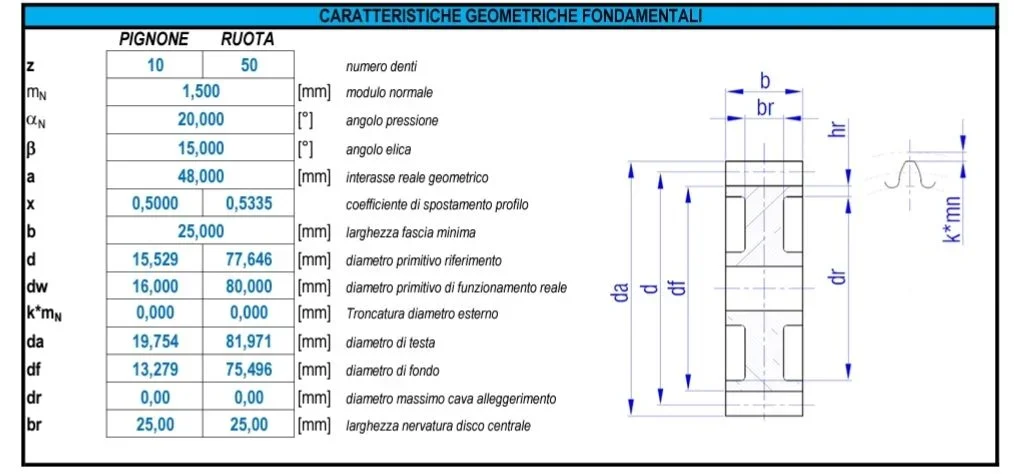
other important thing to say is that there is the x factor that is the profile shift coefficient. As you use helical teeth you need to use the appropriate formulas and you will see that with so low teeth number (10-11....) you will need to make a profile shift almost x=+0,5.
other thing is that with pure lewis you can make a very sizing at spans. then you are obliged to make verification secretobdoe norms in force, iso6336 rather than agma or other.
regarding the width range and module ratio you can get to 20 quietly. if you go further you have to have more precision assembly.

that you have to respect to be compact?
 
making accounts a little fast with iso6336 we can have the first stage with:

z2=60
normal module m=1
reduction ratio i=5
beta helical angle =20°
band b=20mm
profile shift coefficients x1=+0,3 and x2=+0,428
interasse a=39mm
oil iso vg 220
duration 5000 hours
material of both 18crnimo7 cement and hardened gears
safety factor on bending sf=1,2 and 2.3
safety factor on pitting sh=1,01 for both gears

so as you see is the way of knowingly calculating that makes the difference.
I recommend niemann - elements of machine volume 2 so you can put yourself there to think about something more realistic than the usual poor things that teach in lesson.

just to remember it: then in the world of work....you can not miss and use formulas from the very first approximation and make her go well... .
 
I can't give you a more detailed scheme right now, but as soon as I get home, I'll get it. the professor at lesson introduced us the correction factor, but he said that for now it was better to let him stand, as not even in theoretical lessons explained this correction factor. logically the calculations made now are preliminary as explained also in lesson, as later it will be necessary to carry out a pitting and bending verification of the dentate wheels, and a fatigue verification of the tree on which the dentate wheels are cast, and the axial forces agents on this also depend on the angle of the propeller for example. sincerely I would like to maintain the approach explained by the professor, although I imagine that in reality they work well differently.
However, the gears must be in a 194 mm height and 140 mm width, considering a little distance from the wall of the cards (although the size of the carter is not foreseen in the project)
 
then if you are almost obliged to stand on the bases of adamo and eva, I suggest you look at the forum where we talked about lewis so that you can see what coefficients hold on the break and how you can proceed.
If you use as a model a reducer by trade you will surely enter into choices not quite basic, since the products are industrialized, but you can try to approach you.
 
ah still mechanical I have another doubt. what is the difference between the resistance to the tooth of the foot and the resistance to yielding, and what value should I use in the calculation of the module with lewis? Moreover the value that gives me this relationship is the normal form, isn't it?
 
the reference load is the traction break limit and the module is the normal one.
normally the used load is rm/6.
 
on the forum you will find an excel sheet for simplified lewis, formulas, my specific torque curves for first sizing with lewis and with hertz.
find other gearboxes, explanations and things not to do.
find insights for dispensers or books or manuals for gears, even for free.
discussions on the rules for the verification of gears.
Just look good.

the resistance to the foot of the tooth is the ability to resist the bending tooth under load, being assimilated to a framed beam loaded at the tip. the yield limit is lower.
 
I had a moment of time and prepared what I'm practicing.
the scheme of cinematism, using the model 63b which is the two stages with power / spins similar to yours is the one below:IMG_20190323_130745.webpand as you can see, with a minimum of trigonometry I calculated the working interaxis of the two stages.

therefore I have tried to search for 42c. characteristics when you harden the side and not the tooth base with hardness 57 pc. you get a sigma of lewis equal to 380pa that means a tensile breaking load rm di 2280mpa.

then you go to the pure sizing with lewis' which is worth like any other method (even randomly).

for the first couple determines the module and the band:IMG_20190323_155446.webpwhile for the second couple:IMG_20190323_155603.webpand let's say that more or less you can stay in interaxes.

it then passes to the verification according to one of the rules in force, for example iso 6336.
for the first couple you have:IMG_20190323_201304.webpwith its verification according to:IMG_20190323_201319.webpthe second couple will have:IMG_20190323_201512.webpwith verification according to:IMG_20190323_201523.webpas you can notice, the profile correction to avoid the undercut of the pinions and to reach the intersection becomes necessary, how to work on the angle of the propeller.

As you can see, the catalog provides a security factor about double, so it means that it uses larger bands of gears and maybe uses 18crnimo7 cemented and fully hardened.

you could use the book shigley's mechanical engineering design that treats the agma norm that is basic and quite well explained formulas and steps. . You always take the metric norm and not imperial.

another thing you could do to not find yourself with push corrections would be to divide the reduction ratios more balancedly, perhaps both i=4. Keep in mind that the second stage has a larger interasse to bring more torque than the first one that is tighter, so use it.
 
mechanics thank you so much! for now I preferred to leave the calculations as I told you, i.e. without correction factor x as still subject not treated in lesson. as soon as we have studied this subject I will not hesitate to review the calculations made! I will try to take a look at the shigley on which I also studied at the three-year term. Thanks again.
 
Hello mechanics. I am proceeding with the project of the reducer, after statically dimensional bending the dentate wheels, we have been told to verify them with flexional fatigue using the iso norm. I would have some doubt about the coefficients to be used to calculate both the flexional fatigue resistance limit and the value of the agent voltage:
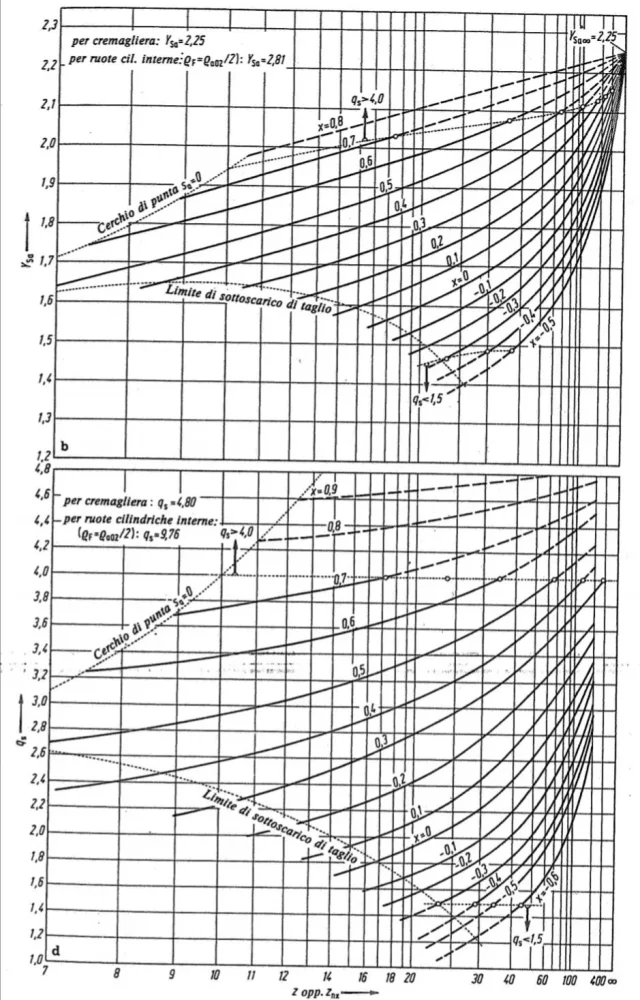
1) the value of the coefficient relative to the sensitivity of carving as is calculated? because not knowing the value of the connection to the tooth foot it is impossible to enter the diagram.
2)where to provide a power of 1700 w, and having on wheel 1 a pair of 18 nm and a tangential force that transmits the motion of 2404 n, the choice of a cemented steel with σlim=a*x+b equal to 500mpa (a=0 b=500 mpa) is consistent?
3)in the calculation of kv, the coefficient k2 and k1 should be taken for "helical gears" or " spurs gears"? Moreover, a processing quality of 8 is sufficient?
4)the sfmin coefficient (minimum safety factor for tooth breakage) for σfp calculation is likely to take it equal to 1.
5) surface roughness of 3.2 μm is a consistent value?
 
Let's get back to you.
I had already dealt with the subject in another post as regards materials and how ax+b is calculated.
If you choose a concrete steel in a cassette you must use the table relative to it and choose a plausible value. if you are looking for there are already from me indicated the values for the 42crmo4 from surface hardening with 370mpa of permissible flexional voltage and the 18crnimo7 with 460mpa of flexional voltage permissible from cementation and tempra (values for materials with casting certificate and chemical analysis). higher values are difficult to achieve. It is also true that on smaller sizes improves surface hardness.
a roughness of 3,2micron is acceptable and also a quality of 8 I would say that for small gears it can stay.
if your gears are straight teeth will be "spurs gear". If you have beta different from zero are helical.
regarding the minimum security factor I can tell you that it was discussed on the forum and posted a document Cassoft where it explains that using 1.4 on the bending is precautionary but it is not true that it must be by force so because only the field of application can give the real results. personally with the iso6336 use it for bending that for wear factor 1 to have the calculation to life ended with 5000 hours... that to me suffice and advance.
if you use standard reference teeth you will have the background radius of about 0.25 or 0.38 multiplied the normal module.
do not mix Standard.
 
Last edited:
just because someone before us did the curves, I train you yfa which is the factor of form, ysa that is correction tensions, the head factor yfs that is the product of the first two and finally the qs that is the cutting parameter all with background radius 0.25•mn... so compare with what you calculated.IMG_20190402_201810.webpIMG_20190402_201837.webp
 
Hello, everyone! I finished dimensionalizing the toothed wheels and for now it seems to be respected and tonight if I have time loading the excel file with the results obtained. I am now proceeding to the sizing of the intermediate shaft but I have a problem: how do I decide in advance the position of the cart and that of the hinge to proceed to the calculation of the reactions?
 
Since the gear bands you know, you have to assume a little more distant than the proportioned bearings. Then check the bearings and review the final measurements.
It is also true that you put everything in excel you do everything in flight at all times.
 
Since the gear bands you know, you have to assume a little more distant than the proportioned bearings. Then check the bearings and review the final measurements.
It is also true that you put everything in excel you do everything in flight at all times.
ninth, for that already I had in mind to do so, that is it is necessary to proceed in this way not knowing what type of bearings will be mounted. the problem is how to determine if the nearest bearing to the wheel 2 is schematisable as a cart or as a zipper, as depending on this choice varies the diagram of normal effort. or is it indifferent which of the two bearings is hinge or trolley?
 
ah ok, your problem is not "where" but "why".
normally and especially the shaft or in your intermediate case must have the following shortcomings:
- on the same tree the wind direction of the two wheels must be equal in order to have the subtraction of the axial forces and to have a minimal result
- if you don't have trees, it changes very little to put the hinge on the right or on the left, so you put it randomly and then I will verify that statically and fatigue does not yield the tree

If the shaft was overwhelmed and the gear out of the two supports, it would be better to have the hinge near the gear so the rest can stretch without carrying axial loads.
 
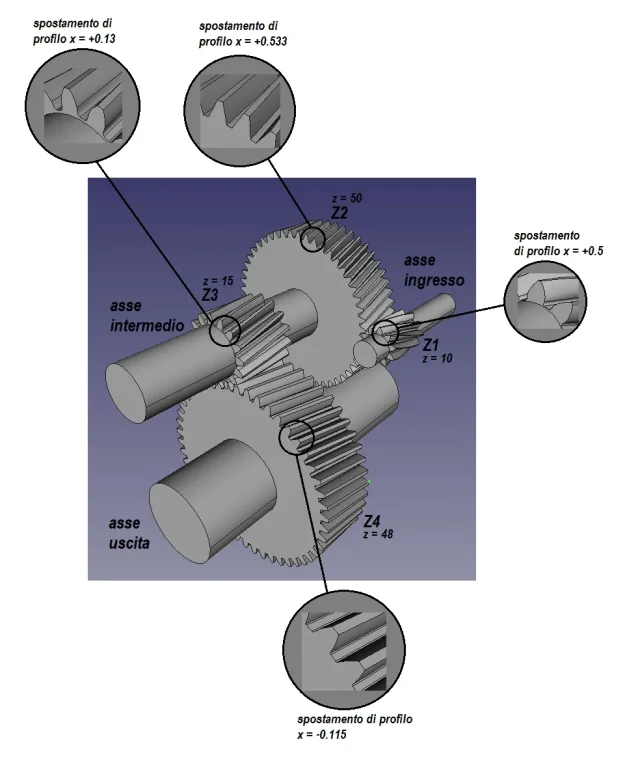
according to the above indicated, with the design values, profile shifts and what else, you get a configuration of gears like this below reported.TRAMEC_MMG.webpAs you can see, the gears with a few teeth need a "maggioration" of the tooth base that you get with positive profile shift. this thing decreases with high teeth. despite everything, a little undercut is visible and present, especially if you use a toothbrush with background radius 0.25 times the module. if you use a 0.38 times the module, you have a larger background radius and therefore an insensitivity to the lower inlet.

If you want to work on it, I'll attach the zipped step of the gears. all was made with freecad version 0.18 developer.
 

Attachments

Last edited:
As for the ratio between width b and module m we have the following.

custom for common b/m applications ranges from 10 to 15.

otherwise assumes the following values:
- between 6 and 10 if molten teeth and non rigid supports
- between 5 and 15 if hardened but not rectified teeth
- between 10 and 20 if rectified teeth and rigid bearings
- between 20 and 40 precision teeth with less than 3000 rpm rotation
- between 40 and 80 sample teeth, high precision and narrow tolerances, rigid supports and rotation less than 3000 rpm

It is very simple to understand that in order to have large gear bands it is necessary that the shaft and bearings are robust and rigid in order to avoid the toothing work of edge, leading to premature damage of the tooth flank with break then to the base and loss of fragments that fall into the gear by splitting everything.
 

Forum statistics

Threads
44,997
Messages
339,767
Members
4
Latest member
ibt

Members online

No members online now.
ciao
Back
Top