• This forum is the machine-generated translation of www.cad3d.it/forum1 - the Italian design community. Several terms are not translated correctly.

resolution goniometric equations

  • Thread starter Thread starter Luigi_72
  • Start date Start date
I do not agree, if n=0 means that buckling is there regardless. what is sought is precisely the critical value of n, what generates buckling. If it were zero it would mean that any applied load would generate buckling. in fact the comparison load comes from the reduced critical load of opportuni coefficients. if the actual load is < of the comparison load, there is no buckling.
 
Okay. I didn't know. However, it seems strange that a beam goes into “impointment” for any load... But I don't take care of these things. I wanted to give a hand on a mathematical level, not conceptual?
 
Hi.

you then set the cell corresponding to n as a target? and the equation with tangents like tracing it? There is something that I miss
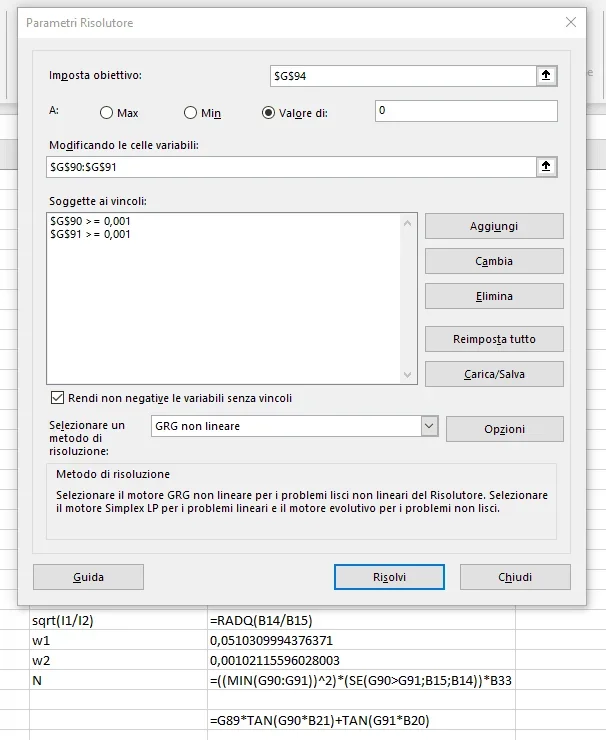
Of course, I was wrong to answer, in the n cell I put the equation, for this I put that cell as a goal, while the wi cells pongo as variables after entering the respective formulas.
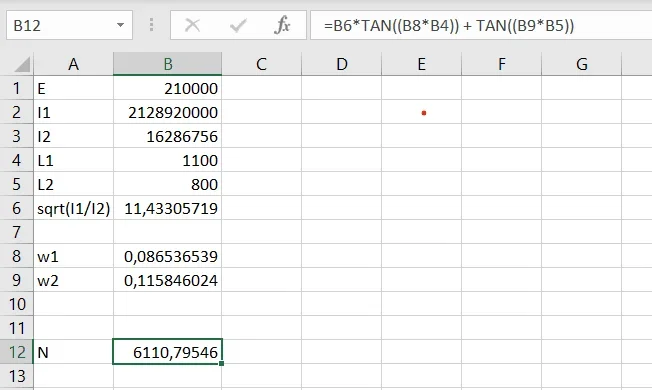
1599742352883.webpI noticed that the i1/i2 root gives a different result (maybe I was wrong? ! )
so you should understand what I did.

I don't know if it's actually right, maybe you could help me figure it out.
The last question I have also concerns the formula, i.e. if the tangent argument is actually already in radiants or not, because if it is not after the command it would serve conversion.
 
Okay. I didn't know. However, it seems strange that a beam goes into “impointment” for any load... But I don't take care of these things. I wanted to give a hand on a mathematical level, not conceptual?
we would miss, then there is the formula that allows the calculation of the reduction coefficient that even provides nk to the denominator. in any case the rules are made to complicate life to the designer. . .
 
Of course, I was wrong to answer, in the n cell I put the equation, for this I put that cell as a goal, while the wi cells pongo as variables after entering the respective formulas.
View attachment 59282I noticed that the i1/i2 root gives a different result (maybe I was wrong? ! )
so you should understand what I did.

I don't know if it's actually right, maybe you could help me figure it out.
The last question I have also concerns the formula, i.e. if the tangent argument is actually already in radiants or not, because if it is not after the command it would serve conversion.
in the n cell you put what equation? the topic of tangent is in radiants for excel
 
What are you saying? must not be converted into radiants ... are already radiant by dimensional analysis! ! !

w = sqrt(n/ei) has by size [1/metri]the argument of the tangent is w*l -> meters/meters —> adimensional .. in mathematical analysis the radiants are adimensional .. not the degrees! if you add conversion from degrees to radiant you make a mistake
 
tant is that the relationship between circumference [m] of the circle and its diameter [m] fa pi_greco [rad]
 
What are you saying? must not be converted into radiants ... are already radiant by dimensional analysis! ! !

w = sqrt(n/ei) has by size [1/metri]the argument of the tangent is w*l -> meters/meters —> adimensional .. in mathematical analysis the radiants are adimensional .. not the degrees! if you add conversion from degrees to radiant you make a mistake
I thought about it after without having the formula under my eye. but in the excell I did not write tan(radiants(...)), so it could be right. However thanks for the observation.
 
the equation that indicates the norm, which in this case should be written as tan(radiants(...)) by expressing that term in radiants
p

the constraints on variables? Obviously they cannot be negative for how they are defined.

the objective for the equation is that you cancel, right?
 
What are you saying? must not be converted into radiants ... are already radiant by dimensional analysis! ! !

w = sqrt(n/ei) has by size [1/metri]the argument of the tangent is w*l -> meters/meters —> adimensional .. in mathematical analysis the radiants are adimensional .. not the degrees! if you add conversion from degrees to radiant you make a mistake
no conversion for charity. It is the method of resolution that makes me doubtful.
 
the goal is to find n for you to cancel. I didn't place any bonds.
Hi.

I don't get there is my limit. I change w1 and w2 by imposing the bond that are >0.001. find these embroidery n from the minor of 2. instead changing n instead the only solution found is zero and it is impossible. Could you please show me the formulas you use?

ps. the values I use are different but the equation is equal.

Thank you! !
 

Attachments

  • Immagine 2020-09-13 180216.webp
    Immagine 2020-09-13 180216.webp
    35 KB · Views: 9

Forum statistics

Threads
44,997
Messages
339,767
Members
4
Latest member
ibt

Members online

No members online now.
ciao
Back
Top