• This forum is the machine-generated translation of www.cad3d.it/forum1 - the Italian design community. Several terms are not translated correctly.

sculpt tread with catia

  • Thread starter Thread starter oro987
  • Start date Start date

oro987

Guest
Good morning to all of you,
my company decided to make tread models for tires with catia v5 migrating to this soft. (i.e. everything and immediately):
in the meantime I read various threads of this forum and thanks also to you I approached the new soft. with less fear and I must say I have acquired some knowledge that I had not before, but I come to the therefore!:wink:
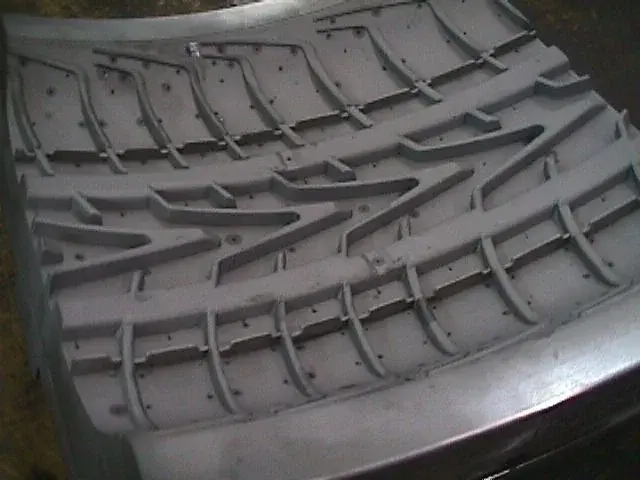
I have to "expalm" a 2d-level writing (pirelli type) inside a toroid and then of course I will have to work it on milling machine.
I remain waiting for some advice and thank you for the attention.
 
Good morning to all of you,
my company decided to make tread models for tires with catia v5 migrating to this soft. (i.e. everything and immediately):
in the meantime I read various threads of this forum and thanks also to you I approached the new soft. with less fear and I must say I have acquired some knowledge that I had not before, but I come to the therefore!:wink:
I have to "expalm" a 2d-level writing (pirelli type) inside a toroid and then of course I will have to work it on milling machine.
I remain waiting for some advice and thank you for the attention.
Oh my god...
It's not really simple. . .
good luck
 
I know matrix, otherwise I wouldn't have posted to you.
thank you anyway for having responded
 
with a basic license you can get to do something more than this
I hope you have help

with the develop license much more and especially easily.


Hi.
 

Attachments

  • pneumatico.webp
    pneumatico.webp
    39.2 KB · Views: 45
  • Pneumatico.rar
    Pneumatico.rar
    349.6 KB · Views: 21
thanks is a good start:finger:
I agree with you (sorry you) that with the catia you can do much more
especially pull on the radial surfaces to the toroid and begin to realize the various steps that make up a tread.
If someone at some instances would like it, in the meantime I'm trying with catia v5r18 a license that my firm has had in use.
 
I agree with you (sorry you) that with the catia you can do much more
especially pull on the radial surfaces to the toroid and begin to realize the various steps that make up a tread.
I don't understand you, but my curiosity, can you make me better understand what you mean?

No problem for you.

Hi.
 
hi, I would recommend you to create a catpart file where to insert the writing on the tread circumference and then assemble it with the wheel. Let me know bye.
 
You know the tire of your car! well, imagine making as a mold (not as a rubber view) all those grooves that are there, with angles of stripes variable but all originally normal to the toroidal surface. that is, the wheel has a center, so all the surfaces of the dowels that form the tread must all be normal to the surface of support
(toroidal). do this tilt with a stripped corner decided by the customer (e.g., bats).
 
especially hello to all of you.
ad alex I wanted to say that I am already trying with the catpart of the writings that I have to parameterize, in order to be able to map them on different diameters and on different cavities. I know it's not easy but I'll try.
 
Dear Alex... If you say so it all seems simple actually I can tell you that it is more complex than it looks. It is also true that in this field there is already a war snaked between various softhouses.
 
but where are the gurus (experts) of catia in this forum?:eek:
a tip on how to plan a tread like that in figure is
welcome.
 

Attachments

  • sportrac_10.webp
    sportrac_10.webp
    28.2 KB · Views: 23
Bye.
I am not a guru and I have never even made a tire mold, but I have to do that tread, I would think of one or more tools that go to make pockets on the solid of the tire and repeated n.volte with a circular matrix, which eventually create the desired design.
the step, then the number of repetitions of the pockets obviously depends on the drawing to be imprinted on the tire and its size that develops cyclically on the circumference.
all other pockets repeated with the matrix, will be identical to the first, then perpendicular or with the strip according to what you decide in the initial pocket. if they change the remains, just change the first pocket and all the others will change accordingly thanks to the matrix.
for the writings, I agree with what suggested you ferretiousness.

greetings
tvi71
 
thanks tvi71it of the council, but what do you mean by tool?
Consider that the tread is composed of 4 steps of different widths that fit 360° therefore the circular matrix at fixed angles can not use it. I'm also looking for an example on foreign forums.
Hi.
 
if you can post math even partial in mold iges we see a little what we can understand

Hi.
Hello rs4,

Sorry, maybe I didn't explain myself well. :cool:

I wanted advice from you experts in caia in creating the mold model of a tread similar to that posted earlier but starting from a 2d design that comes to me from the customer (e.g. bridgestone).
for policy issues I cannot post the dis. but the goal is to achieve the 3d model with catia v5 and parameterize it because as you know there are so many measures with the same design (e.g. 165/70..
185/70. etc.) , the modeling takes place in the toroid so one of the many questions could be "is it convenient to work with solids or with surfaces as I have always done with the old software? "
 
thanks tvi71it of the council, but what do you mean by tool?
Consider that the tread is composed of 4 steps of different widths that fit 360° therefore the circular matrix at fixed angles can not use it. I'm also looking for an example on foreign forums.
Hi.
Look... I changed the example of ferrity, maybe so it is more clear than I suggested before.
the profile is clearly invented, only for demonstration purposes. . .
If you see in the tree, I created a solid "v" to dig the tire and get the central tread part to which I gave a strip of 2 degrees, and I replicated with a matrix n.volte by chance. If, for example, external drawings have a different step from the centre, nothing forbids you to repeat the same process by creating other solids with circular arrays with different step.
the game is to combine the various profiles together ... if for example I look at the image combined with your user, the central "v" part remains separated from the external profiles, in when in between there are 2 strips of uncarved tire.
The solid is nothing but the embossed part on the mold, which will dig your prints on the tire.
I hope I've been helpful.

Hi.
tvi71
 

Attachments

  • Pneumatico.rar
    Pneumatico.rar
    1.7 MB · Views: 18
  • Pneumatico.webp
    Pneumatico.webp
    108.9 KB · Views: 26
I can't open it.
I have the r18
But it seems a good idea. Give me a chance to open it.
Thank you.
 
I can't open it.
I have the r18
But it seems a good idea. Give me a chance to open it.
Thank you.
hi ... erm ... with the "downwardcompatibility" to take it to the r18 lose in any case all the tree ... then to do before I made it an iges...
but you will see only the final result ...

Hi.
tvi71
 

Attachments

hi ... erm ... with the "downwardcompatibility" to take it to the r18 lose in any case all the tree ... then to do before I made it an iges...
but you will see only the final result ...

Hi.
tvi71
Yes! Yes! :finger: we have provided that the surfaces I have highlighted in the attached image are normal to the support surface. only after that I can tilt with a tot angle of stripes.
Hi.
 

Attachments

  • Immagine1.webp
    Immagine1.webp
    6.9 KB · Views: 10

Forum statistics

Threads
44,997
Messages
339,767
Members
4
Latest member
ibt

Members online

No members online now.
Back
Top