d-prom
Guest
Good evening, everyone.
I would like to ask if someone can enlighten me on a matter of this kind: I have a piece like that in the figure below. in this particular the two faces you see colored red must be perfectly round (let's say within a couple of cents). These are faces that will be rectified, but for obvious reasons cannot be rectified together. to put tolerances of flatness on both surfaces is not enough, because tolerance says that they must be flat but not necessarycomplanaries. I could put narrow torches on the lower or upper surface, but that's exactly what I don't want to do because this distance is really unimportant and I'd win who does the piece to a precision that won't feel at all.
summing up: I care that the two faces are flat and flat, but the distance from the faces I care little. What form tolerances should I put on the design?
Thank you in advance.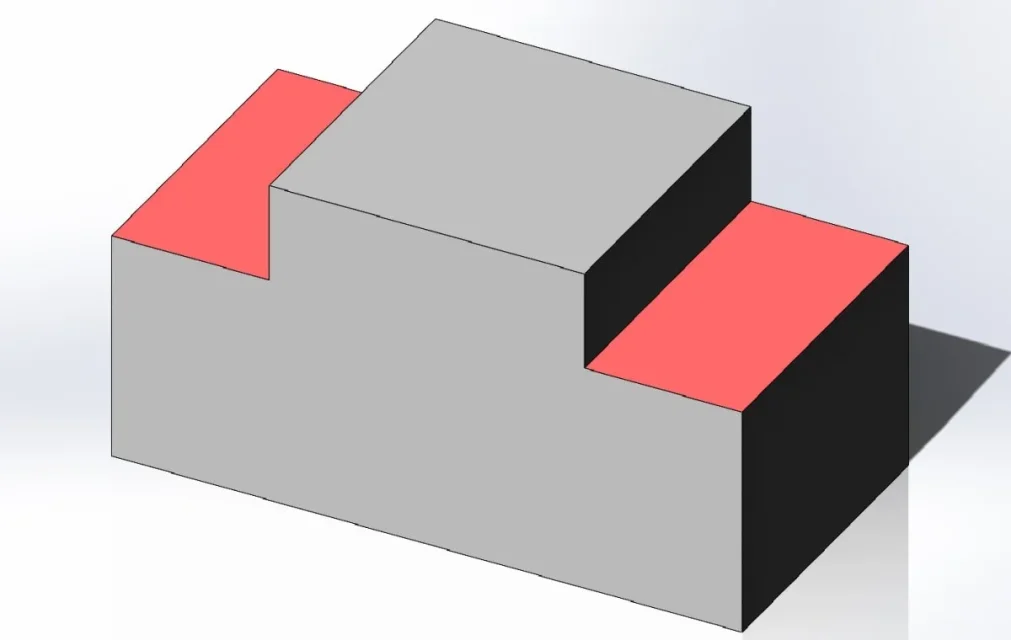
I would like to ask if someone can enlighten me on a matter of this kind: I have a piece like that in the figure below. in this particular the two faces you see colored red must be perfectly round (let's say within a couple of cents). These are faces that will be rectified, but for obvious reasons cannot be rectified together. to put tolerances of flatness on both surfaces is not enough, because tolerance says that they must be flat but not necessarycomplanaries. I could put narrow torches on the lower or upper surface, but that's exactly what I don't want to do because this distance is really unimportant and I'd win who does the piece to a precision that won't feel at all.
summing up: I care that the two faces are flat and flat, but the distance from the faces I care little. What form tolerances should I put on the design?
Thank you in advance.