• This forum is the machine-generated translation of www.cad3d.it/forum1 - the Italian design community. Several terms are not translated correctly.

torque needed to move a vehicle

  • Thread starter Thread starter Camillo60
  • Start date Start date
wanting to also consider acceleration, which you rated in 3000n
It was 3000n when I thought the speed was half a meter per second, not a minute.

However in any case it is not enough to add the inertia force to the calculation of before, it is first reduced to couple to the axis of the engine.
 
camillo please, can you summarize once for all data tastes with their exact units of measurement and possibly the types of electrical actuator you want to put?
if you read the last post a little, there are problems of performance due to low power, very low turns and the desire to put a three-phase asynchronous motor. . .
 
the maximum data are the following (not entirely equivalent to those already provided)
- vehicle mass : 6000kg
- ground slope: 15°
- constant speed max : 0.25 mt/sec
- 4 full rubber tires (mobile type) on concrete
- reduction ratio: 100:1 (available reducer)
- drive : three-phase motor (with or without adjustment) 1400 rpm
 
the maximum data are the following (not entirely equivalent to those already provided)
- vehicle mass : 6000kg
- ground slope: 15°
- constant speed max : 0.25 mt/sec
- 4 full rubber tires (mobile type) on concrete
- reduction ratio: 100:1 (available reducer)
- drive : three-phase motor (with or without adjustment) 1400 rpm
Wheel diameter?
 
I have made the following arguments:
You need to increase the reduction ratio or use an 8-pole motor or decrease the wheel diameter, otherwise you need inverter. this because the cinematic parameters do not lead to having 1400rpm with i=100 and d=680mm for the required speed.

You tell me about what of these elements I can change.

as it is, imposed 15° gradient on the 6000kg which means an increase in the weight of the p•tan wagon(15°).

the choice is to use an inverter or motor with a base rpm of an 8poli and a nominal consumption of at least 0.3kw with peaks for braking of 0.8kw to stop in a second.

I would opt for a engine 8 poly t90l from 0.55kw to 700rpm.

the reducer say you have it, we hope it is able to bring the required torque and that it has the correct size of motor coupling input.

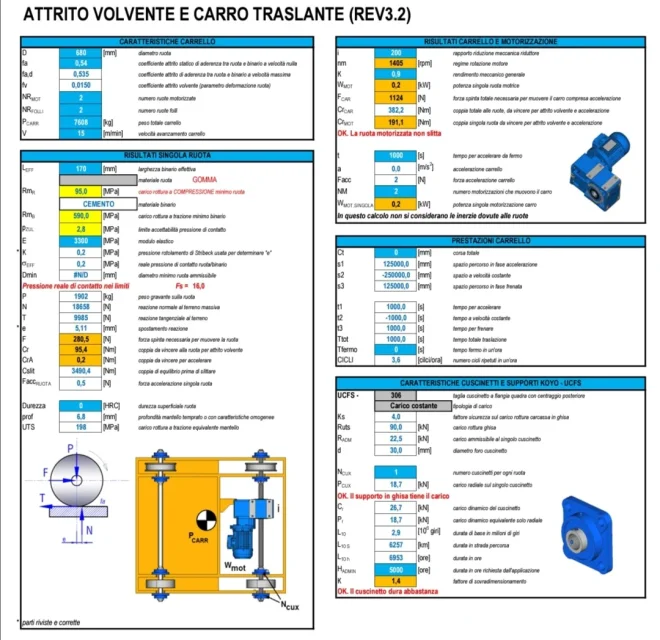
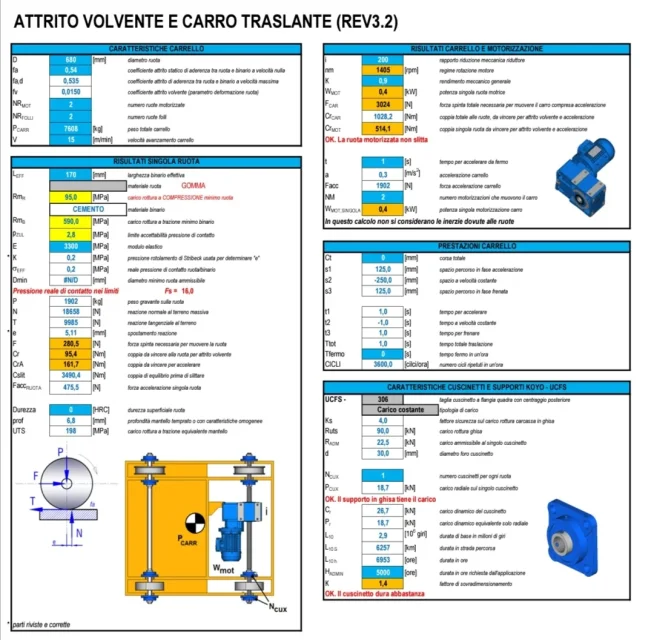
below I carry the transient draft (t=1s) and at minimum (t=1000s) to be realized... then if you want to put a more powerful engine well come.
Screenshot_20230305_210549.jpgScreenshot_20230305_210356.jpgthe values of the materials have been adapted because the spreadsheet is created for metal wheels on metal tracks.
The supposition of the friction coefficient was made according to the approximate type of material used in the calculation and therefore of its elastic module. it would be good to recover tried values of rolling couple of these wheels.
a catalog of tyres for trolleys is This is.
 
I forgot to say that after the reducer 100:1, I considered a pair of gears with rapp. 2:1.
 
I forgot to say that after the reducer 100:1, I considered a pair of gears with rapp. 2:1.
I hope you haven't forgotten anything else...
then we use a 4 poles from 0.55kw to about 1400/1450rpm and a total reduction ratio i =200.

I attach new starting values for the study of motorization.
Transitional and regimental.
Screenshot_20230305_212526.webpScreenshot_20230305_212503_com.adobe.reader.webp
 
with the gearbox that I have are a bit at the limit but I could motorize two wheels (I have several equal gearboxes) by sharing the forces.
 
Thank you. in the next few days I'll do some tests based on how much "we" calculated, first with only one motorization. Thank you for now.
 
Last edited:
How do you reach a power of 0.55kw?
the discussions about the formulas used are those of the links mentioned in the previous posts.... especially that of the cart on tracks.
You have to put together the discussions and you will see that you get there.

basic if to follow I need 0.4kw and in transit 0,8kw I take a motor that has c/cn can satisfy the torque....and therefore the maximum power. since normally c/cn goes from 1.8 to 2.1 ....say that to have max 0.8kw... . need a nominal power of 0.55 which is the one at the catalog. If I use 0.37kw I don't have enough in transit.

then much will depend on how the electronics will be able to manage the engine and how much current they let it absorb. In some cases, you mount the nominal power equal to or greater than the maximum...so 1,1kw.
as we are talking about small variations.
 
with the gearbox that I have are a bit at the limit but I could motorize two wheels (I have several equal gearboxes) by sharing the forces.
therefore two motorized wheels independently with each one a motor from 0.37kw-4poli.Screenshot_20230305_214438.webpScreenshot_20230305_214534.webp
 
test performed :
2 wheel wheels
motor on single wheel 100w -1400rpm
reducer between motor and wheel 100:1 + 50:1

result: the carriage moves smoothly but at the slightest slope the engines slow down until they stop.
 
The above tables also consider slope?
as formulas no, but I had increased some values.
reading how much I wrote you in previous posts we go from 0.55 to 1,1kw installed to move the wagon in slope.
with 10 times less... with 100w it is not ramping.
 
but the reduction ratio employed is much higher than 200..... I would have expected a different result
 
but the reduction ratio employed is much higher than 200..... I would have expected a different result
depends on how you relate speed and torque....that is power.
50*100=5000 ratio that makes the input torque so much increase to give it out. but a reducer of the genus formed by two reducers (of which you did not specify the principle of gears) will have a very low yield because if you use a parallel axle you will have 6/7 stages with a yield of 0,86 but if it is an endless screw you may have yield of 0,4/0,5. means you throw half power for gear friction.
Unfortunately it does not work as images because there are so many things in between and the question is not linear or proportional.
Surely you can get the torque of the wheels due to the desired wait and establish that it takes x nm for each y kg of weight wagon with those wheels, since I seem to understand that 100w are the minimum or almost to move the cart.... but you need to know how many rpm.... otherwise you don't get the pair.
 
once set in motion, I needed 800w to 1400rpm with i=200 and 90% return to go to 15 m/min. This means that the wheels are 982nm.

you with 200w to maybe 1400rpm with i=5000 with a yield 40% you have on the wheel a pair of 2728nm

Your couple is taller than mine and you shouldn't have any problems....only you go slow like a snail.

I doubt your engine wasn't turning at 1400rpm.
 

Forum statistics

Threads
44,997
Messages
339,767
Members
4
Latest member
ibt

Members online

No members online now.
Back
Top