• This forum is the machine-generated translation of www.cad3d.it/forum1 - the Italian design community. Several terms are not translated correctly.

trees:admissible twist angle

  • Thread starter Thread starter biz
  • Start date Start date
from the various books that report the indications on the torsion, there is to evaluate the torsion component in tension mpa with the generated angle. In essence it is like the speech of the supported beam that loaded flette and if the bending is less than l/2000 can be considered rigid for the carpenters and the/4000 for the mechanics.

the formulas for calculating the twist bar are these:
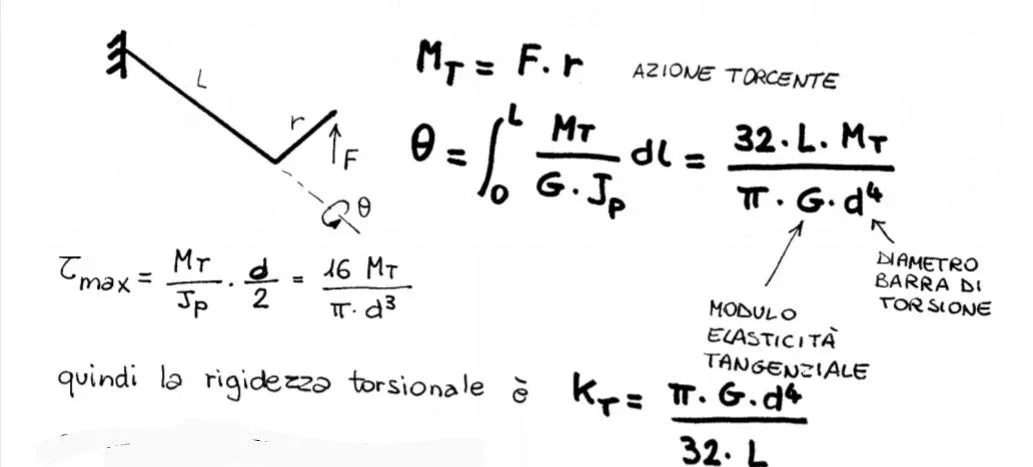
Screenshot_20210512_224134~2.jpgSimilarly we have a torsion tension to be evaluated with the twist angle. generally using as a limit angle 0.25 degrees/meter you have that the system is also guaranteed as regards torsion cutting tensions. the more the beam is twisted and the more the tension is limiting. the more the beam is lean and the more limiting the angle.

Here are some examples:
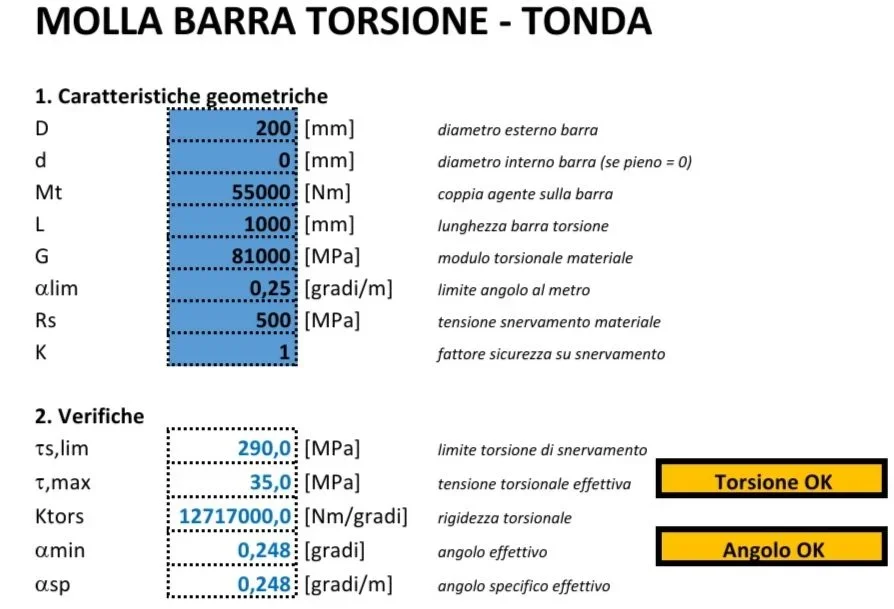
Screenshot_20210512_225509.jpgScreenshot_20210512_225319.jpgScreenshot_20210512_225024.jpgwhen torsional stiffness, i.e. the torque elastic constant reaches limit, you have the maximum angle value. in the central case was still the torque moment.

They are usually empirical values but are dictated by comparison and calculation just performed. you remain in the elastic field and therefore you have no permanent deformation.
the calculation field is usually 0.25°/m for rigid and 0.5°/m for non-important elastic things.

to have more explanations you have to go to look at the treatment of torsion coffins such as springs, fatigue loads etc.
 
from the various books that report the indications on the torsion, there is to evaluate the torsion component in tension mpa with the generated angle. In essence it is like the speech of the supported beam that loaded flette and if the bending is less than l/2000 can be considered rigid for the carpenters and the/4000 for the mechanics.

the formulas for calculating the twist bar are these:
View attachment 62110Similarly we have a torsion tension to be evaluated with the twist angle. generally using as a limit angle 0.25 degrees/meter you have that the system is also guaranteed as regards torsion cutting tensions. the more the beam is twisted and the more the tension is limiting. the more the beam is lean and the more limiting the angle.

Here are some examples:
View attachment 62111View attachment 62112View attachment 62113when torsional stiffness, i.e. the torque elastic constant reaches limit, you have the maximum angle value. in the central case was still the torque moment.

They are usually empirical values but are dictated by comparison and calculation just performed. you remain in the elastic field and therefore you have no permanent deformation.
the calculation field is usually 0.25°/m for rigid and 0.5°/m for non-important elastic things.

to have more explanations you have to go to look at the treatment of torsion coffins such as springs, fatigue loads etc.
valuable intervention.thanks for the umpteenth time.
 
I attach the image of my notes that I wrote years ago taking the indications from the historical books of buildings.
references are to trees and their supports.
Screenshot_20210614_171918.webp
 
thanks biz and hello to all the members of the group, my name is rotten and I had your own professor who gave me your same indications, which I just read on the book you mentioned. The problem is that now I have to put the theory into practice: I have to check the torsion sizing of some industrial mixer trees, with different shoulders. I start from existing machines that have been working for years and which in theory I should not change the designs. It seems correct to me to do a verification, so I make it brief by reaching the conclusions: waiting for the final flexo torsion verification, from a first sizing to pure torsion, the shaft has a service factor of 2 at the weakest point (swimming with lower diameter). I then proceed to check the torque angle, calculating for each shoulder according to its diameter and its length the individual torque angles. summarizing all individual values and dividing for total length, I find myself with a total value of 0,786°/m (compared to 0.25°/m which would be the maximum limit). the fact that the machines currently in production have not had ruptured phenomena is not a sufficiently calming feedback because I do not know those working conditions or the absorption. in a tree with different shoulders, is it correct to perform the diameter calculation by diameter and divide the angle obtained by the total length to get the total °/m? Can someone help me contextualize this limit of 0.25°/m to understand how binding this parameter is? Thank you in advance.
 
thanks biz and hello to all the members of the group, my name is rotten and I had your own professor who gave me your same indications, which I just read on the book you mentioned. The problem is that now I have to put the theory into practice: I have to check the torsion sizing of some industrial mixer trees, with different shoulders. I start from existing machines that have been working for years and which in theory I should not change the designs. It seems correct to me to do a verification, so I make it brief by reaching the conclusions: waiting for the final flexo torsion verification, from a first sizing to pure torsion, the shaft has a service factor of 2 at the weakest point (swimming with lower diameter). I then proceed to check the torque angle, calculating for each shoulder according to its diameter and its length the individual torque angles. summarizing all individual values and dividing for total length, I find myself with a total value of 0,786°/m (compared to 0.25°/m which would be the maximum limit). the fact that the machines currently in production have not had ruptured phenomena is not a sufficiently calming feedback because I do not know those working conditions or the absorption. in a tree with different shoulders, is it correct to perform the diameter calculation by diameter and divide the angle obtained by the total length to get the total °/m? Can someone help me contextualize this limit of 0.25°/m to understand how binding this parameter is? Thank you in advance.
depends on how you calculated it.
definitely a total calculation cannot be done correctly if the diameters vary, although it could be average close to reality. Surely a fem could give you a more truthful match.
 
thanks biz and hello to all the members of the group, my name is rotten and I had your own professor who gave me your same indications, which I just read on the book you mentioned. The problem is that now I have to put the theory into practice: I have to check the torsion sizing of some industrial mixer trees, with different shoulders. I start from existing machines that have been working for years and which in theory I should not change the designs. It seems correct to me to do a verification, so I make it brief by reaching the conclusions: waiting for the final flexo torsion verification, from a first sizing to pure torsion, the shaft has a service factor of 2 at the weakest point (swimming with lower diameter). I then proceed to check the torque angle, calculating for each shoulder according to its diameter and its length the individual torque angles. summarizing all individual values and dividing for total length, I find myself with a total value of 0,786°/m (compared to 0.25°/m which would be the maximum limit). the fact that the machines currently in production have not had ruptured phenomena is not a sufficiently calming feedback because I do not know those working conditions or the absorption. in a tree with different shoulders, is it correct to perform the diameter calculation by diameter and divide the angle obtained by the total length to get the total °/m? Can someone help me contextualize this limit of 0.25°/m to understand how binding this parameter is? Thank you in advance.
Bye.
from what you write it seems to understand that you have a max absorption, on which you are based for calculation, which, in reality, is almost never achieved. In short, you are rightly placed in the worst case, which in reality is difficult to occur.
It may be that the trees have not broken because the limit you calculated is never reached. However, even if they reach this limit for a short period of time it is difficult to break. I invite you to reread the previous posts.
depends also on the conformation of the tree and the degree of slenderness.
for the calculation of the grades on metre it is enough that you divide the angle for the length of the portion of tree on which you made the calculation of the angle of torsion. adding the angles and dividing them for the whole length is like making a sort of "media".
 
Good morning, thank you for the answers you received.

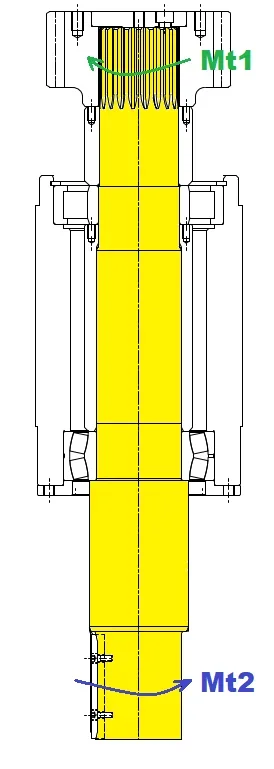
the machine comes with a certain power and you never know how much the mixed product is viscous. the customer could work for more or less long periods to 100% of the nominal power (in addition our inverters allow for short periods to work up to 20%in more than the nominal power). therefore you always put yourself in the worst case excluding the “short periods”.1705502535012.webpthe tree in question is put all in rotation, from top to bottom. In practice it is as if I put it in twist mt1 and block it on the other side (the same way in module and opposite mt2).
1705502591806.webpas you see there are various shoulders. therefore in my opinion for each section subjected at the same torque moment, it should be calculated moment of inertia and angle torsion. adding the various angles (to be converted into degrees) and dividing by the total length I get the value of °/m.

for the fem speech: normally a calculation of this type takes into account the tension only or does it also report the reinforcement of the maximum torsion angle? (which is the point of the topic) I have the fem of inventor.
 
Good morning, thank you for the answers you received.

the machine comes with a certain power and you never know how much the mixed product is viscous. the customer could work for more or less long periods to 100% of the nominal power (in addition our inverters allow for short periods to work up to 20%in more than the nominal power). therefore you always put yourself in the worst case excluding the “short periods”.View attachment 70068the tree in question is put all in rotation, from top to bottom. In practice it is as if I put it in twist mt1 and block it on the other side (the same way in module and opposite mt2).
View attachment 70069as you see there are various shoulders. therefore in my opinion for each section subjected at the same torque moment, it should be calculated moment of inertia and angle torsion. adding the various angles (to be converted into degrees) and dividing by the total length I get the value of °/m.

for the fem speech: normally a calculation of this type takes into account the tension only or does it also report the reinforcement of the maximum torsion angle? (which is the point of the topic) I have the fem of inventor.
I would do a manual calculation without pulling the fem. is easier. However, since you ask about the fem, and from the question you have asked, I believe that you do not have any familiarity with this tool, I tell you that, yes, the fem naturally calculates the movements.
for manual calculation I answered you in the previous post: Just calculate the rotation of each single brush and divide it for the length of the same.
 
Given the irrisori jumps of diameter I would take the minimum diameter along everything.
 
The tree does not seem too slender, that is, the diameter is conspicuous compared to the length, so the risk of torsion instability seems very remote. any phenomena in the rest of the cinematic chain should be evaluated.
 
I would do a manual calculation without pulling the fem. is easier. However, since you ask about the fem, and from the question you have asked, I believe that you do not have any familiarity with this tool, I tell you that, yes, the fem naturally calculates the movements.
for manual calculation I answered you in the previous post: Just calculate the rotation of each single brush and divide it for the length of the same.
hello to all and apologize for the delay in responding. then we go by degrees: I am not mega expert of fem, but I certainly knew that calculates the movements. In the "stress analysis" environment of inventor, however, I get linear shifts in mm, I do not see the degrees of rotation. This measure in degrees is returned to me if I use another tool of inventor: the "creator of trees". anyway I try to simplify to all the problem because it is interest of this post get to understand if a piece you can break not by effort but by overcoming the maximum twist angle. we examine two round pieces of one diameter: the first ø20mm lung 20mm, the second always ø20 lung 1500mm, both subject to a torque moment of 150nm applied to one end and with opposite end blocked. to twisted effort the fs from me calculated + about 1.5. I'd say it's okay. from my accounts the first torque of 0.137° the second of 10,27°. of course the second is 75 times longer than the first for so long the torsion angle is multiplied by 75, but the °/m that makes the first and second are the same. now the second length is purely indicative: (may also be 3000mm, 5000mm etc.); someone by hand calculation or via fem can motivate to what length I have to increase the diameter because the piece becomes too slender and can break. I hope I was exhaustive.
 
The bar di torsione seguono quest formula.Screenshot_20240123_201935_Drive.webpwhen the torsion tau exceeds the yielding tau....we will have the permanent deformation with later incrudiment until breaking. if associated with a composing bending we will have greater damage.
 
someone by hand calculation or via fem can motivate to what length I have to increase the diameter because the piece becomes too slender and can break.
difficult to say. as I wrote in post #20, the value of a quarter degree per meter of length is based on rules of good proportion. It would be interesting to investigate the matter. It is generally stated that a tree, slender, twisted, waxes for deformation and not for overcoming the admissible tensions. as to say that a tree breaks down for excessive deformations, although it does not exceed the yielding voltage. this phenomenon is known, as you will know, with the term of instability, generally indicated with the term buckling. In literature, which I know, there is no justification for the value of a quarter degree per meter. faith the experience, from which the empirical value.
 

Forum statistics

Threads
44,997
Messages
339,767
Members
4
Latest member
ibt

Members online

No members online now.
ciao
Back
Top