• This forum is the machine-generated translation of www.cad3d.it/forum1 - the Italian design community. Several terms are not translated correctly.

wallpaper design

  • Thread starter Thread starter riccardot5765
  • Start date Start date

riccardot5765

Guest
hello to all, indeed to see us again.
It's been a long time since I've been writing, but unfortunately all a series of commitments have kept me away from the forum that I'm going to repeat.

I am evaluating the possibility of buying rhino to use it in the ship. I tried the program by a friend (who uses it for rings and precious) and I find it quite intuitive, but I don't know if it's for me.
In practice, obtained the hull from the curves as surface (which I can do) I also manage to place the lines of the various wallpapers. the problem is how to double these lines, that is to make an offset without deforming to the edges. I have no problem with longitudinal extrusion. other problem is then to obtain in each wallpaper the housings for the longitudinal assembly that must run from bow to stern. I practically have to get some passes for courses that go from bow to stern following the lines of the famine. Finally, as I convert the wallpapers obtained as solid surfaces, I would like to know if it is possible and how to pass it to a cnc mill, in the sense if rhino previews that option to generate the right files.

So much to understand, I should get something like this:45.webp
 
rhino is very used to do what you say. I believe it is the most widely used program in the design of boats. Although, in my opinion, with 3d parametric programs the result is better. with rhino it is difficult to maintain all bodies as solids closed and change the model becomes slower.
in any case seen the quality / price ratio is the most used within small studies and shipyards.
 
for these things is much better a surface modeler than one for features. It's not just my opinion. rhino is an egregio program, but if you do fairing it's a bit better alias. I don't know if the price difference is worth it.

to make the wallpapers and you have to make two floors, the intersection with the hull and then cut them. Is that what you asked?
 
ah, for milling, use iges and make the tool path with the milling software.
 
the curves on the hull I can project them but I can't make an offset oppose, made in solid as full as I can dig the parts I don't need? I can also not draw the courses that link them longitudinally by following the line of the hull. of course the choice of rhino is dictated also by the price.. .
 
for these things is much better a surface modeler than one for features. It's not just my opinion. rhino is an egregio program, but if you do fairing it's a bit better alias. I don't know if the price difference is worth it.

to make the wallpapers and you have to make two floors, the intersection with the hull and then cut them. Is that what you asked?
It seems to me that it's just a matter of cost, big companies use the parameters, for example:
beneteau, elan: catia
Stop: nx
wally: solidworks

However, for what you ask, rhino is the most appropriate.
 
intersect the hull with a plane or surface, create a line then sweep along the line.

However usually the top of the structures is made with offset surfaces of the famine, as they are by definition at constant height (for structural reasons of inertia). other times, they're flat, so the top is flat, like the hips.
if they are currents use offsets or sweeps.
 
when do I offset curves projected on famine what options should I use? I tried to do it but the ends of the wallpapers are crushed. I also had thought of a sweep on trajectory (as in pro e) but can I use the surface of the famine as trajectory? If it is not clear, tonight I place a jpg of the problem I have
 
when do I offset curves projected on famine what options should I use? I tried to do it but the ends of the wallpapers are crushed. I also had thought of a sweep on trajectory (as in pro e) but can I use the surface of the famine as trajectory? If it is not clear, tonight I place a jpg of the problem I have
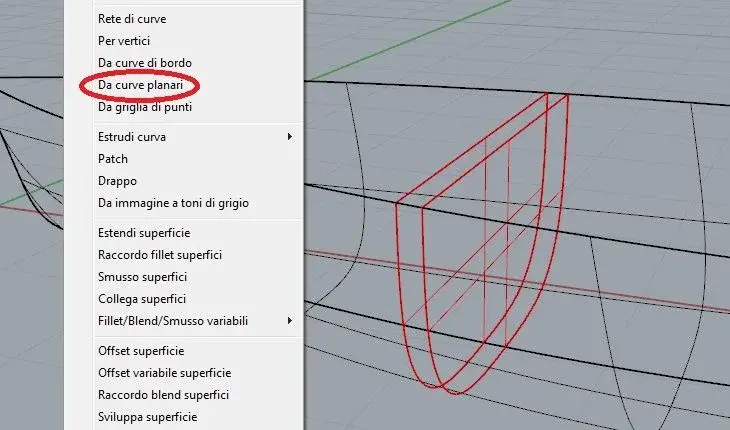
to make the wallpapers create two floors at a distance of 25mm (or how much your wallpapers are) intersect the floors with the hull and create lines.
make sure that all points of the lines end where the next lines start (meaning that your surface is closed) otherwise add the lines in order to form two closed contours. then make a planar surface for the closed lines (or cut the floors with the lines, is the same thing). then sweep two rails between the edges of the two flat surfaces and close the head of the bulkhead, join everything and find yourself with a closed polysurface.

to make offset on carene you have to make surface offset and intersect with planes (or other surfaces) to have the curve. you can't make offset directly of curves as this is done according to the normal local curve.
 
when do I offset curves projected on famine what options should I use? I tried to do it but the ends of the wallpapers are crushed. I also had thought of a sweep on trajectory (as in pro e) but can I use the surface of the famine as trajectory? If it is not clear, tonight I place a jpg of the problem I have
Yes, post a screenshot because I think you're wronging something very trivial, but I can't understand.

when working with surfaces, avoid solids. when working with solids minimize the use of surfaces. many will tell you that it is not necessary to do so. Don't listen to them.

Moreover the way to work with the surfaces is not the same as the way to work for features.

what wrote you wave in the post before is very accurate.

I'm sorry, but I can't help you in detail right now.

As for the cost speech, check alias, that I do not think it costs so much since he entered the autodesk world. Anyway rhino is a great program. the fact that the "big" use "big" type catia does not mean that catia is better. This is a confusion that many do. for example alias is superior to caia in the management of surfaces and costs much less. If a free professional should choose it would be absurd to choose caia. vice versa if you consider a company has twenty stations that work simultaneously on the same project, a plm with relative management of all phases of life of the yacht, rhino would be absolutely insufficient. in this case it would exploit the power of systems as a casket. are produced different for different purposes. using a ferrari to pull the plough or tractor to travel are two mistakes, but this does not mean that the ferrari is better than the tractor or vice versa.
 
So, here's how far I can get here.
obtained the hull, design two segments that then project and then connect the two projections. In this way I can get two surfaces that would be the two faces of the bulkhead. At this point I try to extrude one of the two wallpapers to the other having as curve the falchetta. Here comes a problem: that is, it doesn't make me solid and I don't know why, since a few days ago I managed to create it.
I attach some pictures:im1.webpim2.webpim3.webpWhere am I wrong?
 
I felt like I wrote another procedure.

You can't extrude between two surfaces. on the border between the two corners make a loft.
extrusion and between a surface and a direction

the loft creates a surface from two or more sections
 
I did so:
1- I created two parallel planes at the distance
2- intersection with fair surface, obtaining lines on the hull
3- drawn a cube between the two floors and with one side on the line of the falchetta
4- sweep with tracks, using the drawn cube and the edges obtained at point 2 as tracks
5- I get an empty box, not a solid

Is this procedure okay?
I have to use the same method, right?
immagine1.webp
 
I don't understand.
If you want to make a wallpaper, this is made from the two floors and the boundary between the two floors. to the limit, once you cut the floors with the hull, make a copy of the hull and cut it with the floors, then join everything and get your solid.

If you want to make a madman (transverse structure) then use the sweep 2 tracks for three sides, but the fourth side you always have to get him out of the hull.

What do you mean empty box? in rhino solids are closed polysuperfici. empty boxes. do not think of seeing a "full" section like a parametric cad.
 
What do you mean the fourth side I have to get him out of the hull?
My goal is to have wallpapers in which generic doors or rooms are made, not just madmen. to understand the plywood panels in which cuts are made.
One thing like this:imgres.webpIn this form I must then make some rectangular section cuts on the edge to accommodate currents.

Unfortunately I have always used pro/e and I see that rhino is extremely different. In more pro/e it has a decidedly different cost that is not consistent with the type of project I have to carry out. Mostly I need something to draw small things, like this one I'm trying, and so it costs little. I have seen that in this rhino sector it is very used and I know it costs relatively little, also there are many plug-ins that can be purchased separately. taking advantage of the kindness of a friend, I would like to understand at least the philosophy of rhino. Then, if it turns out to me too ostic it will mean that in the initial stage the drawings will be made to a third even if I would avoid it.
 
I mean a structure has a side that touches the hull. it follows that the hull itself is used to delimit it.
if you make a copy and cut it with the floors, the cut surface part turns out the side of your structure.
recapturing, to make a wallpaper, the two faces are planar surfaces. the lower side is the cut hull. the upper side can be a two sweep rail, a plane or anything.
 
Okay, so I didn't know what you were talking about. therefore the procedure used is correct. If so, problem solved. Thank you very much.
 
rich, as you do, you get a bulkhead with the potentially wrong fourth. how does wave is correct.
 

Forum statistics

Threads
44,997
Messages
339,767
Members
4
Latest member
ibt

Members online

No members online now.
Back
Top