GP.
Guest
Home read well...from yesterday it no longer works and the written cancelled function appears. I tried to reread the various posts but I couldn't find a solution


Home read well...from yesterday it no longer works and the written cancelled function appears. I tried to reread the various posts but I couldn't find a solution
this function is not present in the lisp.... is there a way to bring back on partial and progressive distances those inclined?
I get it. in that case your request makes sense. I imagine that then it is a profile of the excavation already carried out, in practice the profile of the bed laying of the pipes (or better still the profile of the already calculated levellets).in some points the slope is quite high and there would be so much difference in terms of materials than a distance taken in the plane.
we have beaten the points of the network plots to design...the lisp is useful to track the profiles on which then the levellets will be set and everything that follows....the inclined distance, I repeat, is only for a preview of the company that does not want to be found with extra meters of conduct (on paper, but then also in phase of execution) and consequently have also divergences in direction works.to you in practice the profile of the bed of laying of the pipes (in practice the profile of the levelets) is required to take into account the inclined distances. I can't understand how this lisp can help you
ok grazie gpthis function is not present in the lisp.
I don't know the work you're doing, but I assume that the pipes should be laid about the same depth as the dig in every picket or simply rested on the country floor. It's possible that it's pipes of small diameter, maybe those for irrigation. because if it were not then it is the profile of the levelets already calculated what you should measure, especially when the conduct with tubes of a discreet diameter and flow must respect certain gradients (from the levellets calculated from the profile). I say that because you yourself spoke of great repentances. For example, in the profile that you have previously placed between pad 1 and 2 you have 1 meter in height, and then the slope grows.the lisp is useful to track the profiles on which then the levellets will be set and everything that follows.
hi tristus, exactly, I don't need to calculate the levellets , and I think that for this project, most likely the easiest thing to do, will be insert a further line for the total inclined distance taken on all the track (the inclined polylinea that joins each bat).but we put that it is not necessary to calculate the levellets, then the easiest thing to do is to create a polylinea and measure it (or a series of polyninee). after which to make a prospectus with the indication of the inclined measures to give to the client.
Is there a way to report on partial and progressive distances those inclined?
However, you can handle this "external" utilitythis function is not present in the lisp.


You were right, I didn't have a good read. Your suggestion was valuable to me and I have to pay more attention to the posts.
Sorry the delay in the gp. answer, I try this utility and I will let you know as soon as possible. from the video seems to be really useful! Thank you in advance.
good morning gp, I managed to finally use the utility5 and I can confirm that I was useful for changing the profiles.Sorry the delay in the gp. answer, I try this utility and I will let you know as soon as possible. from the video seems to be really useful! Thank you in advance.
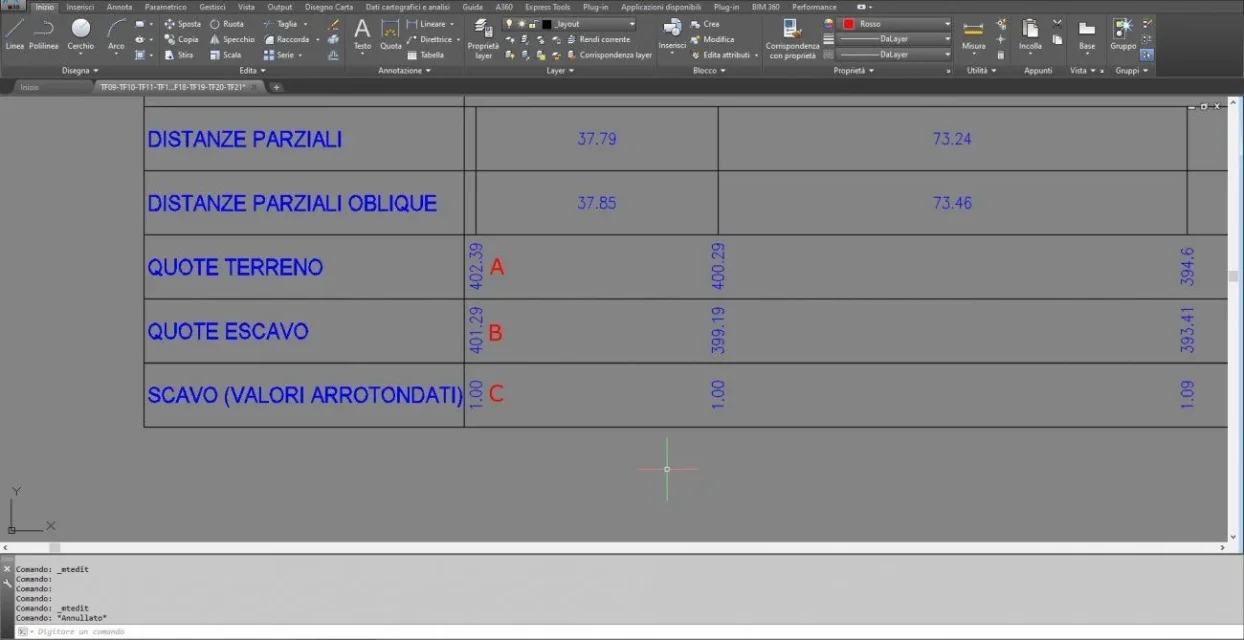 in the case of the photo above, in some cases it may be useful to report in a further finca of the profile the difference between the values indicated by the letters in red "a" and "b" and get the result "c" (instead of doing so with calculator and writing it by hand). Is there any lisp that can do something like that? Maybe not necessarily selecting the polylinea but maybe selecting only the text (I don't know which of the two writing options of a code could be better, I don't even know how to write a lisp). Thank you for your support until now. soon
you did not know "u5" because it did not existon the escort of your "u5" I didn't know, I'd like to ask you if there's something automatic that can help me in what I'm about to illustrate:
some functions may be incompatible with that version, unfortunately I have no way to try.... sometimes though I need to work with autocad 2002. .
attach a dwg containing a cartella that creates this problemhi gp when I use utility 5 with autocad 2017 gives me this message: type of wrong topic: lentityp nil
? ? ?