• This forum is the machine-generated translation of www.cad3d.it/forum1 - the Italian design community. Several terms are not translated correctly.

ball/flying valve gear motor

I'm dealing with the first accounts I've done... and I'm noticing that I've considered that within 4000rpm in the first stage and that's all right. But then unfortunately in the various accounts I considered half the turns... that is 2000rpm. So I've got to go over it.
I again attach the full and magazine version.

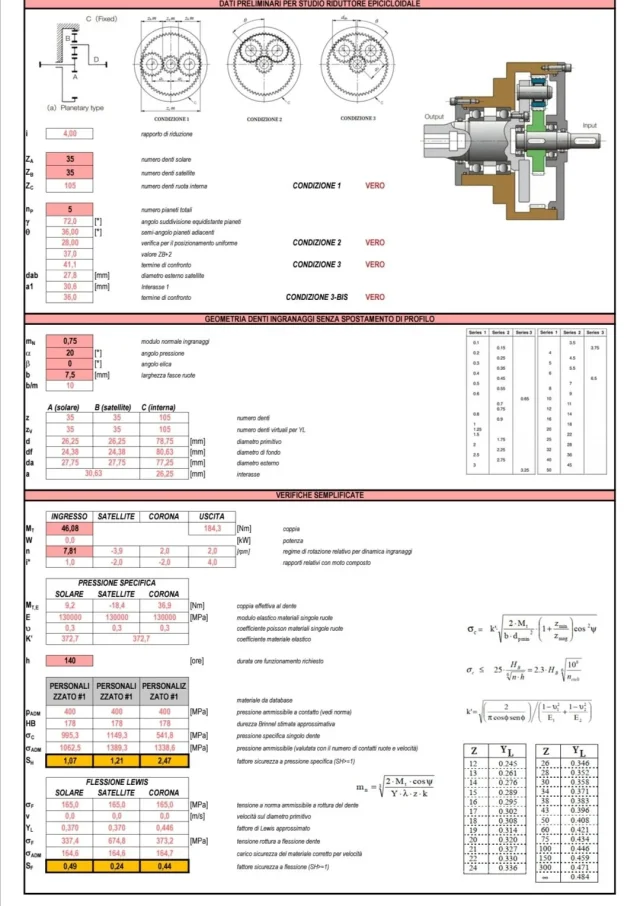
so at full efficiency I 90nmm a 4000rpm supplied by the engine and the gear train turns as from the following table:Screenshot_20201208_210635.webpCousin Stadium:Screenshot_20201208_211325.webpSecond stage:Screenshot_20201208_211558.webpthird stage:Screenshot_20201208_211829.webproom stadio:Screenshot_20201208_212423.webpas you can see having worked with couples and not with the powers have not changed much the results. the values for the wear duration are varied, turning at different regimen.

I used the sintered material with elastic module and similar properties.

as before we 3rd and 4th stage that are not able to bring the couple.
 
Sorry, I had to metabolize the situation.

I understand that we can't take half measures, try different stages?

example:

1st and 2nd stage = m0.75, b5, z15 - z45x3 - z105
3rd stage = m1, b8, z15 - z30x3 - z75
4th stage = m1.5, b20, z15 - z15x4 - z45

I know that probably the band widths will not be enough. . .
If you were to realize it, what would you do?

then you also questioned the reliability of the sintered, is it so critical?
What would it mean to get the last stage from the full?
 
Sorry, I had to metabolize the situation.

I understand that we can't take half measures, try different stages?

example:

1st and 2nd stage = m0.75, b5, z15 - z45x3 - z105
3rd stage = m1, b8, z15 - z30x3 - z75
4th stage = m1.5, b20, z15 - z15x4 - z45

I know that probably the band widths will not be enough. . .
If you were to realize it, what would you do?

then you also questioned the reliability of the sintered, is it so critical?
What would it mean to get the last stage from the full?
First I answer the least complicated question.
the sintered is obtained by taking a powder, put it in a mold, heats it up to fusion and then extracts it from the mold.
according to the compound you get different mechanical characteristics.
basic granulometria remains almost present even after fusion and its breakage is fragile, in fact you have a <5% elongation and the yielding load equal to that of breakage. It's like a cast iron.
steel in bar is cast and rolled therefore is homogeneous and fine grain. The alloy steels 42crmo4 and the like develop solubilization of atoms of various things that increase fatigue resistance, mechanical characteristics, toughness, tenacity....and you can also rectify and lap.
 
I'm a little tired of working with these engine curves. the only curve that tells me something familiar is the n in blue and with that I rule, because my load needs to generate a couple and on that curve I echo the rotation regime. If it's not that sorry.
Screenshot_20201209_223138.webpso we have problem of bending resistance of the teeth of the satellites stage 3 and 4.
 
according to me, you can do different ways to make the reducer. Actually, that engine you chose isn't that it's very good because it turns too high for the couple you give. it would take one that gives more torque (200nmm) to 2000rpm so it takes a little more to close but decrease the reduction ratio.

I thought for the first type, 50nm nominal output, keeping the engine you proposed, to make a stage with two cylindrical gears and then an endless screw with crown.

for the second type, 200nm nominal output I would interpose a further stage to cylindrical wheels.
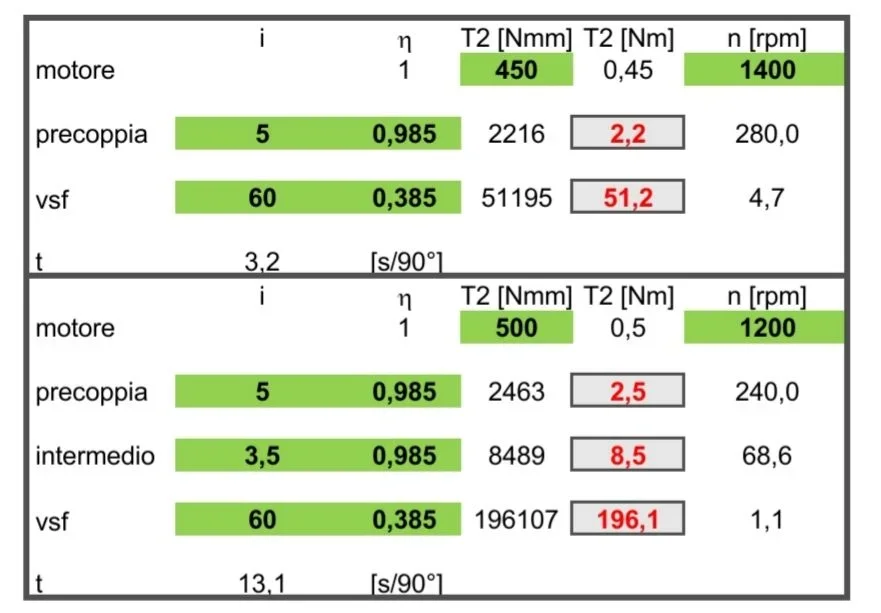
Screenshot_20201210_000752.jpgIt is true that a vsf has yielding about 40% but it is also true that with a stage I can make a very high reduction ratio.

as you see in the calculation I put on the yields so we also see what we dissip.

Keep in mind that there is only the pre-pair you would use for the two models. everything else is different because of very different couples.
 
incorrect corrige to previous postaccording to me, you can do different ways to make the reducer. Actually, that engine you chose isn't that it's very good because it turns too high for the couple you give. definitely using more current you can do it better.I thought for the first type, 50nm nominal output, keeping the engine you proposed, to make a stage with two cylindrical gears and then an endless screw with crown.

for the second type, 200nm nominal output I would interpose a further stage to cylindrical wheels.
Screenshot_20201210_011046.webp
in the formulas of the previous post lacked the calculation of the couple with performance on the vsf.It is true that a vsf has yielding about 40% but it is also true that with a stage I can make a very high reduction ratio.

as you see in the calculation I put on the yields so we also see what we dissip.

Keep in mind that there is only the pre-pair you would use for the two models. everything else is different because of very different couples.

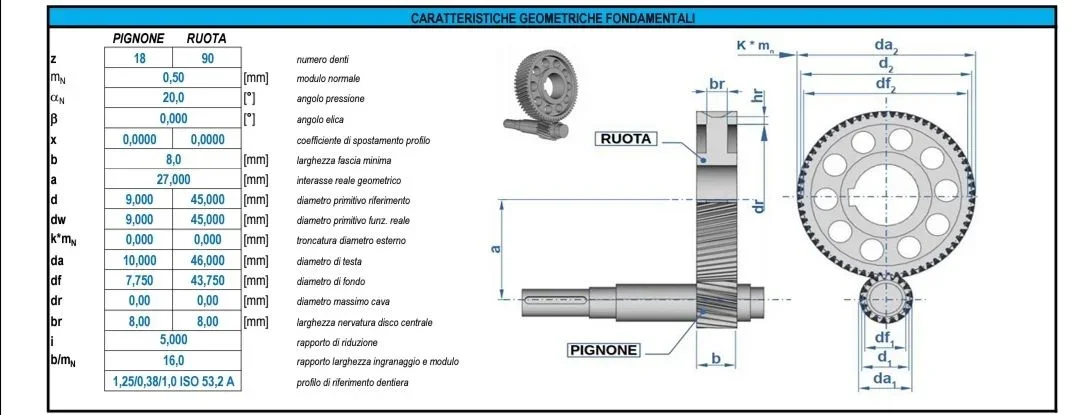
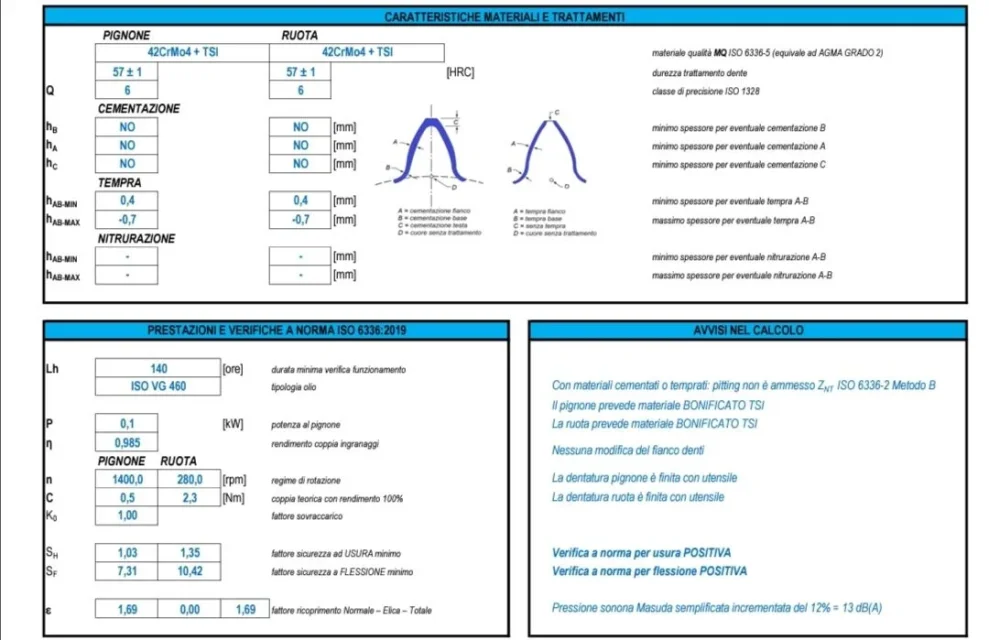
for the first 50nm output reducer you could have the pre-pair so:Screenshot_20201210_005919.webpScreenshot_20201210_005943.webpand the second stage with vsf made like this:Screenshot_20201210_010009.webpat the end pieces and power that turn are those. certainly if you enter high turns you have to do many stages of reduction and save on the absorbed current....but you spend gears.
 
Last edited:
incorrect corrige to previous postaccording to me, you can do different ways to make the reducer. Actually, that engine you chose isn't that it's very good because it turns too high for the couple you give. definitely using more current you can do it better.I thought for the first type, 50nm nominal output, keeping the engine you proposed, to make a stage with two cylindrical gears and then an endless screw with crown.

for the second type, 200nm nominal output I would interpose a further stage to cylindrical wheels.
View attachment 60273
in the formulas of the previous post lacked the calculation of the couple with performance on the vsf.It is true that a vsf has yielding about 40% but it is also true that with a stage I can make a very high reduction ratio.

as you see in the calculation I put on the yields so we also see what we dissip.

Keep in mind that there is only the pre-pair you would use for the two models. everything else is different because of very different couples.

for the first 50nm output reducer you could have the pre-pair so:View attachment 60270View attachment 60271and the second stage with vsf made like this:View attachment 60272at the end pieces and power that turn are those. certainly if you enter high turns you have to do many stages of reduction and save on the absorbed current....but you spend gears.
I think he's already taken the epicloidal road, or he can't change the engine because he should change the electronics. but they are my thoughts. .
 
Good morning, I read the discussion. I try to answer some questions:
I did not foresee any type of bearing to knock down the costs, only lubrication (recommendations? ).
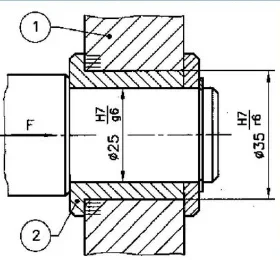
cost reduction reasoning is correct, however (as they have already suggested),it is necessary to interpose between wheel and pin a compass/bronzine (self-lubricating maybe). One thing like that, just to tell us (1 is the wheel and 2 a system with compasses), the pin is fixed to the door (via seeger,spallamento or other systems):
1607678585583.pngSometimes, in order to compensate for errors/disalignments etc. you use "flexible" pins with complex geometries (in your case you would compose the project and increase the costs for which I do not see it as a way in that sense).
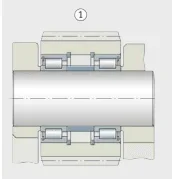
1607677120511.png1607677367033.pngsmall note, configurations of the genus (with roller bearings)
1607676817335.pngare provided for applications other than your (slew drive for excavators, wind turbines etc.)
I'm not sure about the sizing, I did some calculations but very blandi. there were too many coefficients, to me incomprehensible, to be considered and at some point I abandoned them.
as they have already told you there are online configurators (such as khk or some modules inserted in the cad software) if it serves (for this time, seen that you are in trouble to what I understand) you can try to ask the trial version to kissoft and do everything from them...
I do not know what tolerances to insert and where to insert them (I assume it is better to work on the planets).
Do you have 2d designs? maybe we see from there (when finished modeling obviously) ;)
What does it mean to enlarge by 10mm the circumference of the crown? Would it change something or would it remain more or less unchanged the result?
Would you reduce the band width a little?

accepting also to descend to 40nm and 160nm respectively..
usually does not significantly increase fatigue/wear resistance etc. also take into account that there are precise parameters to be respected to avoid problems (such as interference with consequent overpressions, reinforcements etc.)
 
Bye to all,

Sorry I'm late. After a long reflection, as pietro says, I decided to stay on an epicloidal reduction. even if a cycloidal reduction would be very interesting and would lower me many molds. Anyway... .
Actually, that engine you chose isn't that it's very good because it turns too high for the couple you give. it would take one that gives more torque (200nmm) to 2000rpm so it takes a little more to close but decrease the reduction ratio.
I expect great things from this scooter, am I sure of this choice, at least this let me? ...more than anything has a pwm input to adjust the speed, for that there are no problems. We will also manage acceleration and deceleration ramps to limit shocks, etc... and in addition it provides me with 5 spin pulses which, given the reductions, are enough to determine the location, without using any kind of encoder. a jewel


hello calender, thank you for your advice. I would however exclude these bearings given the low number of cycles that they will have to perform. would be ideal but I'm pretty convinced they're not essential. definitely as from your advice I will put a h7 hrc60 plug. very interesting the rolling, I will deepen better with my supplier.


I re-analysed the forces at stake to operate these valves and I probably demanded too much. When I have 100nm out at the 4th stage I'm covered. if there will be different needs I will return a stage from full.

and therefore I have come here:

1st and 2nd stage = m0.75, b5, z15 - z45x3 - z105
3rd stage = m1, b10, z15 - z30x3 - z75
4th stage = m1.5, b15, z17 - z17x4 - z51

What do you think?

I just have to decide on tolerances. fusion 360 gives me three factors: profile shift factor, radial game and game factor("clearance factor", I don't know how to translate it).

how to use them and calculate them?
Screenshot (8).webp
Screenshot (9).webp
Screenshot (10).webp
 
Bye to all,

Sorry I'm late. After a long reflection, as pietro says, I decided to stay on an epicloidal reduction. even if a cycloidal reduction would be very interesting and would lower me many molds. Anyway... .


I expect great things from this scooter, am I sure of this choice, at least this let me? ...more than anything has a pwm input to adjust the speed, for that there are no problems. We will also manage acceleration and deceleration ramps to limit shocks, etc... and in addition it provides me with 5 spin pulses which, given the reductions, are enough to determine the location, without using any kind of encoder. a jewel


hello calender, thank you for your advice. I would however exclude these bearings given the low number of cycles that they will have to perform. would be ideal but I'm pretty convinced they're not essential. definitely as from your advice I will put a h7 hrc60 plug. very interesting the rolling, I will deepen better with my supplier.


I re-analysed the forces at stake to operate these valves and I probably demanded too much. When I have 100nm out at the 4th stage I'm covered. if there will be different needs I will return a stage from full.

and therefore I have come here:

1st and 2nd stage = m0.75, b5, z15 - z45x3 - z105
3rd stage = m1, b10, z15 - z30x3 - z75
4th stage = m1.5, b15, z17 - z17x4 - z51

What do you think?

I just have to decide on tolerances. fusion 360 gives me three factors: profile shift factor, radial game and game factor("clearance factor", I don't know how to translate it).

how to use them and calculate them?
View attachment 60318
View attachment 60319
View attachment 60320
I tried to take a look:
at the 4th stage the crown of 51 teeth cannot be created with the method of envelope.
as regards coefficients:
clearance is worth 0.25 the module and you don't have to worry about it is made using standard tools.
Backlash is the goco on the hips of the teeth to leave because otherwise the teeth would not rotate.
profile shift is the move more or less than the nominal deviation, it's called correction, here the speech would be long, but I don't think it fits in your case, unless it might be a method to solve the problem I raised you for the 4th stage.
 
I took a look at the model, a big doubt, how do you get the hammerheads in the axis? Don't you think you're going to hit the teeth? or did I miss something?
to make you understand what I mean, try to see the design that is present in the spreadsheets of good mechanicsmg.
 
I tried to take a look:
at the 4th stage the crown of 51 teeth cannot be created with the method of envelope.
as regards coefficients:
clearance is worth 0.25 the module and you don't have to worry about it is made using standard tools.
Backlash is the goco on the hips of the teeth to leave because otherwise the teeth would not rotate.
profile shift is the move more or less than the nominal deviation, it's called correction, here the speech would be long, but I don't think it fits in your case, unless it might be a method to solve the problem I raised you for the 4th stage.
I downloaded/comprate a fusion 360 plugin ("planetary gears maker" by https://www.shwivel.com). I put the data in, and he creates it all. I don't know what system you adopt.

with regard to clearance, is it also valid for the creation of the mold? I assume that in this case we must also give it this value. . .
 
In my opinion, I would recommend you to rely on someone who develops your project properly, better yet if you collaborate with the company that does the sintered and gives you the gearbox mounted keys in hand! I appreciate the good will, but certain things do not improvise. roads that seem cheaper almost always cost more. As I said, I admire you, because I can't draw a printed circuit board. but fortunately I didn't have the need or madness to do it. .
 
the values that have told you and explained are just like this. your problem is that you want to make 3d models of gears in a true way because you want to use them to make then sintered molds....but it is not like this: you can model the gear you want to get finished....poi the moldistavdeve ungramented the negative excavation of the profile of the quantity that will be the withdrawal of the sintered. for this reason you can't think independently of creating everything and think it's okay.
You have no experience in sintering, molds, gears. so the most sensible thing is to entrust you to the specialists of every workmanship...or risks almost certainly to throw everything away.
 
I tried to take a look:
at the 4th stage the crown of 51 teeth cannot be created with the method of envelope.
as regards coefficients:
clearance is worth 0.25 the module and you don't have to worry about it is made using standard tools.
Backlash is the goco on the hips of the teeth to leave because otherwise the teeth would not rotate.
profile shift is the move more or less than the nominal deviation, it's called correction, here the speech would be long, but I don't think it fits in your case, unless it might be a method to solve the problem I raised you for the 4th stage.
without graphic analysis, how does it occur if the envelope tempting is complete or not?
but if it remains cut by electroerosion following this non-grain profile? do the bevels on the inner diameter and download?Screenshot_20201211_203355.jpgHow does it work?
I ask you because with internal teeth I don't have much to do except with the basics of the isb or similar.
 

Forum statistics

Threads
44,997
Messages
339,767
Members
4
Latest member
ibt

Members online

No members online now.
Back
Top