
• This forum is the machine-generated translation of www.cad3d.it/forum1 - the Italian design community. Several terms are not translated correctly.

help creation tooth profile

  • Thread starter Thread starter spinner3000
  • Start date Start date
I guess we're on module 30-40-50-60....space gears... steel setter.... 3 meters in diameter.
up to module 16-20 there are creators, expensive, even to plaques ... but if salts you pay also 20000euro and beyond the creator.
inventor also generates tooth profiles or even the khk gears program, but I have never actually verified the accuracy of the profiles .. having always dented with the creators I never placed the problem!
I never had to deal with dense wheels etc.. I don't want to dare even because I don't have a feedback from those who do dentature.
but I have always thought that who uses creators or creates them a verification system has or am I wrong?
 
I guess we're on module 30-40-50-60....space gears... steel setter.... 3 meters in diameter.
up to module 16-20 there are creators, expensive, even to plaques ... but if salts you pay also 20000euro and beyond the creator.
you said well, now I'm working on a detail that has ø7500mm with a toothing m=25 z=305
 
I never had to deal with dense wheels etc.. I don't want to dare even because I don't have a feedback from those who do dentature.
but I have always thought that who uses creators or creates them a verification system has or am I wrong?
creators are normally bought by companies that manufacture third-party gears. only some special companies manufacture internal use of creators because then you have to dress them up and cost a heritage. you can't break up after cutting 10 teeth....
 
I am pointing out, given the volume of gears and the cost of them, I would say that you should feel the kisssoft in Swiss and see that modules you need.... seen that you can see the modules second need. with a handful of thousands of euros you have a 100% reliable system.
 
for gear control so the only method is wildhaber... and possibly to grind a laser cut diamond of 4 or 5 teeth.. on pieces so forbidden to go wrong!
 
I am pointing out, given the volume of gears and the cost of them, I would say that you should feel the kisssoft in Swiss and see that modules you need.... seen that you can see the modules second need. with a handful of thousands of euros you have a 100% reliable system.
I would like to hear the dealer and see what can tell me, in many people told me that kisssoft is 100% reliable as it is used by authoritative automotive and aerospace companies.
thanks to everyone for the answers
 
I would like to hear the dealer and see what can tell me, in many people told me that kisssoft is 100% reliable as it is used by authoritative automotive and aerospace companies.
thanks to everyone for the answers
certainly, in the racing car and motorcycle industry is the bald tool for competition changes. is also used for aerospace and aviation. is used in these years by standard gearboxes and steel hesical gearboxes, sugars and heavy stuff.
It's really reliable.
 
update:

this morning in the office I received the drawing from the customer with indicated the details for the toothing:


they also give me this information:
Height of tooth 18.7mm
thickness measurement of tooth 33.87

By making calculations with the software doesn't fit me, I can't figure out where those valiants appear in the drawing.
Any ideas?
 
height tooth on module 25 I believe it is 56.25
primitive diameter 7625
external diameter 7675
unless there are corrections. .
 
height tooth on module 25 I believe it is 56.25
primitive diameter 7625
external diameter 7675
unless there are corrections. .
I also get the same results, in the design there is no reference note to corrections etc...
perhaps those data indicated refer to some correction
 
update:

this morning in the office I received the drawing from the customer with indicated the details for the toothing:


they also give me this information:
Height of tooth 18.7mm
thickness measurement of tooth 33.87

By making calculations with the software doesn't fit me, I can't figure out where those valiants appear in the drawing.
Any ideas?
I don't even get back.
But look, I'm not surprised if your drawings are wrong. ...look that few technicians can write the right parameters on a gear.
I hope it is to straight teeth (you don't tell us already).
can not have any other parameters the teething.
The height of the tooth is 56,250mm.
is there not the wildhaber size indicated? 2579,202 out of 34 teeth? are not marked background diameters, outside, something?

cannot be the profile shift because it is not so and the tooth height remains.
Why don't you ask the customer if he knows what he writes about it?
 
I don't even get back.
But look, I'm not surprised if your drawings are wrong. ...look that few technicians can write the right parameters on a gear.
I hope it is to straight teeth (you don't tell us already).
can not have any other parameters the teething.
The height of the tooth is 56,250mm.
is there not the wildhaber size indicated? 2579,202 out of 34 teeth? are not marked background diameters, outside, something?

cannot be the profile shift because it is not so and the tooth height remains.
Why don't you ask the customer if he knows what he writes about it?
I have nothing of all this, in fact I have arisen of doubts also to me because I get the same results with more software and also with some calculation by hand.
the only information that is indicated is what I mentioned above and the outer diameter that is ø7675.
I think the teeth are straight, but I don't know how to confirm it.
 
Last edited:
I have nothing of all this, in fact I have arisen of doubts also to me because I get the same results with more software and also with some calculation by hand.
the only information that is indicated is what I mentioned above.
I think the teeth are straight, but I don't know how to confirm it.
I try to send you a step file, meccanimg tries to control. .
 

Attachments

If you have the pinion that mates you can tell us his parameters too?
The whole thing needs.
 
I think you've figured out how they're pointing out the gear information.
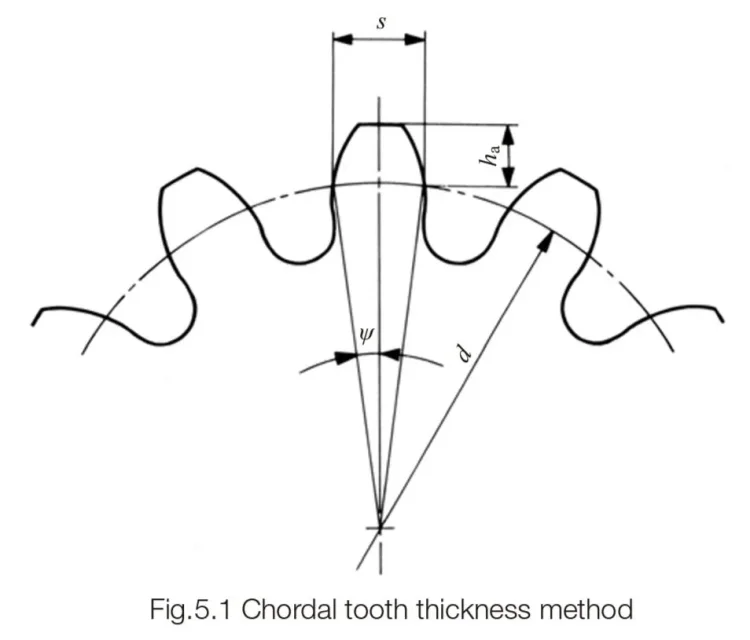
being huge stuff is more practical in place of the wk use the tooth thickness with its height to measure.

the method is this and consists in measuring with the double caliber these two parameters:Screenshot_20200512_203125.jpgthe formulas that govern the system are these, with a lot of numerical example valid for helical and straight teeth:
Screenshot_20200512_203257.jpgfrom which it is necessary first to calculate the value of the height of the addendum has:Screenshot_20200512_211524.jpgconsidering x2=0 which is the profile shift of the wheel 2 and z2 any number, you get it is based on the profile correction.

moral of the fairy tale, your teeth has:
- normal module m=25
- pressure angle 200
- tooth number z=305
- x=-0,25 profile shift
- single cord thickness = 33,87 mm
- height measured by the tooth head to read the rope thickness = 18.7 mm

I didn't have time to make the excel sheet... seeing that I'm with the phone... so the cent decimals are almost about. .
 
I think you've figured out how they're pointing out the gear information.
being huge stuff is more practical in place of the wk use the tooth thickness with its height to measure.

the method is this and consists in measuring with the double caliber these two parameters:View attachment 57783the formulas that govern the system are these, with a lot of numerical example valid for helical and straight teeth:
View attachment 57784from which it is necessary first to calculate the value of the height of the addendum has:View attachment 57785considering x2=0 which is the profile shift of the wheel 2 and z2 any number, you get it is based on the profile correction.

moral of the fairy tale, your teeth has:
- normal module m=25
- pressure angle 200
- tooth number z=305
- x=-0,25 profile shift
- single cord thickness = 33,87 mm
- height measured by the tooth head to read the rope thickness = 18.7 mm

I didn't have time to make the excel sheet... seeing that I'm with the phone... so the cent decimals are almost about. .
you are mechanical reasonmg, theoretically, i.e. without play at a height of 18.7, i.e. a width of the tooth 34.676 so the share they provide, 33.87 includes the operating game
 
I think you've figured out how they're pointing out the gear information.
being huge stuff is more practical in place of the wk use the tooth thickness with its height to measure.

the method is this and consists in measuring with the double caliber these two parameters:View attachment 57783the formulas that govern the system are these, with a lot of numerical example valid for helical and straight teeth:
View attachment 57784from which it is necessary first to calculate the value of the height of the addendum has:View attachment 57785considering x2=0 which is the profile shift of the wheel 2 and z2 any number, you get it is based on the profile correction.

moral of the fairy tale, your teeth has:
- normal module m=25
- pressure angle 200
- tooth number z=305
- x=-0,25 profile shift
- single cord thickness = 33,87 mm
- height measured by the tooth head to read the rope thickness = 18.7 mm

I didn't have time to make the excel sheet... seeing that I'm with the phone... so the cent decimals are almost about. .
really very interesting, now I try to make calculations and see if they match the 3d model that generated the program
 
could be the operating game however the outer diameter cannot be the one marked 7675 to being there the profile shift will have external 7662,3mm
 
I already went off the road, in the program I find thickness of tooth 39.27, I also measured the tooth on solidworks, I inserted all the right parameters.
 

Forum statistics

Threads
44,997
Messages
339,767
Members
4
Latest member
ibt

Members online

No members online now.
Back
Top