• This forum is the machine-generated translation of www.cad3d.it/forum1 - the Italian design community. Several terms are not translated correctly.

parallel axle speed reducer

  • Thread starter Thread starter Kekko999
  • Start date Start date
Keep in mind that the nup bearing becomes axially rigid so you will have to allow the scoring for expansions leaving the outer ring free.
the nu bearing need two shavings of locking outer ring,
as it was said, obtained directly in the case without space, if you opt for the case divided in two half. In this case the nu bearings work better because the inner ring is free to flow without loading the flat face of the rollers against the reservoirs, as happens in the nups, which push the outer rings because of the expansions. It is intuitable that in this case there is a friction for crawling between flat surfaces, and therefore at this point it would be necessary to use ball bearings or barrel rollers that explicate the thrusts for volve friction.
therefore also consider the calculation of the bearing to make subsequent choices.
for this reason, and also seen the irresponsible costs, in the mountain gears always bearings with two rotating roller crowns.
the gearboxes to save they mount conical roller bearings because they sell millions of pieces.
until now I have done only one reducer with two outputs that has bearings to a crown of balls....with ratio to an i=3 stage and little torque to be transmitted....a big toy like a children's backpack.
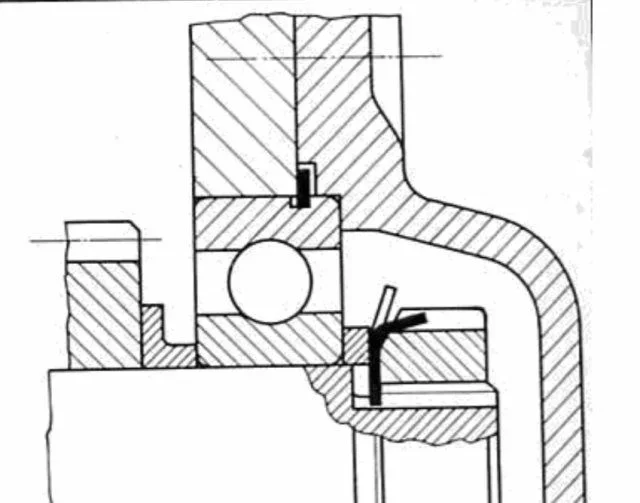
 
Of course. you have cylindrical shaft, fillet discharge throat, fillet.
then if there is the safety rosette there is also the quarry for antirotation.View attachment 59884
Without leaving the bearing type, can I fill in as in the image and mount the needle in contact with the ring via rosette? I don't see an exhaust throat here.
 

Attachments

  • Immagine.webp
    Immagine.webp
    19.9 KB · Views: 38
Of course you can. in such a fitting, that is, without the detachment ring that you see in the image of the post #183, if you do the drain gorge the rosette falls inside.
 
Without leaving the bearing type, can I fill in as in the image and mount the needle in contact with the ring via rosette? I don't see an exhaust throat here.
you can do the fillet even without drain throat. with modern cnc lathes you have the stop of the spindle in exact position and therefore you can make an interpolation of the last half round of thread that radially increases, so to make out the tool (no break) and then end without throat.
 
Without leaving the bearing type, can I fill in as in the image and mount the needle in contact with the ring via rosette? I don't see an exhaust throat here.
How is the picture not that in case of deflection of the tree, the roller containment cage can go to rub on the wreath? I would interpose a space between wreath and bearing.
 
How is the picture not that in case of deflection of the tree, the roller containment cage can go to rub on the wreath? I would interpose a space between wreath and bearing.
this suggestion is often given though if you go to look at the size you cannot touch. idem if instead of the wreath there was the seeger. Of course.... the spacer is more beautiful and in some cases makes the assembly cleaner especially if the editor is inexperienced.
 
Good morning.
basically I threaded the shaft to the face of the bearing and a half inner step; then I considered the thickness of the rosette overlooking the inner ring of the bearing and rides on the tree in correspondence, after the wreath. question: I wanted to know about bearing covers if there are regulations or guidelines (I found little in the internet and only a part that mentioned the optimal circumferential position of the number of fixing screws to the carter).
 
only half internal step is little, you risk hardening of the wreck.
you can also make 3-4 mm according to the diameter, so much for the tree nothing changes.
for fixing screws inspired by the catalogs of gearboxes having equal shaft diameter.
 
only half internal step is little, you risk hardening of the wreck.
you can also make 3-4 mm according to the diameter, so much for the tree nothing changes.
for fixing screws inspired by the catalogs of gearboxes having equal shaft diameter.
I do twice the step that is 1.5 mm, diameter 25mm
 
But it's a toy! I have never looked at wheels size, stuff to make trees with integral wheels and the case from a full picture. We await the development of the model!
 
Good morning.
basically I threaded the shaft to the face of the bearing and a half inner step; then I considered the thickness of the rosette overlooking the inner ring of the bearing and rides on the tree in correspondence, after the wreath. question: I wanted to know about bearing covers if there are regulations or guidelines (I found little in the internet and only a part that mentioned the optimal circumferential position of the number of fixing screws to the carter).
I'm also used to unloading with the 3 or 4 mm cutter on 40...100....mm trees.
as you do not unload you must enter under the bearing to ensure that the wreath works all to face parcel.
A couple of steps could be enough.
 
the connection between the lid and the carcass with the bite screw right?
the lids....they stick in the holes and being snagged, to hold them there against....you put the screw resting on the lid and has the clamping thread in the case.
immagine-jpg.39375
 
What are the compasses where you indicated the bearings? ?
if you refer to these
1607183509589.pngThey are usually made for different thermal expansion coefficients of steel and light metal cannot have a direct effect on bearings. (if the carcass is made for example in aluminium, cast iron etc.)

I open a small bracket, a different conception could predict the use of two x-shaped bearings with initial play instead of the double crown bearing (of the order of the tens of microns) (to compensate for installation errors and thermal expansions)...in this way
1607184417159.pngand fix the other bearing (the roller bearing I mean that it would become a nup or a nj )...but it is more usual as a type of conception when it enters with the input shaft (motor) roller bearing side and not ball bearing side (and, however, especially in the case of presence of helical wheels it is always necessary to be attentive to the direction of the axial force that does not provoke the phenomenon described by candipiedi to the post 180# . )

another thing I wanted to report is on the roller bearing in figure (located inside the carcass)
1607185511363.webp..in this case you risk having a lot of heat that you can't dispose of.. so I would tell you to evaluate whether to use or not increased radial game (c3)


Finally, with regard to lubrication, the bearings are usually lubricated by the same oil circuit that lubricates the wheels.

for the rest other users believe they have clarified every doubt il
 
Good evening to all,
I wanted to thank you for the help you gave me, we practically communicated all this year starting from the first lockdown and you were very helpful, really. I can tell you that I have passed this last test of machine constructions and now I'm working on the ac 75 of the American's cup. We will go to study some configurations of race through rans simulations with star ccm+. Thank you all again for your help, you are a fantastic community and I will not hesitate in the future to contact you for engineering opinions.
 
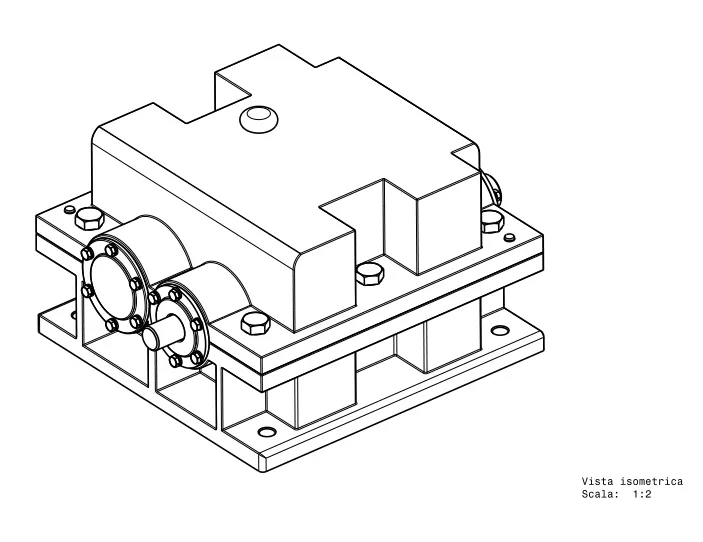
View attachment 60182I was at least trying to show you the explosive on the cat.. I did not contact you during the modeling because I did days and nights to return to the time of the appeal.
p.s Thank you especially @meccanicamg that most of all followed me in this trouble :) good to make!
It's a good job. And it's really nice that you posted the explosive. is definitely very useful as integration to all the design speech.
Go on like this and don't give up.
 

Forum statistics

Threads
44,997
Messages
339,767
Members
4
Latest member
ibt

Members online

No members online now.
ciao
Back
Top