• This forum is the machine-generated translation of www.cad3d.it/forum1 - the Italian design community. Several terms are not translated correctly.

the humble servant

  • Thread starter Thread starter Fulvio Romano
  • Start date Start date
That would seem like redundant control.
the only certain thing is that the grip is different for the two phases (the second requires a precision enough push)

the question is: can't you plan it first? Why is "visual" help necessary?
Maybe to correct any errors?

Unfortunately this question I should ask the robot programmer guy...maybe the next time it happens.


fulvio, another question maybe stupid: but with the earthquake that there was (we are 15 km from the epicenter) it is necessary to recalibrate all the machines (including robots)?
 
No, no, neither falls nor moves.
It rests on a sort of "pallet" and then resumes it to put it in the center of work and make him do the second phase.
The only explanation I give is that of some posts ago. Imagine a cube on a tool car that takes off a edge. You take the cube, but you don't know where the worked edge is. You don't care, because you just have to put it on the pallet. Then you have to take it back, but the worked edge has to go up. What are you doing? The only way is to look at him.

Another possibility is that they told you something wrong. the photo simply serves as a control to verify that the piece had all the necessary work, but who works there does not even know why of certain things.

redundancy is not necessary, indeed, in these cases it is deleterious, because it must be managed. Moreover, an adaptive grip is more precise than the vision, so it is not a simple matter of precision.
fulvio, another question maybe stupid: but with the earthquake that there was (we are 15 km from the epicenter) it is necessary to recalibrate all the machines (including robots)?
Therefore, among some posts I will talk about the calibration, because there are three different types, as mentioned a few posts ago.

the earthquake does not stop a robot, unless it collapses over the ceiling. what can happen is that if the accelerations slip some brakes while the robot is not powered, the controller finds the manipulator in a position different from how he had left it, and for safety deletes the axes zeros. the robot must be "tacked" or a very rough and simple calibration must be made.
 
The only explanation I give is that of some posts ago. Imagine a cube on a tool car that takes off a edge. You take the cube, but you don't know where the worked edge is. You don't care, because you just have to put it on the pallet. Then you have to take it back, but the worked edge has to go up. What are you doing? The only way is to look at him.

Another possibility is that they told you something wrong. the photo simply serves as a control to verify that the piece had all the necessary work, but who works there does not even know why of certain things.

redundancy is not necessary, indeed, in these cases it is deleterious, because it must be managed. Moreover, an adaptive grip is more precise than the vision, so it is not a simple matter of precision.


Therefore, among some posts I will talk about the calibration, because there are three different types, as mentioned a few posts ago.

the earthquake does not stop a robot, unless it collapses over the ceiling. what can happen is that if the accelerations slip some brakes while the robot is not powered, the controller finds the manipulator in a position different from how he had left it, and for safety deletes the axes zeros. the robot must be "tacked" or a very rough and simple calibration must be made.
As for the piece catch, I asked the operator (the first I had in front) just what you assumed:
"Does the photo need to check if all the processing has been done?"
and I was answered:
"No, it's for the catch because it's still going to second stage."

and here I am. I thought you could already plan a grip in advance with a geometry still "to be realized".

sure is that the grip and orientation of the piece are different for the two stages.


As for the calibration, I meant the accelerations that "pack" the zeros.
if I don't remember badly, during the calibration, the "non-eligible" errors are resolved by introducing a "compensation" error.

but for this I wait for your treatment. I therefore ignore this observation otherwise I risk doing the "guastafeste" :redface::biggrin:
 
and here I am. I thought you could already plan a grip in advance with a geometry still "to be realized".
vision only serves when the task is not known at the time of programming.
If you know the shape and location of the piece you go to get, the camera doesn't need. regardless if that shape and position is still to be realized.

I can't understand. . .

Is the camera on the robot or on the ground? how do you grab the piece? Do you have any laughs?
 
vision only serves when the task is not known at the time of programming.
If you know the shape and location of the piece you go to get, the camera doesn't need. regardless if that shape and position is still to be realized.

I can't understand. . .

Is the camera on the robot or on the ground? how do you grab the piece? Do you have any laughs?
the camera is on the robot and takes a photo that is also displayed to the operator on the machine (for this I thought it was for the control of the processing).

the clamp grabs the piece "string it between two fingers" in a horizontal plane.
 
... for me the photo goes for memory, sometimes I take them to the sea... :biggrin:
jokes aside, we happened in some automation line that we were asked to photograph and store some steps to review in case of contestation.. Yours could be such a case.

in any case, you are slipping into the oct and it is a sin because the main topic is very interesting, do not tease Roman lightning, let it work ;p
 
... for me the photo goes for memory, sometimes I take them to the sea... :biggrin:
jokes aside, we happened in some automation line that we were asked to photograph and store some steps to review in case of contestation.. Yours could be such a case.

in any case, you are slipping into the oct and it is a sin because the main topic is very interesting, do not tease Roman lightning, let it work ;p
No, it's not...

It's an in-depth study on foreign sensors... a bit like it happens at university when there is time for questions to prof.
 
but if you go to the technician and ask him to explain more in detail?
on board the car is the interinal in turn.

I told the department to warn me when the omino comes running the robot programming (it will have to come these days to start some machines)
 
....a little as it happens in class at university when there is time for questions to prof.
I'll ask the questions here until proven otherwise, am I clear?
Yes, sir!
Well, thank you very much, do you mind if I run for a while? !
Are you a little excited, are you a little nervous? !
Yes, nervous, sir!
Are you nervous?
Sir, what, were you going to give me some stronxo? !

:mixed:
 
I'll ask the questions here until proven otherwise, am I clear?

Well, thank you very much, do you mind if I run for a while? !

Are you a little excited, are you a little nervous? !

Are you nervous?

Sir, what, were you going to give me some stronxo? !


:mixed:
muahhahaahahahahhaahhaahha. ..mi ricorda full metal jacket :biggrin::finger:

d'ora in poi ti chiamerai biancaneve. . English
 
Mystery solved.

the room serves to allow the robot the precise grip.

the pallet where the pieces are placed between the first and second phase, is not a surface studied specifically with all the appropriate locations for the perfect positioning, but it is the same with which the crude are transported from the foundry.
It's like it's a huge "blister" like a box of chocolates... the pieces dance in it (obviously if moved).

the robot takes the photo also for the first phase (which I had not noticed before) because often the pieces are placed "in case".

the photo allows the robot to perform the socket in function of how the piece is oriented.


I would ask myself another question, but I do not do it, otherwise you denounce me for "sabotage against the fulvio" initiative.
 
Mystery solved.

the room serves to allow the robot the precise grip.

the pallet where the pieces are placed between the first and second phase, is not a surface studied specifically with all the appropriate locations for the perfect positioning, but it is the same with which the crude are transported from the foundry.
It's like it's a huge "blister" like a box of chocolates... the pieces dance in it (obviously if moved).
But is it that when you put it down?
Right!
I would ask myself another question, but I do not do it, otherwise you denounce me for "sabotage against the fulvio" initiative.
I will try not to enter technicalisms if not strictly required, but please ask questions (not too difficult!) to help me deal with the different topics.
Do it, do it, do it!
 
Do it, do it!
Thank you! :smile:

we said that the room serves for the "vision" and to favor the correct grip.
the question is: once the robot "sees" the piece placed in a certain way, how does it "decide" what is the sequence of movements to achieve the right grip?At first I thought there were some "pre-installed" configurations but I don't think it's so...it happens that the piece is in a position so it's not planned (in the programming stage) a solution, or put the opposite case, more solutions for a specific socket. :confused:
 
we said that the room serves for the "vision" and to favor the correct grip.
the question is: once the robot "sees" the piece placed in a certain way, how does it "decide" what is the sequence of movements to achieve the right grip?
Thus, the chamber sees the piece and by means of automatic vision algorithms extracts the parameters of primitive. for example if it is a cylinder will extract the diameter, the height, the coordinates of the base center and the managers of the axis.

at this point he knows he has to grasp the piece by closing his fingers along a diameter, half height.

the point where the tool is to arrive (e.g. the finger center of the tool) which will be the point in the middle of the axis. the orientation of this point will be such that the axis of the clamp is parallel to the axis of the cylinder. the angle around this axis can be chosen randomly. for example always 45° compared to the base.

At this point you completely defined the robot's arrival point. the robot is not redundant, so given a point and a trim, it has a finite number of configurations with which it can reach it. or from a minimum of one to a maximum of 4*. the choice of configuration must be done by hand, indicating which of possible. for example the "number 1".

you have identified the point where you have to arrive, you will write a metacode like this:
go 200mm above point x
open the clamp
slowly down 200mm
close the clamp
updates the dynamics of the robot with the addition of weight
lift 200mm piece
posing somewhere
how to perform each instruction, or how to move the axes synchronously to get for example a straight, circular movement, etc., is a controller problem, and you don't have to worry about it.

if the point ends in a position not reachable by the robot, or do a type verification
se [(X^2 + Y^2)^0.5] > 1000 then stop and communicate to have a problem
or you don't care, the robot will start the path, when he realizes he can't finish it, he will stop and go wrong.

I don't know if I answered your question. .
 
I promised to explain this configuration problem. I take advantage of it and do it now. Since an image is worth more than a thousand words, look at the robot below, with the tool always at the same point and with the same trim, but with the following four configurations, whose corners of the joints are:
configuration 1: [-10, 7, 42, 75, -31, 99]configuration 2: [-10, 7, 42, -104, 31, -81]configuration 3: [170, -36, -161, -56, -37, 41]configuration 4: [170, -36, -161, 124, 37, -138]
 

Attachments

  • Configurazione.webp
    Configurazione.webp
    100.8 KB · Views: 15
I promised to explain this configuration problem. I take advantage of it and do it now. Since an image is worth more than a thousand words, look at the robot below, with the tool always at the same point and with the same trim, but with the following four configurations, whose corners of the joints are:
That's exactly what I meant.

defined the point of arrival through the help of the room, how does the robot reach it if it was actually not programmed?
that position is not told in the programming phase, but the "discovery" after...the corners of the joints are therefore not known.
you know only the final point.

I'm sure I don't know the subject and I shoot cag...te.:tongue:
 
That's exactly what I meant.

defined the point of arrival through the help of the room, how does the robot reach it if it was actually not programmed?
that position is not told in the programming phase, but the "discovery" after...the corners of the joints are therefore not known.
you know only the final point.

I'm sure I don't know the subject and I shoot cag...te.:tongue:
in the programming language you tell the robot "go there", where " there" is a variable.
the variable can be defined in the joint space or in the operating space. If you define it in the operating space, the cinematic transformation does the controller, you don't have to worry about it.

Imagine you want to say a "here" in the operating space. the variable that contains the "the" will have:
- location coordinates
- angles for orientation
- configuration (1, 2, 3 or 4)
- possible position for axes outside the robot

if the camera gives you a new position (x, y, z), you will simply write that the new variable "there" is equal to the first, except for the position, which assumes the new value. And then, go there.

are only variable. Clear? or did I not understand the question?
 
in the programming language you tell the robot "go there", where " there" is a variable.
the variable can be defined in the joint space or in the operating space. If you define it in the operating space, the cinematic transformation does the controller, you don't have to worry about it.

Imagine you want to say a "here" in the operating space. the variable that contains the "the" will have:
- location coordinates
- angles for orientation
- configuration (1, 2, 3 or 4)
- possible position for axes outside the robot

if the camera gives you a new position (x, y, z), you will simply write that the new variable "there" is equal to the first, except for the position, which assumes the new value. And then, go there.

are only variable. Clear? or did I not understand the question?
Clear!
Thanks :finger:
 
- force transducersForce transducers are similar to load cells, and are installed on the wrist flange, between the tool and the robot. the most complete are able to measure the forces along the three Cartesian axes and couples around them.
always without entering into the detail realize, a six-degree sensor of freedom has the shape in the figure. the central square is fixed to the tool, the four "points" are fixed to the box which is fixed to the flange of the robot.
when a force is applied to the central square, the four tips "deform". each tip has two strain gauges to measure its bending and, with a special matrix (rentangle!), it is possible to transform the eight strain gauge values into the six values of forces and pairs in the sensor reference system.
This sensor provides a direct measurement of the forces exchanged between the manipulator and the environment, and of course its accuracy is independent from the instant configuration of the robot. the use instead of the couple sensors to the joints, let us remember, although it manages to give the same measure, this must undergo a transformation from the space of the joints to the operating one, and therefore its accuracy is strongly dependent on the instant configuration of the robot.

finished the sensors, we proceed seeing the other components of the robot.
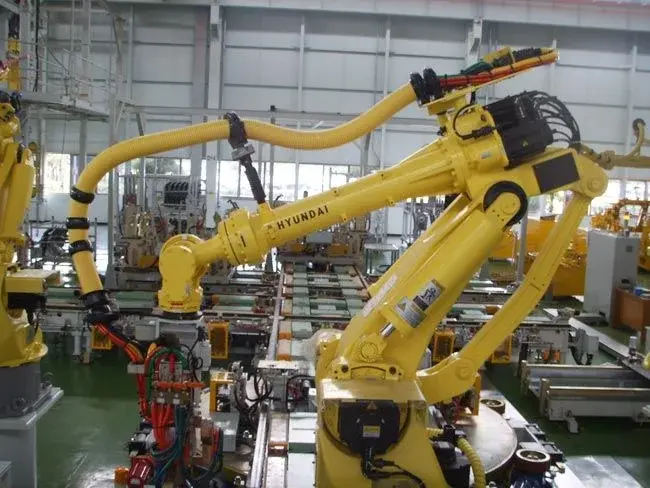
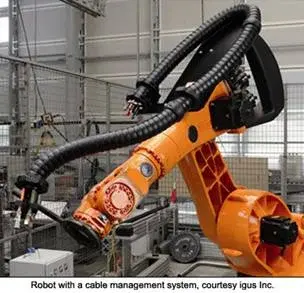
wiringObviously a manipulator must have wiring to bring energy and signals along the structure of the robot. The cablings are two types. the robot's own ones, are always present and serve to feed the engines and to bring the feedback of the resolvers, encoders etc. often pass within the structure of the manipulator itself, leaving only in correspondence of the joints. the wiring of the user instead are those that bring power, signal, fluids, etc. to the tool. are present except in cases where the tool is fixed and not powered.
depending on the task more or less complex, the greater difficulty, usually, lies in the passage cables external to the manipulator, for the stretch from the elbow to the wrist. in the link below you find an example of a method to solve the problem. below you can see interesting videos.http://www.igus.it/wpck/default.aspx?pagename=robots_triflex_rs
OtherOther elements on board the manipulator are the following.
the counterweight, already explained quielectronics. typically placed at the base of the robot, some electronic cards mainly deal with managing the resolver/encoder data. a battery allows you to maintain in the memory of the manipulator the calibration data of the joint transducers, and the condition of the counters. As said in fact, being present gearboxes with a rather large ratio, the absolute transducer informs about the angular position of the engine axis, but to know the position of the joint it is also necessary to count the full number of turns of the engine.

some manipulators have at the base a button with six buttons. these buttons allow the manual release of the brakes of the engines. are very comfortable, although quite dangerous, because at least the axes 2 and 3, if unlocked, cause the fall of the manipulator by gravity. Whereas a robot that raises 200kg exceeds the ton of weight, the risk is there.
 

Attachments

  • SensoreForza.webp
    SensoreForza.webp
    38.7 KB · Views: 3
  • CroceMalta.webp
    CroceMalta.webp
    9.3 KB · Views: 11
  • dressing1.webp
    dressing1.webp
    62.5 KB · Views: 7
  • dressing2.webp
    dressing2.webp
    23.8 KB · Views: 14

Forum statistics

Threads
44,997
Messages
339,767
Members
4
Latest member
ibt

Members online

No members online now.
Back
Top