• This forum is the machine-generated translation of www.cad3d.it/forum1 - the Italian design community. Several terms are not translated correctly.

the technique and history

  • Thread starter Thread starter Exatem
  • Start date Start date
We didn't even start, huh?
:36_1_18
ah ah ah
uh...
I'm sorry.
You want more vocals?

while we wait patiently for the "horizon"
Hi.
 
even less than half page can suffice :cool:
I could not disappoint "friends" like this! :biggrin: but before facing the horizon. . .
functional polyvalence = modularitywith the upads and the fremm we introduced the concept of “modularity” trying to explain that with it you do not want to mean “political unity” but rather “adaptable” to the operational needs, that is, equipped with that which is called “functional versatility”. In practice it is a platform that is common to the needs of different customers or missions. it is not an absolute Italian novelty. In fact, other marines have introduced this concept so much that the term modularity seems to have become one of the slogans in the field of the realization of modern naval units; a concept that is increasingly interested by an increasing number of marines, of which we will now make a “carrellata”, also because over time, the ways of putting it into practice have diversified allowing to expand the available options.
historically the first to conceive of the idea were the Germans of the construction site blohm und voss of Habsburg with the “meko” (mehrzweck kombination), already conceived since the 1970s.
meko is a family, more than a class, of ships able to meet all the requirements required and you can consider a real commercial success if you consider that 1500 meko modules installed on more than 60 units worldwide covering an area ranging from corvettes to patrollers to frigates.
the story of this project began as said, in the seventies and the first built unit was the “aradu”,
Aradu.webpordered by the nigeria in 1977 (a meko 360; the versions are: meko 100 “corvetta-pattugliatore”; meko 140 “corvette”; meko 200 “fregata”; meko 360 “fregata- huntership”).
Then the following year the Argentine ordered 4 specimens after exploring the possibility of buying “maestrale” from Italy, then not yet in service but previewed as evolution of the wolf project already ceded to Peru and Venezuela. Italian ships were superior as performance to mekos but two factors occurred for our negative industry. the first was purely political: being at the time the Argentine a dictatorship of the right, the workers of the Italian yards protested "vivaciously" threatening to boycott the buildings (which instead did not happen then for the cession of the wolf to the iraq); the second fortunately was a more serious reason. the teachers were ships however “conventional” while the mekos introduced a completely new concept, the “container ship with modular structure”; So the Italian yards, at the time one of the most active in the world, lost the primacy in favor of the Germans.
the contract stipulated between Argentine and Germania previewed the construction of four ships in the German yards and six corvette class "explore" to be built in Argentine on license, a contract similar to that stipulated by us with the araq that previewed 4 frigates class "lupo", six corvette class "al-asad" and a supply class "stromboli" with the difference that, because of the surviving embargo,
and if initially the meko concept was adopted exclusively by "minor" marines such as Argentine and Nigeria, in the 80s also nations with the most important marine armed forces have been interested, as in the case of Australian, Turkish and Greek. Finally, in recent years, Germania, always “careful” to economic aspects, has converted to the concept.

So let’s talk about the idea of ship meko. ships consist of a relatively large hull, whose internal components are modular and replaceable. modular architecture facilitates the modernization of all subsystems (arming, electronics and other) and increases the longevity of the medium. the ability to resist and contain damage, the so-called survival, is part of the meko concept, having the functional modules a certain independence in ventilation, power supply and more. therefore has developed an original type of construction, a ship that was not “modern” in the classical sense of the term but “modular”, that is, prepared from the beginning to accommodate various kinds of modernization.
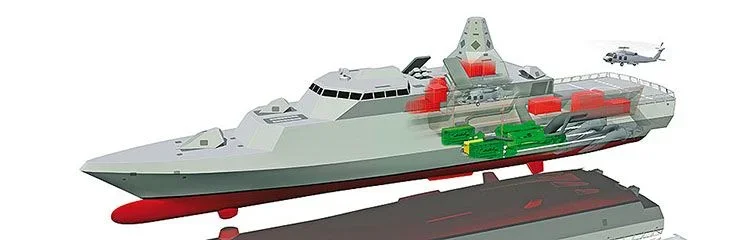
MEKO.webpthe solution capable of satisfying these requirements was that of a hull “container” to be filled according to the need, with modules containing the necessary to fulfill the desired missions. the modules, of standardized size iso and having variable lengths from 3 to 4.5 m; (the functional modules for the combat operating power station are provided in the form of bases on which the different consoles are then mounted), can contain weapon systems, sensors and even consistent parts of the unit. beyond their physical and structural aspect, they are constructed separately from the unit itself and are almost completely independent; are installed in the platform in appropriate recesses and connected to it thanks to connections for electricity and interfaces with onboard systems, including combat systems, i.e. connected with the necessary utilities (electricity, conditioning/ventilation, cooling water, communications, information distribution network if not already provided) through interface elements also standardized. also auxiliary equipment, such as air conditioning and ventilation systems, generators, and as much as possible, can find place on pallets specifically pre-set and feasible in the form of closed containers, structures with open sides, bases and complete tree (as we have seen with the unmast). the concept “modular” therefore requires an optimized design to receive the container of which the dimensional characteristics are known. some modules can be simply installed on the blanket and on the rails, others will be arranged internally therefore, they will have to be prepared suitable openings; In both cases, reinforcements of the structure must be prepared. This forces us to resort to larger dimensions which, if on the one hand require greater power (at the same speed required), on the other contribute to increasing the survival qualities. . .
(follows...) )
 
Last edited:
great, thank you but......
Italian ships were superior as performance to mekos but two factors occurred for our negative industry. the first was purely political: being at the time the Argentine a dictatorship of the right, the workers of the Italian yards protested "vivaciously" threatening to boycott the buildings (which instead did not happen then for the cession of the wolf to the iraq); the second fortunately was a more serious reason.
In my opinion the first was a very serious reason, the discriminant lies in those few years of difference between one and the other:
1978 and 1981 if I understood correctly...
and also in the fact that the Italian presence in Argentine was very wide and very felt.
with unchanged estimate :)
 
great, thank you but......


In my opinion the first was a very serious reason, the discriminant lies in those few years of difference between one and the other:
1978 and 1981 if I understood correctly...
and also in the fact that the Italian presence in Argentine was very wide and very felt.
with unchanged estimate :)
Okay. but I remain of the idea that politicians have to make politics and yards have to make ships, that if then we are not to sell, we only benefit foreign countries who see us as smoke in the eyes and expect nothing else. in fact the Germans did not scruple and sold 4 with option for another 2.
we make moralists and others make money.
It's a little like the husband who cuts his jewelry to spite his wife...
still better stay in the "technical" area... :wink:
 
(...cont'd)
We find great differences with the past at the platform level.
if we return to the seventies and paragogue the escort units of then with the ships having same functions in plan today, notice obvious differences. then it was in fact platforms of about 5000 tons, armed with at least two bina towers of medium caliber both prora and aft, often equipped with a ramp missiles and antisom systems. The superstructures were essentially used to support electronic communication and surveillance sensors. the propulsion consisted of steam plants with boilers and turbulents from at least 75000 hp that allowed speeds close to 35 knots, this also thanks to slender and thin hulls. the complexity of the bulky onboard systems prevented the presence of a flight bridge for helicopters and their technical accommodation, and required very numerous crews, even more than 500 units, whose living conditions were anything but comfortable.

what has radically changed is the shape of the hull, the superstructures and the propulsion, now entrusted to combinations, even imaginative, between diesel engines gas turbines as well as other innovative solutions. the maximum power has been set around 50000hp for a speed often less than 30 knots. in the weapons systems the towers are reduced to the minimum, with calibers ranging from 76 to 155mm, to leave space to missiles and helicopters. all control of the various sensors is entrusted, through optical fibre connections, to hardware/software systems able to provide a complete tactical picture. thanks to automation the crews have reduced to a maximum of 230 units with a large female presence. evolution has produced a substantial increase in the size/performance ratio of the warship, the range of action of the weapon systems has grown considerably, with lower reaction times and greater precision. radar marking has decreased drastically and survival capabilities have increased without resorting to armor and armor. the autonomy has increased with the improved efficiency of the less thirsty engines of fuel and the construction times have reduced considerably.

Today the designer is asked to realize units whose prevailing characteristics are survival, sea-holding, reduced marking, an efficient propulsive system, characteristics concentrated in a relatively small platform trying to achieve an optimal relationship between displacement and fire power, all in a modular configuration. overall it is a rather net detachment compared to the past when the major units were designed for air defense functions of naval groups, tasks entrusted to cruisers and missile destroyers, anti-submarine struggle to which hunting and frigates were destined and, anti-ship contrast, mission that is “fashioned past” with the Second World War thanks to aerial superiority but that returned to fashion in the seventies. even if at the time we were talking about “multirole unit”, in fact the ships were equipped with sensors and systems aimed at a prevailing function on the others (anti-aircraft, anti-ship or anti-som).
one of the first steps in this direction was the use of propulsive systems with high power density, therefore, gas turbines.
then thanks to the vertical launch systems of the missiles it was possible to reduce the necessary volumes to the ramps and deposits since the launchers can be entrusted with different targets. a multipurpose surface unit will join traditional functions, such as antisom struggle or air defense, other specialized functions such as special forces boarding, mine countermeasuring operations, reconnaissance of vast maritime areas and, defense from new asymmetric threats. These concepts attract the interest of many nations and represent a remarkable rate of the world market. to coexist polyvalence and size has “forced” to resort to the “functional mobility” of which, as said, the first example is represented by meko.
to say the truth initially blohm und voss sought only a method to reduce the time (and therefore costs) of production of the platform, but later the evolution of the concept has laid the foundations of a real functional polyvalence that allows to modify in contained times the configuration of weapons and sensors in relation to the specific function that the naval unit is called to carry out.
This is such an important concept that even the most powerful marina in the world, the US, has embarked on this road with the aim of increasing quantitatively and qualitatively access to “littoral” scenarios. This interest has had its implementation with two lcs programs, well defined platforms (including a speed greater than 40 knots) called “seaframe” that can board three different configurations contained in functional modules becoming so anti-ship, anti-submarine or for countermeasures mine. the platform includes the “permanent systems” i.e., the control and control systems, a 57mm cannon, the systems for the launch and recovery of rov, etc.
instead, “module mission” modules contain specialist systems and those supporting them as weapons and sensors. to facilitate the change of configuration the computer architecture has been distributed in order to exploit the potential of the individual modules. also the crew is remoduled according to the mission by setting up the so-called “mission package”.
Americans consider the lcs a carrier platform from which they can be boarded/sembarked in a few hours container mission. In this way the lcs can be entrusted to a single unit a series of different tasks that cannot be done to a conventional unit.
the meko program and the lcs program represent the application of the concept of functional polyvalence.
lcs_independence1.webp (six.)
 
(...cont'd)

but there are those who have followed a different approach... is the case of the Danish navy with the “standard flex” system, a variant of the meko concept applied to a much smaller platform, about 480 tons of displacement, made of fiberglass. The hull has 4 “holes” in which they can be installed in a few hours standardized modules that allow missions ranging from anti-ship contrast to mining operations, from oceanographic detection to anti-pollution supervision. the new roles assigned to the Danish navy have made it indispensable to equip itself with a sufficiently large platform to be used as a flagship even at large distances from the native mother. the Danish study has referred to the “thetis” class coaches and has produced as a result two platforms called “flexiblestøtteskibe, fs” (flexible multi-role ship) and “patruljeskibe, ps” (patrol boat), having numerous elements in common. the ps program has been realized with the “absalon”
Absalon.webpe la “esbern snare”
Esbern Snare.webpranked “arm operations support unit” while the FS produced the “peder skram” class, real combat units configured for air defense. Therefore it can be said that the two projects have a common root and in fact the size of the platform confirm it (the size of the hull is 137m for 19,5).
the main differences are:
class fs - "flexible" bridge extended under the flight bridge and for about 2/3 of the length of the ship, having an area of 900 square meters and equipped with ramp and door access on the stern mirror. the term "flexible" is due to the possibility to accommodate, along 250 linear meters, a range of loads equivalent to 1,700 t (the bridge is equipped with structural reinforcements for the boarding of tanks, as well as the spaces for a reconnaissance battalion of the army).
- two supply stations in the sea, gates on the flight deck and on the weapon deck (on the tunnel in the center), which allow the handling of loads on the bridges below;
- flight bridge and airship for the operations of two helicopters "eh-101" (the flight bridge is also sized to accommodate a heavy helicopter "ch-47 chinook");
- weapon equipped with five recesses for boarding as many modules
with interchangeable weapon systems.
the normal equipment of the absalon class units provides two modules for missiles «harpoon block ii» (16 ordnances for anti-ship function and strike missions against prefixed terrestrial targets) and two modules for the vertical launch of 36 missiles “evolved sea sparrow”; a 127/54 cannon and, on the weapon deck, two groups of “mu-90” type guns.
the ps class differs by:
- absence of the flexible bridge,
- more powerful propulsive system (and therefore greater speed),
- different equipment of sensors dedicated to surveillance and control of weapons,
- helicopter accommodation (only for an “eh-101”)
- different weapon deck configuration.
in this case, in addition to four modules to be used for missiles “evolved sea sparrow” and “harpoon block ii” in various combinations, there are four eight-cell modules for vertical launch of surface-air missiles or cruise, a configuration that allows the ps to play a leading role in the defense against ballistic missiles of theater and in the projection of power against the territory, without for this reason renouncing to other important capacities such as surveillance and contrast.
another example of ships built with the concept of modularity are the class “sigma”
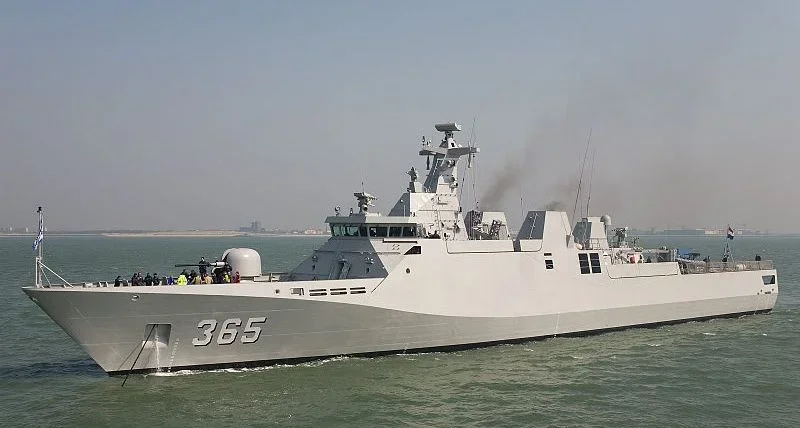
Sigma1.webpof the naval shipbuilding damen schelde shipbuilding, a Dutch ship yard with headquarters in flexinga. the sigma project (ship integrated geometrical modularity approach) offers a range of platforms ranging from 50,4 meters to 148 and 9 to 15 meters wide, with displacements up to 5000 tons. simply by adding standard modules of 7.2 meters you get units ranging from corvettes to ocean patrols to frigates. Unlike the meko project, which does not alter the platform and is seen as a container to be filled with modules, sigma exploits the opposite principle and the platform transforms. you can have 2 or 4 diesel, or 4-6 generators for an electric drive, or still tag. to each of these configurations you can combine two fixed or variable step propellers or “water jet”. here more than on reconfigurability, it has focused on the fact that the construction of the modules, happening at the same time to the platform, makes it possible to install the equipment chosen by the customer reducing the times of construction and the costs. Starting from a minimum configuration of 7 modules you get a unit of 50.4 meters per 9, while reaching 20 modules, you get to more than 148 er 15. the sections are standard and each has its own bulkheads with tinned doors and are almost complete with any other structural component.
to further contain costs, a limited number of suppliers for platform management systems, combat systems and propulsive systems have been selected, while commercial components can be used.


(follows...) )
 
So can I move on? :tongue:
You can't, you have to.........
we follow you faithfully for the 7 seas eh eh :rolleyes:
Hi.

p.s.
thanks anyway for the time you dedicate to us and the forum
 
Last edited by a moderator:
(...cont'd)

both the hull and the superstructures incorporate all the latest technologies in terms of marking reduction, protection against nbc threats, platform security in case of damage on board and ensure easy access to onboard equipment.
an innovative approach that has managed to achieve significant results in terms of orders.
orders arrived from the Indonesian Navy and the Moroccan.

in the first case, four corvette class “diponegoro”, was chosen type 9113 (90.71 meters long and almost 1,700 tons of displacement) that employs 12 sections.
diponegoro.webpmotorized with two diesel semt pielsticks of 8.190 kw each that allow speed between 14 and 28 knots. the combat system is the “tacticos” of thales which also provides the radar “mw08” for the discovery and tracking of the targets, both surface and air, and a radar for the direction of the shooting “lirod mk 2”; to these are added a “bridgemaster” navigation radar of the “sperry” and a “thales kingklip” hull sonar. have a 76/62 super-rapid, two binati launchers for anti-shipping missiles mm-40 exocet, two tetral quadruple launchers for mistral anti-aircraft missiles and two anti-som torpedo launchers, as well as a couple of 20 mm. a stern is present a flight bridge for operations with helicopters. the crew is about 80 men
on the other hand, he ordered three frigates, two of which type 9813 (97.91 meters long and 2,100 tons displacement) and one of the type 10513 (105.11 meters long and 2,300 tons of displacement), respectively with 13 and 14 sections. the propulsion is entrusted to two diesel semt pielstick 20pa6b from 8910 kw, 4 generators caterpillar 3406c ta from 350 kw, while the fighting system is always tacticos, with radar “smart-s mk.2”. an otobreda from 76mm, two quadruple launchers mbda mistral, four mbda exocet mm40 block ii, two 20 mm and two lancesiluri mu90. version 10513 will have space dedicated to the control and control functions, with a crew of 110 men, while the two 9813 will be without them and will have a reduced crew of 91 men. on all three there is a hangar and a flight deck to accommodate and operate an average helicopter.

In the 80s the birth began one of his most ambitious projects, eight countries of the Atlantic Alliance (United States, Canada, United Kingdom, France, Germany, Italy, Spain and the Netherlands), joined with the aim of developing a common platform for the realization of a frigate, the project nfr-90. If, as we have seen with the fremmes it was practically impossible to agree on everything between only two countries, you can imagine the difficulties with 8 different needs. the differences were practically on all aspects of the project. For example, European countries preferred to focus their studies on a ship for air defense while Americans wanted in multi-mission units. After endless discussions in fact, in 1988, he used it out of the program followed immediately after the English. failing the most important of the participants, the project finally collapsed. the failure of the nfr-90 program did not mean that the needs had faded, indeed. in Europe two groups were formed and while great bretagna, france and Italy gave life to the project horizon, germany, olanda and spagna agreed on the "trilateral cooperation frigate program" started in 1993. We temporarily spend the project horizon (but of which we will talk widely later) and discover the program "tcf". This is an atypical program since it excluded from the beginning the development of a common platform but rather aimed at the exchange of information for the adoption of common components in order to minimize costs. the aaws (anti air warfare system) would have enjoyed the maximum collaboration since the ships were born with the main purpose of providing adequate air defense. in June 1995, however, the spagna abandoned the partners preferring to follow the development of the aegis system that resulted in the class “alvaro de bazan” (although it was officially opened the collaboration for the development of a new platform), while Dutch and germany created two classes respectively “de zeven provincien” and sachsen”
Sachsen.webpthat, although different, present many similarities in weapon systems and sensors, including aaws.
the Germans began construction in 1996 with an order of three units plus an option for the fourth (never realized). derived from the previous brandeburg class, present lines more attentive to the “stealthness” performance and make use of the “meko” system with replaceable components. are over 143 meters long, 17.5 meters wide, with a dive of 5. the displacement flows 5700 tons while the crew is 240 units.
the propulsion is of type tailg (combined diesel and gas), with two diesel engines mtu 20v 1163 tb93 from 7,4 mw each, used for the cruise runs, and a gas turbine ge lm-2500 tda 23,5 mw, three gearboxes (two of which are used with diesel and the third that connects these with the tag) and two variable step propellers. combining diesel engines and tags can reach maximum speeds of 29 knots. There are also 4 diesel generators of the deutz from 1 mw each and a system of stabilization of the type rudder-roll, based on the action of the thymoni.
the combat system is the sewaco-fd (sensor, weapon control and command) of thales nederland, based on 17 multifunctional consoles that also receive data from electronic war systems, integrated communication system (internal and external) and ipms (integrated platform management system).
two radar stn atlas 9600-m in band i/j have surface and navigation research tasks, while two other apparatuses deal with air defense functions: the smart-l for aerial and surface discovery at large distances, and the apar (active phased radar array) characterized by the four-sided fixed configuration. It is responsible for tracking aircraft and surface targets as well as for driving missiles. there is a sleeping space at stn atlas dsqs-24b. As for weapon systems, there are four eight-cell modules mk. 41 vertical launch for a total of 32 wells that can accommodate 32 evolved sea sparrow missile (four for each well) for point aerial defense and 24 standard sm-2 iiia for that area. then we find two quadruple launchers for rgm-84f harpoon anti-ship missiles, while always for the defense of the unit are installed two launchers for rams, missiles for air defense, a 76/62 super fast and two 27 mm remote control. for the antisom struggle, there are two triple launchers for mu-90 torpedoes, while the flight bridge and the hangar allow the use of two lynx helicopters that will be replaced with nh-90.


(follows...) )
 

Forum statistics

Threads
44,997
Messages
339,767
Members
4
Latest member
ibt

Members online

No members online now.
Back
Top