• This forum is the machine-generated translation of www.cad3d.it/forum1 - the Italian design community. Several terms are not translated correctly.

the technique and history

  • Thread starter Thread starter Exatem
  • Start date Start date
Isn't it much?
noooooooooooooooooooooooooooooooooooooooooooooooooooooooooooooooooooooooooooooooooooooooooooooooooooooooooooooooooooooooooooooooooooooooooooooooooooooooooooooooooooooooooooooooooooooooooooooooooooooooooooooooooooooooooooooooooooooooooooooooooooooooooooooooo
as someone said......
All right, exatem. Thanks and quiet.
Good evening
 
Isn't it much?
noooooooooooooooooooooooooooooooooooooooooooooooooooooooooooooooooooooooooooooooooooooooooooooooooooooooooooooooooooooooooooooooooooooooooooooooooooooooooooooooooooooooooooooooooooooooooooooooooooooooooooooooooooooooooooooooooooooooooooooooooooooooooooooooo
as someone said......
All right, exatem. Thanks and quiet.
Good evening
are images that I had collected here and on the internet from the various sites "shipvattelapesca" or "navychilosà" and stored in my "database" which, as I often promise but never do, would need a reorder.
Good evening to you and thank you:wink:
 
(to be continued)

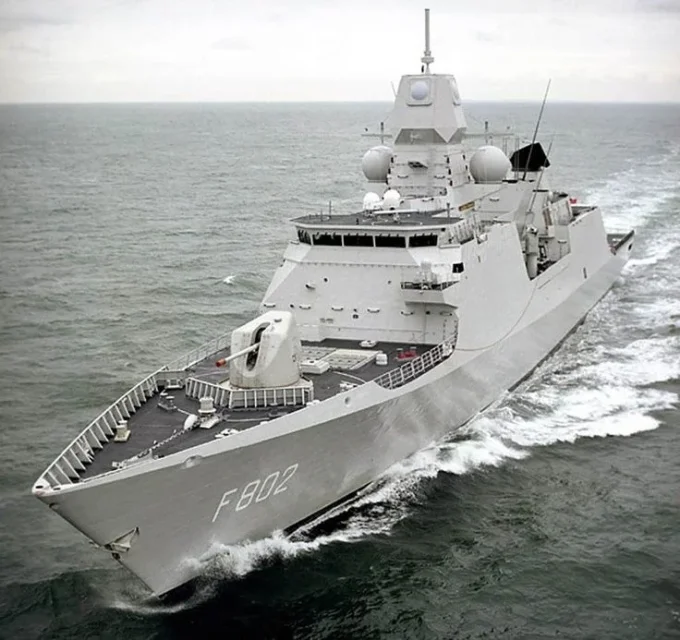
and while the Germans, after the failure of the nfr-90 program devoted themselves to the sachsen, the Dutch gave rise to the lcf (luchtverdedigings en commando frit, i.e. frigated for aerial defense and command) class “de zeven provinciën”, unit that with regard to the general characteristics, are considered among the most complete and balanced of their category.
their history began in 1991, when the Dutch Navy issued a requirement for a new type of air defense unit.
at the end of 1993 the signing of a first contract between the "koninklijke marine" and the royal yards of the Siege for the design, two years after a second contract sanctioned the construction of the first two units and in 1997 was signed that for the last two.
in 1998 it was set, the f802 “de zeven provinciën”, followed after a year by the “tromp”, the “de ruyter” and finally by the “evertsen”,
De Zeven Provincies.webplike all modern naval units, also the lcfs indicate the care put in an attempt to contain the radar track; the same attention was also placed on those of other type (thermal in particular) and on passive safety through the subdivision of the unit in seven main compartments and a high level of protection for the vital areas. the platform is one of the smallest, “baked” only by the sachsen; 144 meters long for 18,8 wide and with a fishing of 5, full-load displacement reaches 6,050 tons.
the propulsion is codog (combined diesel or gas) and employs two diesel engines stork-wartsila 16v6st with a power of just under 10 mw each, and two gas turbines rolls royce spey sm1c from 18.5 mw each on two variable step propellers for a speed of over 29 knots with the tags in action. four 1,6 mw man generators ensure the production of electricity, the stabilization system is of type rudder-roll
The combat system is the sewaco-tacticos of thales nederland, in xi version, specially designed for air defense missions. collected data of sensors and onboard systems are displayed on 24 multifunctional consoles. to the 202 crewmen normally boarded, if they can add another 32 for command and control functions of naval “task forces”.
the radar system is equal to that of sachsen, smart-l for the discovery of aerial and surface targets and apar for their tracking and guidance of standard sm-2 missiles and essm (evolved sea sparrow missile). to these two he adds another, the scout of thales nederland for surface and navigation search; finally, a stn atlas dsqs-24c sonar is installed for research and attack.
the weapon systems present on the de zeven provinciën are among the most complete among those of similar units (sachsen, horizon, alvaro de bazan and daring) today in service in Europe. five modules are installed on the front deck for vertical launch mk. 41 (with the possibility to add another) to eight cells each for sm-2 and essm missiles. to these are added two quadruple launchers for anti-ship missiles rgm-84 harpoon. a 127/54 piece of the oto over and a ciws goalkeeper system. for the contrast of submarines are finally installed two triple launchers for light torpedoes from 324 mm mk 46, while aircraft equipment allows to operate one or two lynx or nh-90 helicopters.


we will then see another military navy, the Norwegian one who in turn embarked on a deep renewal program begun with the corvette class "skjold"
Skjold.webpand then continued with fried class "fridtjof nansen"
Nansen.webp (follow...)
 
(...cont'd)

the need for a new class of challenging units like a frigate, given the small size of a marina that counts less than 4,000 men, was born in the early 90s when the units of the class "hoslo",
Oslo.webpbuilt between ’63 and 67, they begin to denounce all their limitations beginning with the inability to face new threats and to ensure the Norwegian participation in international missions.
the program “future escort frigate” for the realization of six units.
after a long “management”, finally in 1999 the project presented by lockheed martin for aegis combat systems, in collaboration with the Spanish yard izar regarding the platform. the having entrusted the construction to the Spanish yard evidences the descent of the project from the “alvaro del bazàn”
Alvaro_De_Bazan.webpin practice, of copies in a reduced scale.
the length ft. is 134 meters while the width is 16,8 and the fishing of 4,9; the displacement at full load is about 5,300 tons. the forms of hull and superstructures clearly indicate the effort to contain the radar track and are optimized to ensure high sea-holding and quiet qualities that, associated with further measures on the propulsive system, facilitate the hunting operations to submarines.
the propulsion is traditional, codog solution (combined diesel or gas) centered on four bazan diesels good 12v from 4.5 mw to which is added a 21.5 mw ge lm2500 tag for speed ideas to more than 27 knots. the propellers are two and variable step, while for the generation of electricity there are four diesel-alternators mtu 396 12v from 900 kw.

the fighting system is, as said, based on the aegis of the lockheed martin with collaboration of the kongsberg. it associates the command and control functions to those of management of the weapons on board. the “heart” of the system is the passive phased-array radar to four faces fixed an/spy-1f of the same American company. It is a multi-function sensor, able to guarantee the functions of research, discovery, tracking multiple targets (both air and surface) at the same time, as well as driving missiles intended for the interception of targets and shooting direction for artillery pieces.
In addition to the spy-1f, whose antennas are on a specific, evident structure, there are two raytheon an/spg-62 lighting radars for essm missiles. complete the equipment three northrop grumman radars for surface search and navigation.
considered the main mission, that is the antisom struggle, a particular attention was paid to the sonar sensors with the installation an active 2000 mrs and an active/passive sensor towed captas, both of the thales.
the weapons systems available to the nansen are: a 76/62 mm super rapid of the bred oto and a vertical launcher mk. 41 to eight cells each of which contains four anti-aircraft missiles “evolved sea sparrow missile”.
at the center-ship there are two modules from four launchers each for anti-shipping missiles nsm (nytt sjomalsmissil), while for the fight antisom are available two binati launchers for stingray torpedoes, release systems for depth charges and a nh-90 helicopter that has a large poppiero flight bridge and a hangar for its shelter.
the adoption of an integrated platform management system (ipms) and an integrated bridge system (ibs) have allowed to contain the number of crewmen in 120 units, although it is possible to board up to 146 people.

(follows...) )
 
(...cont'd)

we have seen how because of new scenarios of employment there has been a decided increase in the functions and tasks to which the naval units must cope. and if, on the one hand, the platform specialised in a single function, or at most two, is no longer sustainable both for the burdens, and for the operating limits deriving, at the same time the attempts to make a multipurpose vessel, in the strict sense of the term, have proved utopian at least since historically demonstrated.
for decades the configuration of the warship has been an immutable dogma, the traditional displacement famines have represented almost absolute totality of the projects, excluding some attempts by more "ardite" marines such as hydrofoils, hovercraft or ses hulls, but always limited to special means. Today however, attempts to break with traditional patterns and some projects, such as lcs or American “zumwalt” class hunts are increasingly evident.
Zumwalt Underway alt.webpso innovative in some cases, a question to be born... what advantages, compared to the classical monohull displacement that dominated the scene until now, can bring new forms as in the case of the trimarano lcs or the famine “wave piercing and tumblehome” of the zumwalt?
first you need clarification for non-workers... the traditional or displacement hull is characterized by more rounded shapes than other solutions, guarantees good stability and the speed of progress is according to its length.
the semiplanant famine instead has forms that allow it to rise partially from the water, reducing the immersed part and thus guaranteeing a greater speed.
a hull with a hull tumblehome has a width to the float greater than the width to the deck and therefore presents the walls tilted towards the inside.
the term wave piercing refers to the prora straight tilted towards aft and therefore able to crack the waves.
back to the question, are they just “mode” of the moment destined to follow their illustrious predecessors on the path of failure, or are they destined to become the model of the near future?
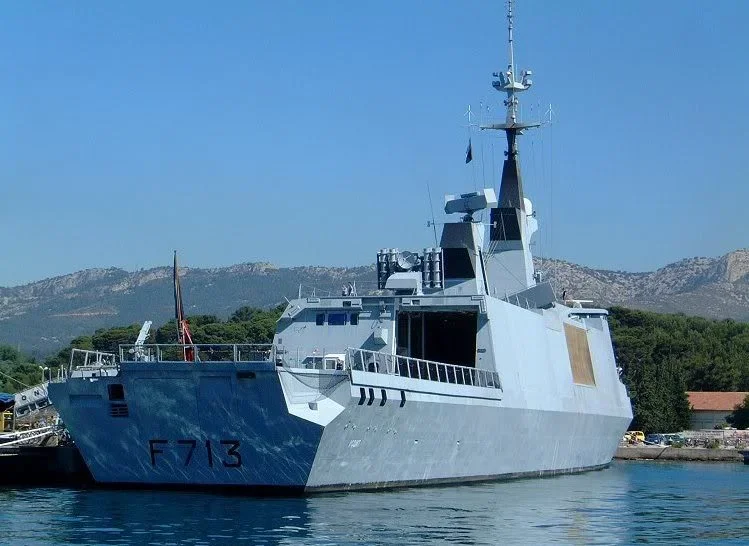
We point out that the new forms of hulls are not due to the designer's advantage but are essentially born in the need to reduce the reflective surface to the radar. This involves inclined surfaces and reduction of angles between walls and superstructures, in contrast to what was the traditional design that wanted straight or inclined walls to the outside to increase the width of the blanket. the frigates French “lafayette” class
nm-lafayette-01.webpnm-lafayette-14.webpwere perhaps the first to introduce the inclined superstructures towards the interior that created a edge (chine) in the intersection with the walls traditionally tilted towards the outside. But this means that if the ship rolls, at a certain time the superstructures will be vertical compared to the sea therefore, well visible from the enemy radar.
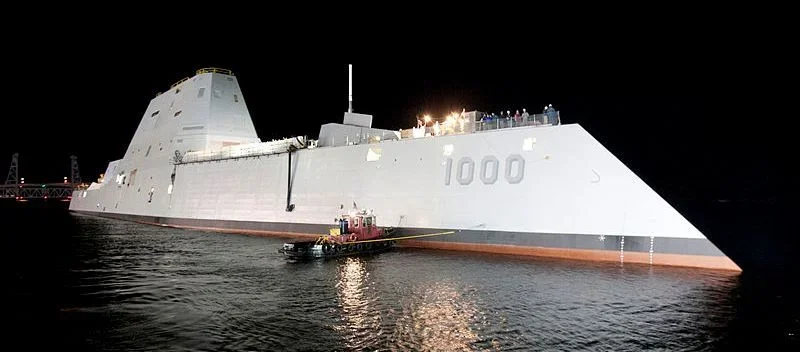
the purpose of the design of the zumwalt project is to avoid the occurrence of this problem with a stabilization that prevents its vertical position and with a platform as low as possible on the water, reducing to the minimum the superstructures.
800px-USS_Zumwalt_(DDG-1000)_at_night.webpand the reduction of the superstructures also increases the ability to survive because the anti-ship missiles generally affect the superstructures or the high part of the walls, then arrange the vital spaces of a warship in the low areas of the hull increases the survival skills even if it requires a greater volume immersed, from which the use of the solution "tumblehome". the paradox is that a ship carefully designed to be stealth, will be greater than one by conventional design.
another advantage of the design of the zumwalt comes from the unusual prora. if we take a conventional design, the bow is tilted forward accompanied by the “stellation” (the staring angle can ideally be measured by tending a lead wire on the edge of the deck of the ship, the angle that forms between walled and wire indicates the degree of starvation), solutions introduced to generate a “door” that can lift the whole prora in case of beaking and to reduce the quantity of covered water. in the prora of the zumwalt instead, called “wave piercing” the beaking causes a decrease of the thrust and the bow, instead of riding the wave “enter” it cracking, this results in a reduction of the stresses induced on the structures.

Many other considerations have resulted in the choice of such a daring design but in the end a 185-metre long vessel, 24 wide with a displacement of more than 14,000 tons. initially programmed in 32 specimens, the rise of costs has falcided the number reducing it to only 3 specimens. It is not only stealth research that has caused such high costs, but also cutting-edge electronics, two multi-arm vertical launchers for a total of 256 missiles, two 155mm automatic cannons and two 57mm ciws systems for point defense. the project also previews the installation of induction guns (railgun) when this technology will mature.

currently none of the military marines, except the American one, presents projects with solutions introduced by zumwalt and even if they are sought stealthness characteristics, you still prefer to orientate on conventional hulls, as in the case of the “project horizon” that will be the next topic...
fine​
 
we want some photos, construction phases, engine room, bridge, housing, operating rooms... :cool:
 
Ohhh, are you always complaining?
and I can't even fuck you because you're my audience...:biggrin:
And you like us a little bit...... :tongue:
We make you feel the perfide pirate commander of a ship (always pirate obviously) that angaria (you can say) his crew.
Hi.
 
we had already mentioned the multi-national program between Italy, France and, great brethren, called “horizon” that was born after the cancellation, occurred in early 1990, of the tormented program nfr-90 (frigata replacement for 90).
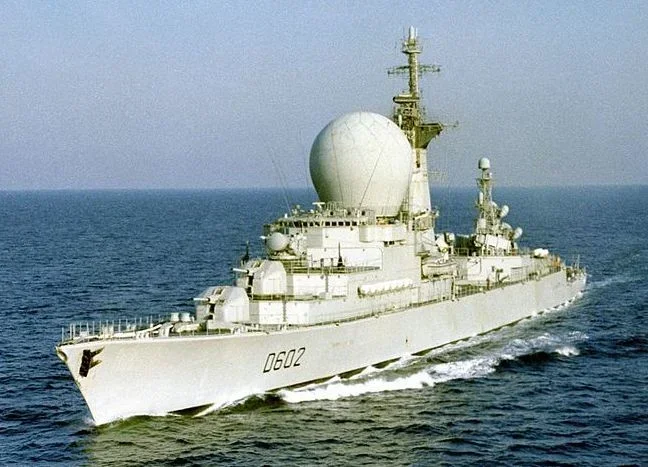
the royal navy, which had the need to replace the 12 ddg type 42 or class “sheffield”, type_42_sheffield_class.webp and the france that had to replace the class “jean bart” Jean Bart.webp and the class “suffren”, Suffren.webp they agreed to give life to the common a3f program (anglo-french future frigate) for the realization of a ship with very advanced characteristics and addressed to the aerial defense. the preliminary agreement was signed in 1991 and confirmed in the summer of the following year. in December of the same year also Italy entered the re-designed program cgnf (common new generation frigate) and later “horizon”. responsible for the project were malcom mcintosh, yves sillard and for Italy the ammunition that established a fair division of the costs of development and construction proportional to the number of units to be realized. at the time it was thought to build even 22 so divided: 6 for Italy, 4 for France and 12 for the great brethren. in the estimate of costs, between 6 and 8 billion pounds, was excluded the missile system which would have weighed considerably on the final price. from the feasibility study a ship of 6300 tons, 140 meters long and about 20 wide that would be developed in parallel to the French-Italian fsaf program (future surface air family) relative to a new family of surface/air missiles and a medium-range naval missile.
in London, it was on September 1, 93, became operational the jpo (joint program office) to which it was attributed the management of all the activities of the program and within it assumed a fundamental role the paams combat system (principal anti air missile system), a surface/air missile system for point aerial defense within 10 km and medium/long range for threats to high altitudes.

we will then see the consequences of this choice...

we arrive at summer 1994 when with the theme of the mou (memorandum of understanding) by the three governments concerned, the horizon program, despite all the difficulties, seems to have taken the right path for its realization. In fact, in February 95 the international joint venture company was established with the task of managing the industrial program of the project while for the construction part an agreement is signed between the French of the dcn, the English of the gec-marconi naval systems and, the Italians of the consortium horizon (Finmeccanica and fincantieri). In short, the intentions promised, too optimistically, to succeed in bringing together the needs of the three countries.
the france wanted a ship with strong anti-aircraft characteristics for the escort of the charles de gaulle even if in limited number considered the ability to self-defense of its carrier.
Italy also demanded anti-aircraft characteristics to escort the cauliur but with a radius of operation not excessively extended, being able to count in Mediterranean on the coverage of the military aviation (it seems the history does not teach anything...).
the royal navy, on the other hand, considered it necessary to equip itself with more autonomy, capable of carrying the protective ability to a fleet that operates in hostile zones from the mother's homeland.
the compromise that seemed to solve the querelle, was the adoption by italo-French of the radar empar (empar phased array g band multi-purpose radar) to electronic scan passive matrix,
EMPAR.webpwhile the British would install the sampson (type 1045).
SAMPSON.webp(follow...)
 
(to be continued)

However, the period 95/96 served to bring new, different needs and numerous technological problems to light, so that a slippage of the date of entry into service until at least 2006.
It seemed more and more clear that the French-Italian solution would hardly have satisfied the British demands that now also concerned the propulsive apparatus.
This state of affairs led to the inevitable breakup of the pact and in March 1999 the nghilterra came out of the agreement giving rise to the ddg type 45 project vented into the "daring" class.
Despite the serious defection, Italy and France decided to continue in the development of the program and on 22 September 2000 the agreement on the technical characteristics and the general configuration of the ship was officialized. codog propulsion with 2 general electric gas turbines – improved fiat lm2500 and 2 diesel semt pielstick. control and control system in improved version of the French senit 8 already adopted on the de gaulle and 76/62 super rapid oto melara (two for the French and three for the Italians) instead of a 127 as originally planned.
renouncing the artillery piece prevented the use of the space made available for any additional modules of the sylver missile launcher aster paams.
the mou then named the French-Italian consortium "horizon sas", constituted by finmeccanica fincantieri and armaris, chiefcommittee of the realization whose first order was signed on 27 October 2000 for the construction of 4 units whose burden was estimated in 2,8 billion euros excluding the missile system paams (which would be purchased with a separate contract at the cost of approximately 80 million per ship).
for information, the combined kingdom for its “ddg type 45” preferred to adopt the American mk4 system capable of launching tomahawk missiles.

for the Italian units the cut of the first sheet was for the ddg 553’ “andrea doria” (which was initially intended to be called carlo bergamini, instead attributed to the first of the fremm) on 19 July 2002, while for the ddg 554 “caio duilio” on 19 September 2003, both in the trigous yards, while the French (“forbin” and “chevalier paul”) were built in the yard dcn the doria was launched on 15 October 2005 and transferred to the yard of the muggiano of the spice for the stage of preparation.
on 20 September 2006, tests began at sea, but the ship will be completed in November 2008 as evidence of the complexity of the work. Nave_Duilio_modifica.webpchevalier-paul.webpafter the description of the long “management” of the project, we now see the characteristics of the two units.

the platform has an original and innovative general configuration. the length outside everything is 152,87 meters, between the perpendicular is 141,7 m, while the maximum width is 20,3 m (at the line of the float 17,9 m); the construction height is 11,8 m but the tree rises to reach 43.2 m. the dive in correspondence of the bulb reaches 7.5 m and the displacement is 6635 tons.
the hull has been realized almost entirely in s355nl steel and s355j2g3, but on the Italian units (not on the French) the front tower and the central tree are in light alloy to "low" the center of the ship.
the famine was designed by fincantieri taking into account the experiences matured with the “de la penne” and provided excellent results to the tests. counts on an active system of automatic stabilization to 4 non-retractable fins that allows to conduct flight operations even with sea force 5-6. The thymones are two and are semi-compensated.
the motor apparatus is on two axes and two fincantieri propellers with 5 adjustable and reversible blades from 4,8 meters in diameter. There are two machine rooms, prodier and poppiera, arranged in two soundproofed compartments. the configuration is of type codog (combined diesel or gas) that is the classic scheme of frigates and hunting in service with the mm, pattern reached after long discussions with the transalpine counterpart. diesel engines are two 12 cylinders diesel s.e.m.t. pielstick 12 pa6 b stc 4,32 mw (5,875 cv) each. motors are delivered in more than 350 units for 12 marine units. designed for long low-speed navigation, they are characterized by the “sequential turbo charging” , two turbochargers that come into operation in succession allowing reduced consumption and operating flexibility.
Diesel pielstick.webpgas turbines are two general electric – avio lm 2500 from 20,5 mw each.
TAG.webpare installed in soundproofed containers and equipped with electronic control units developed by the avio, have reduced dimensions and weight. are of the same series of those boarded on the cauliur with different calibrations. the lm 2500 was produced in more than 2000 specimens but compared to those embarked on the master class, they had over 300 modifications.
a prora is installed a trhuster to facilitate maneuvers and mooring.
the total power is slightly higher than that available on the “durand de la penne” which have a displacement however less than 1000 tons.
the two gearboxes are locked to the dcn with hydraulic insertion, the maximum speed on the tags is 29 knots, that in diesel drive is 18 knots. the electricity is produced by 4 diesel generators isotta fraschini vl 1716 t2 me from 1.6 mw. in normal condition two groups are used thus using a surplus of 100% energy.
all distribution system is controlled by a computer-controlled system.

(follows...) )
 
(...cont'd)

the platform is completely managed by an integrated automation system (platform management system of the dcn company) pms for the conduct of the motor apparatus (mcas), electric plant (epcams), auxiliary (ascs) and safety service (dsac) with possibility of conduct from the bridge, the scc/cop or the two stations located in the zcp (zone control post).

as the tradition of Italian combat units, the hull also allows the float with 3 of the 12 pond compartments, adjacent to the flood. the shape of the hull is characterized by surfaces appropriately inclined in order to reflect the radar waves in different directions from that of origin making the rcs (radar cross section) as limited as possible. the study has been conducted with the collaboration of the “system engineering” and has led to conceal all the installations that are usually arranged outside as for example marine mooring accommodations. the purpose I remember again, is not to become “invisible” but rather, to reduce the distance from which the ship can be identified. special care has also been placed in the reduction of the ir marking with the adoption of “educers” that significantly lower the temperatures of diesel exhaust gases and tags, moreover the motor apparatus is soundproof reducing thus the radiated noise.
a field to which special care has been reserved is that of safety: the machines are protected by shocks and vibrations with a proper sizing of the supporting structures and the use of elastic and antivibrant supports; the operating premises particularly “sensitive, inside the superstructures, are protected by an intercapedine of anti-foul and anti-explosion ballistic steel; the nbc defense is ensured by a filtered air circulation in case of crossing of radioactive clouds, pressurization and, by a washing system, while passive defense is ensured by fire systems of various nature (water spraying, boiled water nebulization, foam, co2, powder).
the superstructures are asymmetrical and disassated (as well visible in the photo),
horizon.webpdivided into two blocks at the height of the blanket due to the presence of the entrances of the areas destined to the supply in the sea. There is also a large portal for easy loading/unloading of materials. on the sky of this tuga are the launchers for the anti-ship missiles we will see later. the prodiero block is dominated by the large bridge overstated by the “must” that houses most of the sensors and antennas of the ship. immediately behind this truncated pyramid, it is slightly disapproved on the right, the central tree with its antennas for communication and at its side, the imposing fumaiole of the prora machines strongly inclined to the outside. passing through the central tuga, there is the stern block with the second chimney tilted from the opposite side and the large tower surmounted by the antenna of the radar lrr s-1850m.
Andrea Doria destroyer.webpa small superstructure on the right side over the hangar and serves as a base for the 76/62 super fast. the blanket ends with the flight bridge of 494m2, studied for the use of day/night also under adverse conditions of an eh-101 thanks to the tc-asist of the Canadian company indal technologies in collaboration with the calzoni (a nhf-90 on the French with system samahe of the dcn). the hangar can accommodate and support an eh-101 or a nhf-90. for control operations by teams of specialists, the ship has a fast boat that can be put to the sea and recovered from stern as well as two rigid bark gums housed in two recesses of the poppiera superstructure and protected by antiradar shutters.

but the structurally most important novelty is undercover.. .

(follows...) )
 
(...cont'd)

In addition to a central corridor that runs through the hull from stern to prora, there are two “technical series” parallel to it, placed in walls, inside which pass tubes and cables necessary to the operation of the systems of edge.
This solution, in addition to special disassembled openings, allows rapid replacement of systems and devices and significantly improves the liveability for the crew by approaching the American standards, the interior premises are thus "sew" from pipes, cable roads, etc. also offers additional anti-missile protection. This is a real innovation for the mm units.

on the horizon the level of automation is so pushed by having allowed to limit to only 189 the members of the crew subdivided into 24 officers, 53 sub-offices 33 sergenti and 79 troops of truppa, with the possibility however to "locate" up to 230 (if you think that on the pens are 330, you see the remarkable progress in this sense), crew that is housed in maids from 1, 2 and 4 places (second part of the corridor
for the management of electrical, auxiliary, services and safety systems, there is the integrated automated system pms (platform management system) that can be used by the operating power plant, the bridge or, from stations present in different premises.
This is a system developed by dcn, avio and elsag whose value amounts to 16 million euros, employs cots components (commercial off the shelf) adapted to the requirements required by the classification authorities and mil legislation. signals, collected by sensors, travel on an optical fiber network that connects the operator stations.
large space deserves the fighting system constituted by a complex system of sensors and weapons in many cases unpublished for the units of the mm whose management is entrusted to the cms (combat management system) of eurosysnav, an architecture called "federated" that represents the state of art in its kind, a sophisticated system that replaced the previous sadoc 2.
counts on 22 software modules, 20 control desks, 10 processors and 1 million code lines. allows the management of armaments, tactical links and the analysis of the information transmitted without forgetting the integration of the data coming from other ships or aircraft, both Italian and allies. There is also a secondary power station, with 3 consoles, capable of subduing in case of destruction or avary of the main system.
the most complex and sophisticated equipment is the “volumetric radar 3d multifunctional phased passive array – empar”. its antenna, a square of 2 meters on the side, rotates at the speed of 60 g/min. is inclined by 30 degrees and counts 2160 “sphasers”, placed on the top of the tower is enclosed within a 5 m radius of diameter. can discover a target of 10m2 at a distance of 120km or a target of 0.1m2 (a missile) at 50km. the epar is also composed of a number of equipment including the power transmitter and the real “management calculator” of the system. the epar is an integral part of the paams system (prncipal anti-air missile system), a sophisticated anti-missile system that, with very short reaction times, guarantees a multi-layered air defense to the naval formation of which it belongs. if the epar is the mind, the aster family represents its arm. aster 15 and aster 30 missiles, launchable from the vertical silver a50 system, a 6-cell complex for a total of 48 fire-ready devices,
vls sylver.webpare in possession of the sophisticated and innovative flight control system called “pif-paf” that guarantees high manoeuvrability, and an advanced driving system that if initially is inertial, after receiving flight data from the epar, uses an active “seeker”. these make it useless, contrary to the standard/exsm American system, dedicated illuminators. the aster is a missile with a 0.18m bistadium propulsor in diameter and differs in versions 15 and 30 exclusively for the booster. in version 15, 4.2 m long and weighing 310kg at launch, the aster reaches the mach 3 3 has a range up to 30km and 13 of altitude. the aster 30 is 4,9 meters long, weighs 450kg, can reach 4,5 mach and has a range of 120km.
ORD_SAM_Aster-30_Launching_EADS_lg.webp(follow...)
 
(...cont'd)

volumetric radar 3d “early warring” for long distance aerial research is the bae system s-1850.
s1850.webpequipped with a stabilized antenna 8.2 meters long and 6.2 tons heavy, which rotates at a speed of 12 g/min, allows to discover and track 1000 targets. This is a great power equipment and allows accurate three-dimensional information on potential threats allowing the aa system to “enter” to the target as soon as possible.
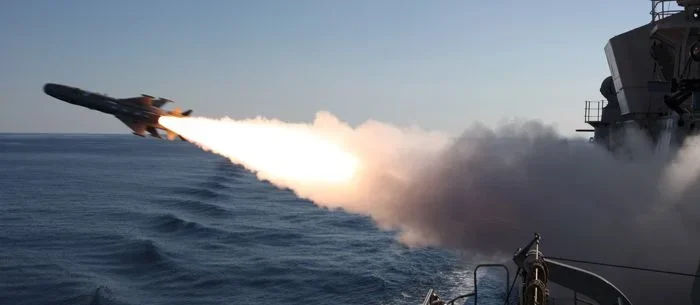
surface search radar is selex s.i. rass (mm/sps-781) present only on Italian units, and has a range of 50km.
to finish the roundup on the radar, I remember that there are three navigation radars, two multisensor pointing systems (radar and electro-optic) mstis na 25x (rtn-30x), a radar for helicopter coupling.
complete the equipment a system of discovery ir (iras) sagem vampir mb and a medium frequency sonar thompson/thales marconi sonar ums 4110 cl.
all these systems are visible in the image of the doria posted previously and identified with different colors.

The counter-coast/connave armament deals with the missile system mbda teseo mk2/a located at the ship center with 4 complexes each with 2 containers (the French have the exocet mm-40 always of mbda).
original_OTOMAT_TESEO_02_w.webp exocet_mm40_block3_4.webpWhile on the pens as a multipurpose rocket system the French sagaie had been installed, here it returned to the sclar in its latest version, the "h" remotely controlled, present in two specimens. the new multicell complex weighs without ammunition 1150kg, can launch 20 105mm rockets or 15 from 105 and 4 from 118mm and also uses rockets intended to transport anti-ship missile deceptions.
sclar-h.webp SCLAR_H.webpfor the antisom struggle, in addition to the helicopters boarded, the doria can count on two binati launchers “eurotorp mu-90 impact” for 324mm torpedoes with capacity up to 25km,
24 torpedoes.webpthat are part of the slat system (systeme de lutte anti-torpille) which is based on three main components: the search module (alert) with sensor towed sonar and hull sonar, a threat assessment module (rate) that analyzes, evaluates and decides, and the module for countermeasures (cmat) constituted by a multicell launcher to 12 tubes, for electro-acoustic decoy able to create a “image” sound similar to that of a ship or jammer type that emit signals capable of obscure the head.
(follows...) )
 
(...cont'd)

Let's go to the artillery now.
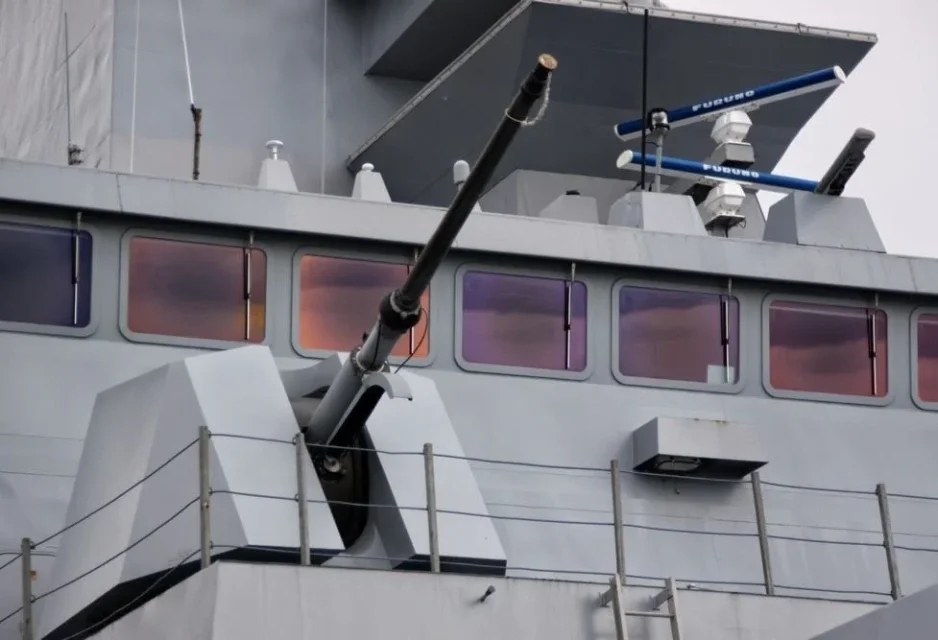
the last defense, in case a missile has managed to exceed the three degrees of barrier of the paams, is entrusted to the naval cannons oto melara 72mm/62 super rapid in stealth tower (two specimens on the French, three on the Italians), dua to the bow in front of the block of the anterior superstructures and one aft over the hangar.
as the systems placed on the “commandants”, are equipped with the update of the schooner that allows to transfer information in real time from the shooting center to the ammunition. in the future is previewed the adoption of the kit rhinestones for the guide of the undercalibrated bullet to correction of trajectory “dart”. the bullet measures 40mm in diameter, exits from the barrel at 1200 m/s and after 5 seconds is already at 5000m away. Of course, the 76mm towers can also be used for countercoast or anti-ship shooting. In addition to 76, there are two kba machine guns of 25/80mm in a single complex melara oto mod. 503 with stabilized affusto.
main guns.webp
gun.webpLast but not least the fics (full integrated communications system) that uses satellite shf/uhf sicral systems, hf, vhf,uhf military, vhf icao, vhf imm, inmarsat, metoc and gmdsss and datalink multitactic system.

in conclusion we can affirm that the horizon program was one of the most important, both for the technological and financial commitment, of the new millennium and has produced innovative and extremely valid ships.
It has certainly lost a lot of time, especially when compared to German, Dutch or Spanish programmes, and this is distrusted by the difficulties to grant the needs and to “synchronize” the complex industrial organization of the two countries. It is necessary to take into account that while these have resorted to the American missile system, France and Italy have preferred to travel the far more demanding path of binational development that has required time for development and development.
Nevertheless, for the first time, two European marines managed to realize together an important class of ships, with undeniable logistic advantages and standardization since the joint between the Italian and French versions is 90%.
Moreover, the experience gained was fundamental for the next fremm program.
for the Italian industry was able to accept to the ultranationalist France systems like 76/62, radar empar, tags, etc. etc. can be considered a remarkable success.

a last curiosity...
the first French unit, the forbin, during the preparation presented problems of installation of the combat system and strong problems of rust. . what our units have not yet shown.
Nave-Doria-.webp
fine
 
What's the end? :frown:
Look at that we don't slow you down, you know!
:3559:
What do you tell us about beautiful now?

jokes aside, what do you mean in the last post when you write:
"as systems boarded on “commandants”,

What are the commanders?? Did I miss what??? :confused:
Hi.
 

Forum statistics

Threads
44,997
Messages
339,767
Members
4
Latest member
ibt

Members online

No members online now.
Back
Top