• This forum is the machine-generated translation of www.cad3d.it/forum1 - the Italian design community. Several terms are not translated correctly.

the technique and history

  • Thread starter Thread starter Exatem
  • Start date Start date
What's the end? :frown:
Look at that we don't slow you down, you know!
:3559:
What do you tell us about beautiful now?

jokes aside, what do you mean in the last post when you write:
"as systems boarded on “commandants”,

What are the commanders?? Did I miss what??? :confused:
Hi.
You're right, maybe I talked about it in "over and under..." but I had to specify better.
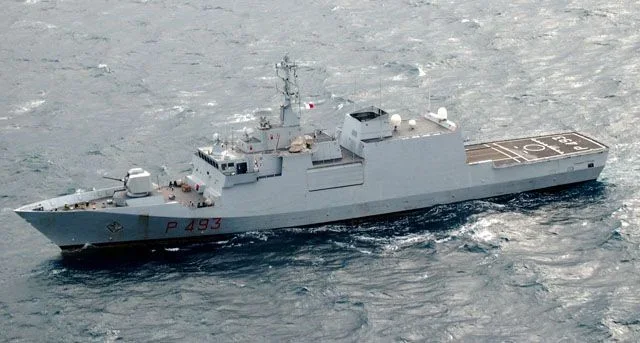
the "commandants" as I called them, are a class of 4 units that mm ordered in 1999. are more likely defined numc (new minor units fighting) or more simply "patches".
are the ships that are among the main protagonists of sea nostrum. the four ships are called "juseppe cigala fulgosi", "coast borsini, "ener bettica", and "adriano foscari", in memory of as many decorated with gold medal to the military valor for enterprises completed in the Second World War.
have length of 88.6 meters; width of 12.2 m; construction height 8.2 m for a displacement of over 1800 toon full load.
2 diesel wärtsilä-nsd w18-v-26 xn with a power of 6480 kw at a 1000 r.p.m. that develop a continuous speed of 25 knots and a peak speed of 26 knots on 2 axes with 2 propellers with 5 swivellable blades, 2 fincantieri gearboxes, 2 sword timones, there is 1 propeller of maneuver at the bow.
the new patrols were the first stealth units of the Italian Navy, officially ordered in April 1999 with the aim of replacing the scattered hydrofoils and maintaining the second line to 16 units.
of the four ships the p493 seals was built with the composite superstructure instead of steel, this has allowed to save 40% of the weight with a consequent reduction of consumption and wear in the life cycle of the ship. the structure has been realized by intermarine with the express request of the marina to maintain unchanged the geometries regarding the steel version.
the superstructure is mainly built in glass fibers duly integrated with other structural fibers that give additional features such as the bridge area, which includes an integrated ballistic protection made of alternate layers of fiberglass and aramid fibres that at the same time offer structural strength and protection from the threat of a born std caliber 7.62. to increase the coverage of electronic devices some parts of the hull are integrated carbon fibers.
the foscari recently was selected to experiment with the stealth shield to the main cannon and for the tests of ammunitionally davide/dart for the oto 76/62 cannon. the foscari, last of the class, was stuffed in January 2004.
1627a.webp
It's no!!!!!! ! ! ! ! ! ! ! ! ! ! ! ! ! ! !
What do I read?

I was an artillery
Talk to us
m 107

amphibians like 113 etc.
Hello exa....... .
Good Sunday

Hello, Enzo. Thank you.
It is not that I know a lot about the army.
Then I'd like to close the fleet by visiting the flagship, the cauliflower.
Let's see. I just find some time.
 
Last edited:
a last curiosity...
the first French unit, the forbin, during the preparation presented problems of installation of the combat system and strong problems of rust. . what our units have not yet shown.[/CENTER]
How come? The French?
 
Thanks for the exa answer, always precise and punctual :finger:
duty! :-)


I found some material on the American ddg zumwalts (I mentioned earlier).
considering that this is an innovative project, I thought I'd spend some time before facing the cauliur.
What do you think? Interested?
 
duty! :-)


I found some material on the American ddg zumwalts (I mentioned earlier).
considering that this is an innovative project, I thought I'd spend some time before facing the cauliur.
What do you think? Interested?
ahia and what is......... .
:confused:
something you eat?? ?

Anyway, as far as I'm concerned, I'm omnivorous, so if you want to leave, go ahead. :finger:
Hi.
 
We begin the usual long discussion on a historical/technical topic continuing to analyze the current trends in world marines. Today we go to sewing in the use...
premessaanalyzing what are the new “tendenze” among the military units of almost all the marines of the world, we mentioned to the lcs units and the ddg1000 class “zumwalt” that is, the new U.S. destroyers, a program to say little ambitious both in numbers and objectives. But first we see how the Americans interpreted the concept of “modular ship” compared to what their European colleagues did.

the end of the Cold War and the terrorist attack immediately in October 2008 by the destroyer “uss cole”, strengthened in the American navy the sense of unpreparedness towards the threat represented by small fast boats operating in coastal environments. this led to a reformulation of the U.S. maritime strategy, called “sea power 21”, articulated on three fundamental principles: offensive projection, defensive power and, deployment of forces.
These three families were the foundations on which the new operating concept was built, known as “global conops”, which defined roles and functions of each category of units available to the naval apparatus. In this context, it played a fundamental role in a unity that guaranteed an effective presence in coastal areas also distant from the American continent. the program lcs responded and these needs and would have helped to reach the goal of a us navy bringing the number of its units to 315, a number below which was considered very risky to descend, but at the same time succeeding to some deficiencies relative to the ability to carry out certain missions.
the sea power 21 also previewed the replacement of the 51 frigates of the class "perry", units conceived in full cold war but now arrived at the end of the career, with cheaper ships, an operation to be framed also in the context of the renewal of the American fleet, aware that it would be very difficult to increase the number of carriers, cruisers and, submarines. in practice the new American navy should have been centered on 3 platforms (excluding aircraft carriers, underwater vehicles and amphibious support): dd(x), cg(x) and lcs.
only that the new class of cruisers is “disappeared”, the destroyers have passed as we will see from 32 to 3 and the lcs, have been heavily resized since it will not go, perhaps, beyond the 32 units.
in their place a new class of units per hour only mentioned, probably a frigate, more likely a modified version of the same lcs. In practice, this is a total failure in a complex and secure environment.

the American navy in recent years has accumulated an intense operational use of its units in every corner of the planet, exhausting the ever less economic resources victims of the cuts imposed by the last administrations, after years of constant growth of the funds allocated on the wave of anti-terrorism commitment. This reversal of the route has led to a deep analysis of the entire apparatus which also considered new operational needs such as repositioning to Asian areas of the Pacific rather than those of the North Atlantic. the crossroads in the face of which the armed forces of the use have been found, has made decisions to say little questionable of which are responsible in part the pentagon and in part the politicians.
programmes to say little pharaohs children of distorted visions, both short-lived because they proved excessively expensive and/or because conceptually wrong, they survived at the cost of very large funding.

some examples can be clarifiers...
the "future fighting system" of the army clamorosamente failed after having literally devoured funds and funding for years, program strongly wanted by the defense minister donald rumsfeld who would provide the army 18 new systems of heaven and earth integrated among themselves according to the mythical doctrine of the c4i (command, control, communication, computer and intelligence).
the “expeditionary fighting vehicle” of the Marine Corps, an amphibious vehicle prototype characterized by numerous problems, also important, of technical character and development.
or for the us air force, the f22 “raptor” (they were made in total 187 at the unit cost of 339 million dollars) and the b2 “spirit” whose cost, between costs of design, development, production and, integration of the new equipment, has been set on a value of approximately 48 billion dollars (this figure, spread over only 21 specimens, translates into a cost of 2,2 billion dollars even embarrassing programs in numbers.
and the f35 “lightning”, to stay in topical, is not showing better...
(follows...) )
 
Last edited:
(...cont'd)

but in this unconstructed context the navy used has been particularly distinguished for which not only one of the programs is punctual and without problems. for example, we take the new “gerald ford” nuclear aircraft carriers whose first cutting of the plates took place in August 2005. Currently only the first of the 3 units planned is under construction (and it is expected that it will not be delivered before 2016) but on it weighs the weight of the costs (more than 14 billion once completed), beyond 22% more than anticipated.
huge reliability issues come from a key system such as emals (electromagnetic aircraft launch system). also for the new eleven lpd-17 of the “san antonio” class the costs are practically doubled accumulating delays of more than 3 years.

a program we mentioned, but that will be the next topic, is that concerning the lcs (litoral combact ship) whose purpose was to replace with a single platform both the frigates class “perry” and some “avenger” and “osprey”.
the program, born over ten years ago, previewed as a point of force the "modularity" that is the possibility to change different "mission packages" according to the needs. a platform that would have to cost about 220 million dollars while we are already around 430÷440 million (“mission packages” excluded).
this because instead of choosing one of the two totally different projects presented by competing yards, it is preferred to proceed to the purchase of both. also of the so-called “mission packages” (miw, mine warfare more asw and asuw, anti-submarine/anti-surface warfare); no one is yet operational and it is not clear when they will, how much they will cost and above all, how effective they will be compared to the assigned missions. at this point the “solution” decided by the secretary to the defense was to reduce from 52 to 32 the lcs to be realized.

paradoxically it seems that the only relatively quiet program is that of the destroyers of the class "arleigh burke", unit conceived in the 80s and that, according to the current plans of the American Navy, will continue to be built at least until the end of the 2020 years with the version flight iii; the result will be that the last burkes will leave the service about 70 years after being conceived...
and finally we come to one of the protagonists of this chapter that we could define the most significant and embarrassing representative of the confusion that reigns in the us navy, the ddg-1000 class “zumwalt”.

(follows...) )
800px-USS_Zumwalt_(DDG-1000)_at_night.webp
 
Last edited:
(...cont'd)

Let's talk about a program born in the 90s with little ambitious numbers, resized over time and survived the expense cuts. before technical analysis... a bit of history.

in 1991 the us navy started the “21 st century surface combact” i.e. a program whose aim is the development of a family of platforms that from the remarkable initial number fell to the study of a “destroyer” (cacciatorpediniere) and a “cruiser” (cruiser) and then concentrate exclusively on the first of the two baptized dd-21. the need to replace the “spruance” class and the 51 frigates “perry” class had determined the choice.
It is evident how strategic senators are to determine the need to equip themselves with a system rather than another and the American leadership, taken note of the changes resulting from the collapse of the Soviet bloc and consequently to the increasingly remote possibility of naval confrontation in large ocean spaces, they considered to have to equip themselves with units capable of operating in “littoral” environments without compromising operations in open sea.
but what does it mean to operate in “littoral” environment?
We start from a simple observation, 60% of the urban areas of the world are within 50 km from the coasts. this makes it indispensable “land attack” capabilities especially in function of support to amphibious operations of marines. In fact, during the crisis of the Libyan of 1983-84 and the "desert storm" of 1991, the old armoured "iowa" class from the world war and their artillery from 406 mm took over the role of naval gunfire support (ngfs) and naval surface fire support (nsfs).
but the coastal environments are hunting ground of the fearsome conventional submarines and ground-based aviation therefore, they also make indispensable antisom and anti-aircraft capabilities. the new dd-21 should therefore possess such characteristics in modern key and with wide margins of growth, a platform that is from the "open" architecture guarantee of future modernizations.

In January 1995, the sc-21 programme was launched, which included the concepts so far expressed. the us navy on this occasion believes to carry out in a single solution both the phase “concept design” and the “initial design” focusing immediately on what the priority program that is the dd-21.
two industrial teams present at the race: the “blue” and the “gold”. the first is led by the bath iron works/general dinamics with the participation of the lockheed martin, while the second consists of the northop grumman ship system and the raytheon integrated defense system. as each race, at the end of the selection, only one of the two teams could have continued with the signing of the contract for the construction of the units.
but on May 7, 2001, when it was one step away from the selection of the winning team, the news came about the suspension of the program 21 following a complete redefinition of the requirements and operating concepts that in practice leads to the definition of a new family of units.
so the lcs (littoral fighting ships) are born not only to replace the frigates class "perry" but also the hunters class "osprey" and "avenger" while for cruisers and hunts previewed in the suppressed program 21 are coming important news...

it is thought to start with the design of a destroyer on whose hull then you can develop a new cruiser.
in this reorder also change the names of the programs so the dd-21 becomes dd(x) while the cruiser becomes cg(x).
not only the names but also the specification of the project beginning with the “numbers”. the 16,000-tonnes hypothesised will have to be reduced to 12,000 while the 32-inch units will become 24. Thus the selection that sees winner the team “gold” but as the whole world is country, the classic recourse of the defeated team temporarily blocks the procedure.
Finally, rejected the appeal, in August 2002 the victory of “gold” can be confirmed. phase 3 begins at this point in which companies focus on the most "delicate" technologies such as the reduction of radar and infrared marking, the forms of hull and main systems such as total ship computing environment (tsce), the integrated power system (ips), the advanced gun system (ags), the horizontal vertical launch system (pvls), the dual radar band (db firewr), the
in 2005 the programme is considered sufficiently developed to start production and within a few months the contracts of phase 4 are assigned in which the main contractors are designated: raytheon integrated defense systems, bae system, lockheed martin and boeing.


(follows...) )
 
everything ok until now but......... .
but lockheed martin wasn't in the "blue" team, the defeated one?? ?
:
 
everything ok until now but......... .
but lockheed martin wasn't in the "blue" team, the defeated one?? ?
:
You're right. to try to synthesize, I omitted a part making the speech confused.
between 2002, year of consecration of the gold team as winner, in 2006, the year when the navy us from start to stage 4 i.e. that of designing detail, an important novelty has happened. the companies involved in the program, are associated with the “national team” for which 4 main contractors are identified, the yards ngss and biw/gd, raytheon integrated defense sysytem, bae system. with a lesser role are also part lockheed martin and boeing. I mean, the war was first and then the cake was split.

Sorry about the mistake.. .
 
Last edited:
(...cont'd)

but it is at this point that there is an unusual turning point and that will be decisive.
after lively discussions in fact congress, pentagon and us navy agree on a new strategy. instead of awarding the entire contract to the winner of the race, it is decided that the first two units will be built by two different yards. the idea officially was to stimulate competition between the yards and then compare the results by choosing the one considered better but in reality already in this phase it was decided that the commission would be divided equally between the two yards. Employment problems probably led to this decision in addition to the aim of providing the two groups with a significant technological development opportunity.
between all these passages the number of dd(x) to be built had fallen further from 32 already reduced to 24, to only 8 units even if the marina had indicated in 16 the number necessary. the program had decreased by a quarter making the cost of each unit disproportionately rise. in 2006 the us navy announces the optical badge and the name of the new class; ddg-1000 zumwalt. elmo zumwalt was between 1970 and 1974 the "chief of naval operations" of the American Navy author of an important reform of the staff of the Navy in an attempt to improve the life of the enlisted staff and loose the racial tensions. Meanwhile the work continues and on 13 February 2008 are awarded the two contracts of which the first to the blue team worth almost 1.4 billion dollars and the second, to the gold team of slightly higher value.
at this point it was thought that the obstacles were overcome but instead on 31 July 2008 a clamorous fact occurred. the parliamentary committee responsible, in fact, announces the intention to interrupt the program to the only 2 units in contract, but made even more horrific to certain aspects, are the reasons that led to this decision; ddg is unable to ensure air defense.
In short, when we had already reached the construction we realized that in super-technological zumwalt could not guarantee the same performance of the “burke”, in practice, even if not officially declared, we must admit to having developed platforms with dimensions (but also from the costs) disproportionate to the face of too limited operating capacities and almost confined to the only coastal scenarios. the adoption of the dbr (dual radar band) does not allow the use of sm-2, sm-3 and future sm-6 missiles, does not absolve to ability to defend from ballistic missiles. as one can imagine the decision raised a sea of controversy especially for the amount of billion dollars already spent, also because raytheon had ensured to be able to integrate its systems both with sm-2 and with sm-3...

but in my opinion a fact is particularly indicative of the confusion that struck the summits of the us navy.
ddg-1000 are born with an inadequate sonar suite especially for a unit intended to operate in a coastal environment or the preferred environment by conventional submarines. intervention now to improve performance would have meant a further important burden of costs without guaranteeing the overcoming of the characteristic limits of the platform.
because the truth is that the American navy has embarked on an overly ambitious program, from unsustainable costs and despite this, with serious operational deficiencies. However, even for the employment concerns of such a drastic reduction, the navy authorized the construction of a third unit even if it had to overcome a further obstacle i.e., the violation of a rule that provides in case of significant increase in costs the revision of the program; violation caused by the decision to limit the number of units to be realized thus sharing the costs of research and development on only 3 platforms. In fact, when the program began, the cost estimate, drawn up in 1998, provided $35.8 billion for 32 units equal to a unit cost of 1,14 billion. today the last estimate made in August 2013 calculated in 22 billion pairs to 7,33 per unit i.e. an increase of 540% compared to the initial forecasts!

finally in October 2010 also this obstacle is exceeded...
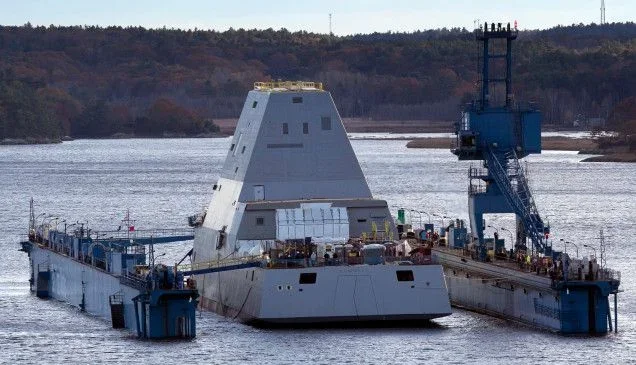
on 17 November 2011 the setting ceremony of the first unit was held even though the construction of the modules had already begun in February 2009. on 28 October 2013 the official baptism took place on 12 April 2014. the first tests at sea are planned for the spring of 2015 to witness the long gestation of the program. the second unit saw the beginning work in March 2010 although the setting ceremony was held on 23 May 2013. delivery is estimated in 2017.

(follows...) )
 
(...cont'd)

zumwalt
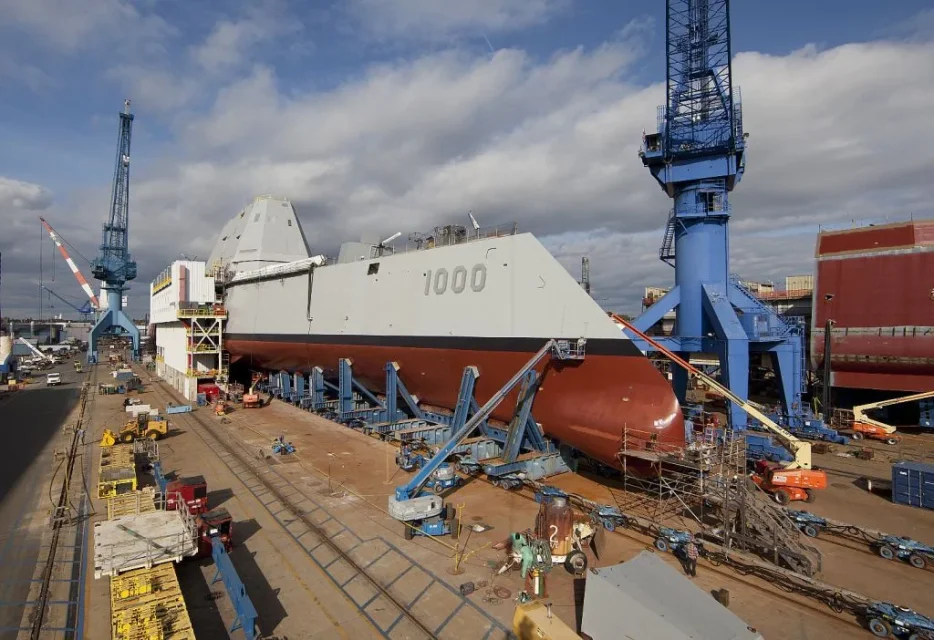
zumwalts are innovative hulls, indeed in some respects it can be called revolutionary. the construction takes place through the preparation and subsequent assembly of 85 “unit” i.e. modules of relatively small dimensions, that go to constitute 9 “ultra-unit”, each of which can reach to weigh beyond 4.000 tons.
untitled2.webp
These ultra-unit are set up within a large covered structure that allows you to achieve faster realization times and better quality levels. Once completed, the "ultra-unit" is transferred to the outside and rested on the "land-level transfer facility" (lltf) which acts as a construction port and then allows the transfer into the water of the ship by means of a flood basin.
194prcqupc9wtjpg.webp
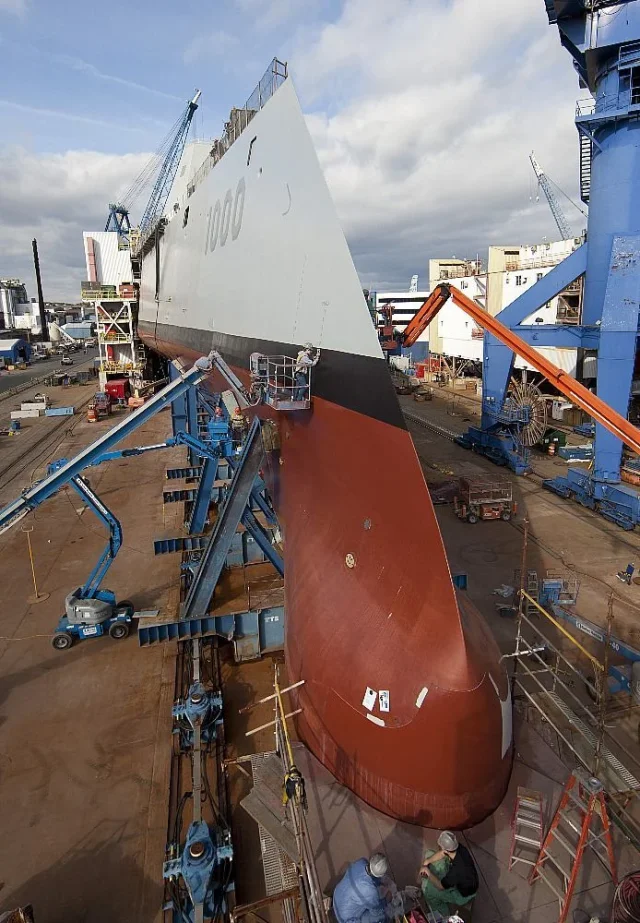
the definition “revolutionary” finds its confirmation by observing the forms of the hull and in particular the bow.
this adopts a conformation called “wave piercing” as it allows to “line” in the wave and not to follow the bike as in traditional configurations. this unusual configuration is the result of the will to get a low radar traceability as a ship that does not catch, offers a lower reflective surface.
untitled7.webp
always for this reason, observing the cross section, we notice a conformation that was no longer seen from the times of the galleons, the so-called “tumlehome hull”, a hull in which the walls decrease in width from the float to the blanket. These are solutions that logically raised doubts and controversies about their nautical qualities. in fact has been realized a demonstrator of more than 40 meters that has confirmed the positive expectations of the designers also expect more severe evidence in real marine weather conditions of strong wind and sea moved. the hull however has two long non-retractable anti-roll wings in the central area and is realized at the yard bath iron works in the maine while the superstructure is built in the northrop grumman ship system in the missisipi from where it is sent for the final assembly in the maine. on the first two units the superstructure, the hangar and the launchers, are made in composite. a wood core of balsa or foam, is covered by several layers of carbon impregnated with resin with a saving of several tons compared to a steel construction. on the third unit this solution will not be adopted for economic problems and the increase of weight will be compensated by the removal of a radar. This imposing superstructure contains all the premises used for conduct and combat operations, exhaust and aspiration of the engine system, all the sensors and antennas that are no longer on trees but “floated” in the structure and hidden from “transparent” panels to emissions.
untitled6.webp
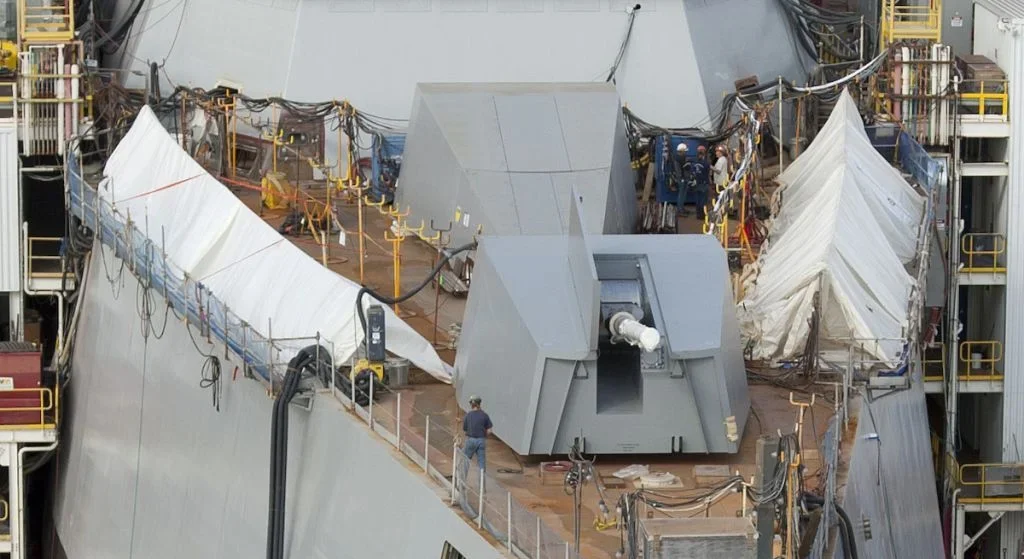
in a ship with stealth characteristics so pushed could not be different and each element is designed for this purpose. the artillery are in shaped turrets that hide also the reeds and the working areas are all covered obtaining a reduction of the radar track by 50% compared to a ddg-51.
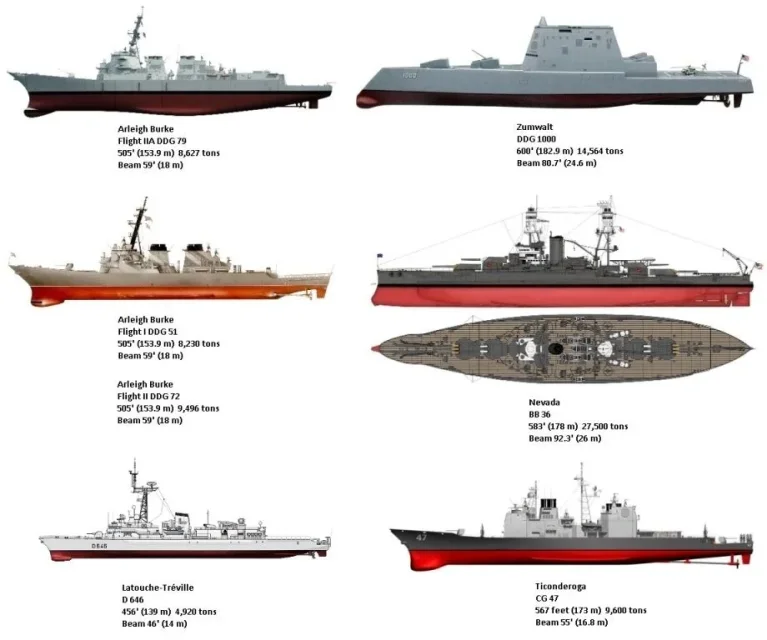
untitled4.webpthe hull measures 183 meters long and 24,5 meters wide. the dive is 8,5 meters. the height including the superstructure reaches 34,5 meters and the latter is over 60 meters long for 21 of width. the displacement should be 14,800 tons full load even if it is expected to reach 16,000 during the operating life.
but innovations are not only those visible from the outside... the real revolution is the tsce (total ship computing environment) ie the network of computers that manages and regulates every aspect of the zumwalt contained in 16 server rooms at the inerno of as many modules protected from magnetic interference. has control of every system and apparatus of the ship, from propulsion to energy generation, to its distribution, from the management of emergencies to the control of damage, from the conduct of the ship to the combat systems, from the sensors and communications to the systems of weapon and countermeasures up to the aircraft boarded.

(follows...) )
 
(...cont'd)

another great novelty is in propulsion and electricity generation. the ddg-1000 are “all electric ship” thanks to the integrated prpulsion system consisting of 2 turbo-generators and as many auxiliary units that operate two electric engines of propulsion. in essence each group consists of a rolls royce mt-30 tag of 36 mw that drives the generator while the auxiliary consists of a rolls royce rr4500 tag of 3,9 mw. the installed total power is 78mw. the electric motors are two converteam advanced induction motors from 36 mw that without gearbox, operate two propellers. the maximum speed exceeds 30 knots (there is 33 knots). the 4 generator groups also provide energy to all onboard utilities. the current produced at 4160 v, is transformed from alternating to continuous and lowered up to 1000 v then through two separate and independent lines (right and left) in turn divided into prora and stern, distributed to the utilities. each line also has a 500kw emergency diesel generator.

the combat system is no longer the traditional aegis of the American navy but a new specific system developed specifically. A dual-band radar was initially planned, but then, to contain costs saving 200 million per unit, the raytheon mfr was adopted with its three planar antennas that will have to ensure functions of aerial and surface research, discovery and tracking of targets, direction of both missiles and artillery.
There are 3 optical/infrared sensors, a navigation radar and a suite of underwater sensors intended to discover submarines and mines.
A large flight bridge of more than 710m2 is available to two mh-60r and 3 uav sqm-8b/c fire scout. the outer surface of the hangar is covered with absorbent radar tiles (ram).

the armament consists of two 30mm mk46 for close defence against small boats while one notices the absence of a close defence system like ciws phalanx antimissile. Twenty modules to 4 cells mk %/pvls for 80 launch wells, are positioned not the central position as usual but along the walls to leave more space in the center and for greater safety. can launch essm (evolved sea sparrow missile), antisom rocket vl-a and, tomahawk.
but the most important feature of the weapons system are the 2 ags (advanced gun sysytem) around which the class zumwalt has been realized. the ags is not simply a piece of artillery but it is actually a complex system consisting of the weapon, a specially developed bullet and a fully automated ammunition storage. realized by the “unite defense” became then “bae sysytem” is a 155mm piece. the barrel is 62 calibers long and uses a water cooling system and when it is not used, it falls within the shaped tower for a low radar marking. (in the following photo you can see the two towers in the two open/closed configurations)
untitled3.webpthe complete tower weighs 80 tons and below it is the storage ammunition 13.7 meters long and 9, heavy 160 tons.
welcomes 304 rounds loaded on pallets containing each 8 launch charges and 8 lrlap-type bullets (long range lande attack projectile), a 2,2-metre long bullet, 104 kg heavy with rocket propulsion and a 75-nautical mile range; inertial driving system and gps. the loading system is totally automatic and the shooting cadence is 10 strokes per minute although thanks to the “multiple round simultaneous impact” mode you can pull on the target 6 bullets in 6 seconds.
As for countermeasures there is probably a mk53 decoy launch system (dls) consisting of 137 mk launchers for active decoy and super fast bloom for the launch of chaffs. the dls can also launch deceptions for torpedo even if it is planned to install a system of discovery and contrast called “surface ship torpedo defense”.
a stern of the ship is a place that allows to contain 2 rubbers with a rigid keel from 7 or 11 meters with an extendable ramp that allows operations even with sea strength 5.


the whole ship is monitored by dozens of cameras and thousands of sensors against what is the number one enemy for a ship, the fire. the aafss (autonomic fire suppression sysytem) controls the data obtained from this sensory network and automatically, intervenes in case of fire reducing the time of intervention.
an unusual innovation concerns a system that generally does not offer many ideas to designers i.e. the anchor system. here they got rid of and the plant finds accommodation in the center of the ship in internal position with the anchor that exits "from below".
numerous other innovations and the introduction of high levels of automation has allowed to reduce to 130 the number of men boarded to which the 28 of the flight department must be added and the ship can sail with only 19 people in service. all the crew stays in cabins of 1,2 and 4 beds depending on the degree while the available places are 186. Additional spaces are provided for a team of 14 special forces (navy seals).
Therefore, why would the ddg-1000 program represent a failure? the answer is precisely in the features listed. in practice these units are built at exorbitant costs, almost exclusively around the two ags, which limits their operation to one type of mission i.e. the “naval gun fire support” also considering the equipment of tomahawk. Air defense capabilities are limited not to mention those anti-submarine. under the technical aspect then, is questioned the resistance in case of fire of a structure made of wood and composites. other perplexities arise from the decision of the us navy to abandon this constructive solution after the first two units, in favor of a more traditional steel as this entails a redistribution of weights upwards with consequent risks of instability still to be checked. futuristic destroyer from the cost-effectiveness report very questionable.

DDG-1000-Zumwalt_USS-Arleigh-Burke-FltI_USS-Arleigh-Burke-Flt-II_USS-Nevada-m6.webp(in the comparison image between zumwalt and other units of the us navy)

(follows...) )
 
always very interesting, thank you.

I mean, synthesized, what could potentially be a great piece of ship is revealing itself for a grand failscions, if only you had thought a little better about how to make it + multi role.
Right? :
 
always very interesting, thank you.

I mean, synthesized, what could potentially be a great piece of ship is revealing itself for a grand failscions, if only you had thought a little better about how to make it + multi role.
Right? :
I think they started with the usual idea of making the universal medium good for everything but then for technical impossibility and exorbitant costs they have mutilated more and more a project that had well other ambitions. at the end of all the units that had to be built will do very few, it seems three, making increase the unit price of each of them again.
But as I said, the confusing state that seems to have hit the American leadership is not limited to this case. wait to read the following.. .
 
(...cont'd)

in the premise we had seen how in intentions the lcs had to be relatively economic unit compared to the current American units whose unitary cost often exceeds the billion dollars, able to be produced in large numbers and, able to carry out multiple missions disembarking and embarking the necessary modules.
the goal was to quickly build 55 lcs, also because made with commercial standards, but many exponents of the us navy maintained this unsuitable choice to units intended to operate in the insidious coastal waters. these rethinkings have resulted in changes to the original project that have overwhelmed time and costs. for example, no advanced combat systems such as those for example boarded on “burke” or “ticonderoga”, indeed all sensors and systems had to be contained in mission modules to board from time to time.
the simplicity of project would have had to allow high production rhythms and the crew very contained in order to reduce operating costs.
but as Admiral guillory admitted, “the initial objectives were too optimistic about costs and timing.” In fact the first two lcs had a cost three times higher than expected 220 million and their construction required over a year more than expected. this has determined the cancellation of additional units and only the third and fourth have been authorized.

as we have seen everything originated with the seapower 21.
the program was announced in November 2001 when the three new generation fighter units were defined on which the new navy would arise: a destroyer for long distance fire support dd(x); a cruiser for aerial defense cg(x) and lcs. the following year were defined the technical and performance characteristics relative to the platform, aircraft capabilities, etc.
the characteristics of project were: speed not less than 40 knots, autonomy of about 3500 miles, operation for a helicopter type mh-60r and a uav also with sea force 5, possibility to operate with gums to rigid keel from 11 meters also with sea force 3, crew not exceeding 50 actual with at least 75 beds, living for 21 days, systems of supply at sea and times of reconfiguration of the modules in 4 days.
absolutely imposed bond was the dive corresponding to the full load that had not to exceed 6 meters so as to allow access to ports and coastal areas.
at the preliminary stage, on the basis of these requirements, there were 6 “competitors” that were oriented on a conventional platform, of the type normally adopted for corvettes and frigates that however did not satisfy the “vow of innovation” of the navy us.
at the end of this initial selection, three contracts were awarded to projects submitted by as many consortia, one to the lm group led by lockheed martin, the second to the gd group led by general dynamics and the third, to the raytheon group.
to the lm group has contributed fincantieri that provided the famine on which the project is based, a semiplanant steel hull able to exceed 40 knots despite the 115 meters long and the 17.3 wide and with an immersion of 3.9 meters, derived from the project “destriero”, winner of the blue ribbon in 1992.
Destriero07.webpequally innovative the solution, indeed, more striking, offered by the group gd. on the basis of the experiences on the Australian fast ferries built from the austal, was proposed an aluminum trimaran with a very narrow central hull but with a very high stability offered by the two side boots in the center-piece. 127.3 meters long and 31.5 meters wide, has an immersion of 4.3 meters.
&trimaran.webpthe third group instead proposed a solution inspired by the patrolman with surface effect “skijold” already used in 5 specimens from the Norwegian navy, aluminum and composite materials, able to exceed 50 knots.
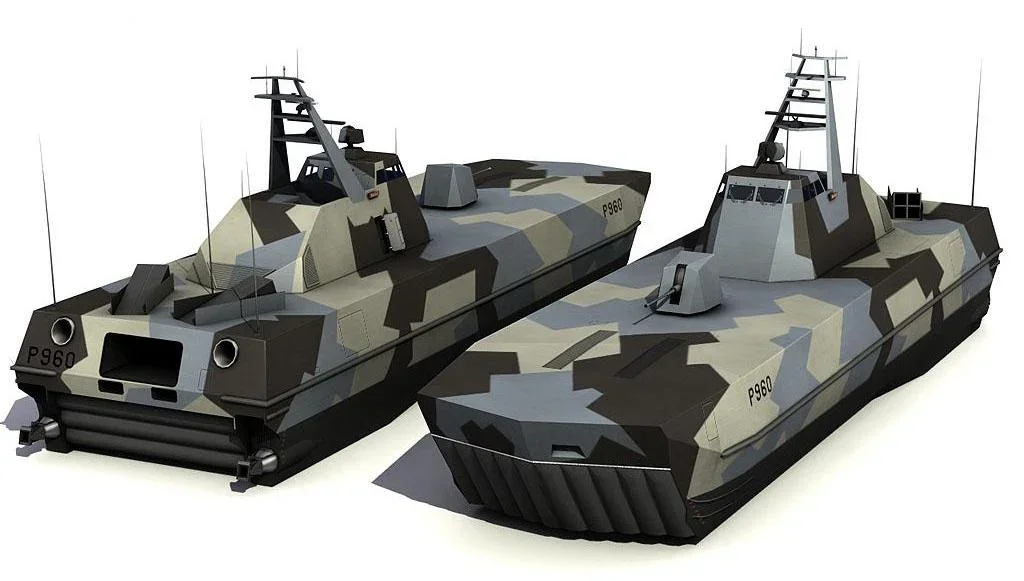
DSC_0035_wm.webpin May 2004 the contracts were reduced to two, with the selection of lm and gd proposals to which a contract was offered for the realization of the project detail and the option for the construction of two units each. both hulls displace approximately 3000 tons and have large flight bridges. let's see them more in detail starting from project lm.

(follows...) )
 

Forum statistics

Threads
44,997
Messages
339,767
Members
4
Latest member
ibt

Members online

No members online now.
Back
Top