maxopus
Guest
Then we have to see how to handle the axieme... but does that swx do?
With two cads around, it's double work.
I'm going to go...
With two cads around, it's double work.
I'm going to go...

Yeah, I got here now.I wrote you now with 2 attachments and an address to see.
I forgot that in addition to the timoni, you also make the hatch, don't you? :biggrin:
hello and everyone standing on the couch.
..I hope so; at least until the vare should holdThen we have to see how to handle the axieme... but does that swx do?
It was only 2.With two cads around, it's double work.
If so, it is not necessary to go further. the degree of continuity in fact does not indicate the degree (or order) of a surface, but how many times the polynomial can be derived without creating discontinuity. as a degree of the surface instead you can go further, if in fact you do the bending analysis on a spline of order 3 you see that it does not generate the same degree of continuity of a spline of higher order. a connection between two surfaces with continuous g2 (curve continuity) requires at least 2 points (for u or v) of control generated on the first surface and 2 other control points generated on the other surface, in total are 4 points and therefore form a spline (which can be b-spline or nurbs) of grade 5. Therefore the degree or order 5 is the minimum possible to obtain continuity of curvature in the fitting of generically curved surfaces.this surface is heavy and "burnt" because it pedissequamente follows the lines with all their defects and the degree of the same is consequently exaggerated (some were of a degree greater than 100 ...)
at this point I lay the surface from the lines and decrease the degree reaching a compromise, as the lower the degree, the more the surface is smooth and the more it moves away from the lines.
in our case the degree of surfaces compared to the trend of orders is 7 (which in the automotive field is exaggerated ... we use single grade 3 or 4 surfaces to the maximum).
hi paolo, with degree of the surface I meant the number of control polygons that constitute it, not the type of connection with adjacent surfaces. using different cads is easy to run in unclear definitions.If so, it is not necessary to go further. the degree of continuity in fact does not indicate the degree (or order) of a surface, but how many times the polynomial can be derived without creating discontinuity. as a degree of the surface instead you can go further, if in fact you do the bending analysis on a spline of order 3 you see that it does not generate the same degree of continuity of a spline of higher order. a connection between two surfaces with continuous g2 (curve continuity) requires at least 2 points (for u or v) of control generated on the first surface and 2 other control points generated on the other surface, in total are 4 points and therefore form a spline (which can be b-spline or nurbs) of grade 5. Therefore the degree or order 5 is the minimum possible to obtain continuity of curvature in the fitting of generically curved surfaces.
In any case, I am convinced that the best road is the one you choose, that is to generate the hull as close as possible to the original building plan, and then to often and to obtain the executive orders.
Yes, I understood you were referring to the number of control points when talking about heavy surfaces. in fact if the points are too many the surface is heavier and more subject to the details (= less smooth) as you said. I understand your difficulties, they are the same as I encounter because although we do use different cads, which use different interfaces with different approaches, native geometries (or mathematicians, as they often say) are always the same (or at least that I know).hi paolo, with degree of the surface I meant the number of control polygons that constitute it, not the type of connection with adjacent surfaces. using different cads is easy to run in unclear definitions.
I would say with 3250 kw you can make 16 knotsI'm particularly addressing dragon. I'm gonna get you some work.
to have as maximum speed 16 knots, keeping hull, displacement, etc. original but adopting for diesel drive and gearboxes, how many kw do I need? and the propellers and axes what size they have?
Hello, dragon.I would say with 3250 kw you can make 16 knots
220 mm axles
eliche depends on the reducer we choose, but to have a good performance
I would stay on about 200 rpm so:
diameter 2850 mm approx.
greetings
dragon, you who are the only one of the unmistakable (excluding logically sam and max) when you can post me the updated propeller? the stern is almost ready...I would say with 3250 kw you can make 16 knots
220 mm axles
eliche depends on the reducer we choose, but to have a good performance
I would stay on about 200 rpm so:
diameter 2850 mm approx.
greetings
..you are definitely optimistic:tongue::biggrin:the stern is almost ready.. .
.
Come on, let's get the edges and the dirty work is done...you are definitely optimistic:tongue::biggrin:
I like it!
greetings
Marco:smile:
He likes popes.Come on, let's get the edges and the dirty work is done.
we had several fixes in the race but it seems to me that we start to be there. if you think we started out from the beginning when we had the surfaces from max...
e! should set up mandatory update courses.He likes popes.
What did you get? ! !
:biggrin:
on poppes?e! should set up mandatory update courses.
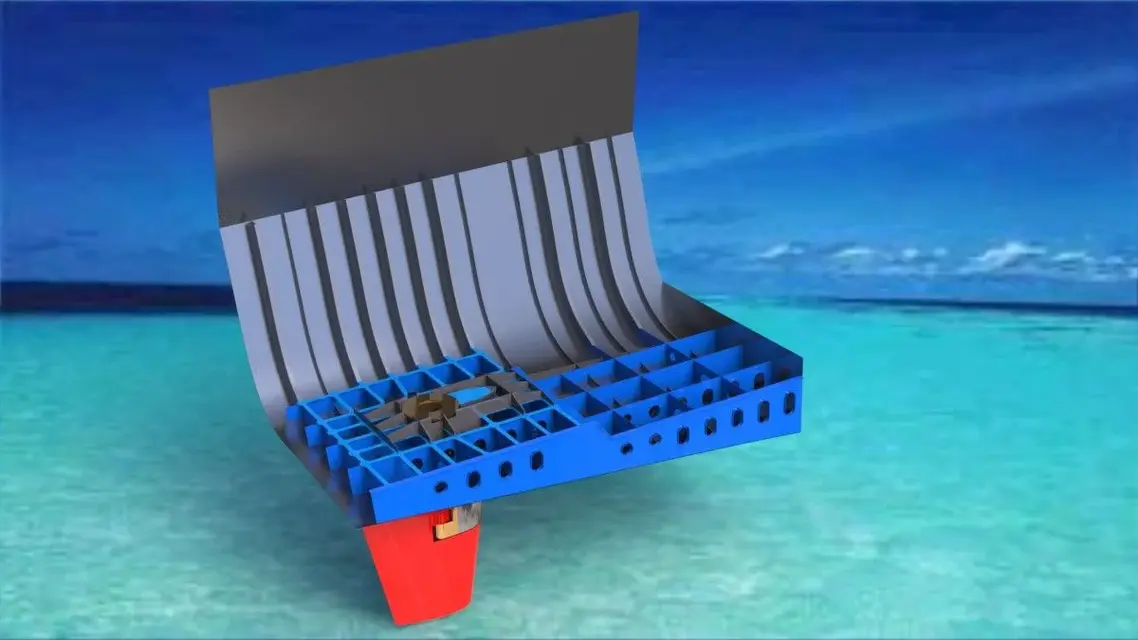 this is only the beginning of the workman who is carrying out the excellent (..ecco the root of the nick..:biggrin
 exatem.
Apparently everyone in vacation. .Okay, enough with the jokes. .
You want poops? and that poppes are:View attachment 16171What do you think?
Maybe not like how we dyed. . We could put a nice tapestry on flowers.Apparently everyone in vacation. .
or all to droop in front of the calendar:tongue::biggrin:
greetings
Marco:smile: