• This forum is the machine-generated translation of www.cad3d.it/forum1 - the Italian design community. Several terms are not translated correctly.

project ladice

  • Thread starter Thread starter Exatem
  • Start date Start date
Then we have to see how to handle the axieme... but does that swx do?

With two cads around, it's double work.
I'm going to go...

 
I wrote you now with 2 attachments and an address to see.
I forgot that in addition to the timoni, you also make the hatch, don't you? :biggrin:
hello and everyone standing on the couch.
Yeah, I got here now.

Okay, I'll try with the hatch. .

Hei, if someone has ideas and advice do not timid, I recommend:wink:

greetings
Marco:smile:
 
this surface is heavy and "burnt" because it pedissequamente follows the lines with all their defects and the degree of the same is consequently exaggerated (some were of a degree greater than 100 ...)

at this point I lay the surface from the lines and decrease the degree reaching a compromise, as the lower the degree, the more the surface is smooth and the more it moves away from the lines.
in our case the degree of surfaces compared to the trend of orders is 7 (which in the automotive field is exaggerated ... we use single grade 3 or 4 surfaces to the maximum).
If so, it is not necessary to go further. the degree of continuity in fact does not indicate the degree (or order) of a surface, but how many times the polynomial can be derived without creating discontinuity. as a degree of the surface instead you can go further, if in fact you do the bending analysis on a spline of order 3 you see that it does not generate the same degree of continuity of a spline of higher order. a connection between two surfaces with continuous g2 (curve continuity) requires at least 2 points (for u or v) of control generated on the first surface and 2 other control points generated on the other surface, in total are 4 points and therefore form a spline (which can be b-spline or nurbs) of grade 5. Therefore the degree or order 5 is the minimum possible to obtain continuity of curvature in the fitting of generically curved surfaces.

In any case, I am convinced that the best road is the one you choose, that is to generate the hull as close as possible to the original building plan, and then to often and to obtain the executive orders.
 
If so, it is not necessary to go further. the degree of continuity in fact does not indicate the degree (or order) of a surface, but how many times the polynomial can be derived without creating discontinuity. as a degree of the surface instead you can go further, if in fact you do the bending analysis on a spline of order 3 you see that it does not generate the same degree of continuity of a spline of higher order. a connection between two surfaces with continuous g2 (curve continuity) requires at least 2 points (for u or v) of control generated on the first surface and 2 other control points generated on the other surface, in total are 4 points and therefore form a spline (which can be b-spline or nurbs) of grade 5. Therefore the degree or order 5 is the minimum possible to obtain continuity of curvature in the fitting of generically curved surfaces.

In any case, I am convinced that the best road is the one you choose, that is to generate the hull as close as possible to the original building plan, and then to often and to obtain the executive orders.
hi paolo, with degree of the surface I meant the number of control polygons that constitute it, not the type of connection with adjacent surfaces. using different cads is easy to run in unclear definitions.
 
hi paolo, with degree of the surface I meant the number of control polygons that constitute it, not the type of connection with adjacent surfaces. using different cads is easy to run in unclear definitions.
Yes, I understood you were referring to the number of control points when talking about heavy surfaces. in fact if the points are too many the surface is heavier and more subject to the details (= less smooth) as you said. I understand your difficulties, they are the same as I encounter because although we do use different cads, which use different interfaces with different approaches, native geometries (or mathematicians, as they often say) are always the same (or at least that I know).
 
I'm particularly addressing dragon. I'm gonna get you some work.
to have as maximum speed 16 knots, keeping hull, displacement, etc. original but adopting for diesel drive and gearboxes, how many kw do I need? and the propellers and axes what size they have?
I would say with 3250 kw you can make 16 knots
220 mm axles
eliche depends on the reducer we choose, but to have a good performance
I would stay on about 200 rpm so:
diameter 2850 mm approx.
greetings
 
I would say with 3250 kw you can make 16 knots
220 mm axles
eliche depends on the reducer we choose, but to have a good performance
I would stay on about 200 rpm so:
diameter 2850 mm approx.
greetings
Hello, dragon.
Sorry I didn't answer you right now, but I didn't notice the post.
now control with propellers from 2850 how many degrees I have to give to the axis then we define everything well.
Thank you.
 
I would say with 3250 kw you can make 16 knots
220 mm axles
eliche depends on the reducer we choose, but to have a good performance
I would stay on about 200 rpm so:
diameter 2850 mm approx.
greetings
dragon, you who are the only one of the unmistakable (excluding logically sam and max) when you can post me the updated propeller? the stern is almost ready...
Bye.
 
..you are definitely optimistic:tongue::biggrin:
I like it!

greetings
Marco:smile:
Come on, let's get the edges and the dirty work is done.
we had several fixes in the race but it seems to me that we start to be there. if you think we started out from the beginning when we had the surfaces from max...
 
Come on, let's get the edges and the dirty work is done.
we had several fixes in the race but it seems to me that we start to be there. if you think we started out from the beginning when we had the surfaces from max...
He likes popes.
What did you get? ! !
:biggrin:
 
e! should set up mandatory update courses.
on poppes?
What? Always those are. .
Perhaps you mean on new materials, the new trend seems to be the "gomma" (even easier to model, with proe it would have to get rid of):biggrin::tongue:

greetings
Marco:smile:
 
Okay, enough with the jokes. .

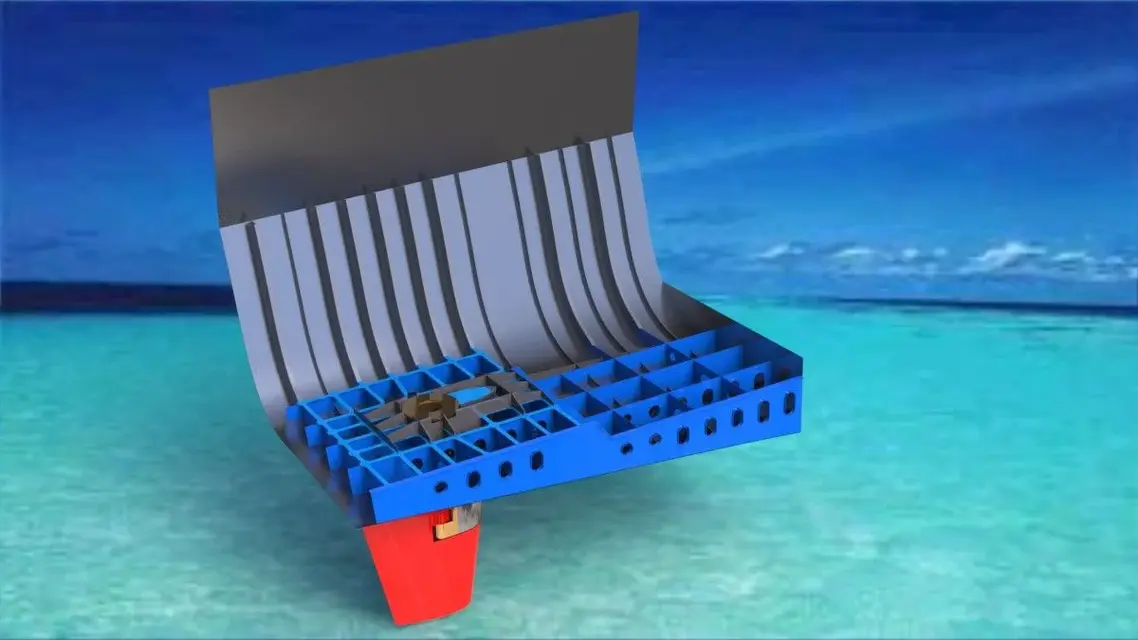
You want poops? and that poppes are:POPPA LAODICE.webpthis is only the beginning of the workman who is carrying out the excellent (..ecco the root of the nick..:biggrin:) exatem.
I am not that the humble Amanuense servant:wink:

What do you think?

greetings
Marco:smile:
 
after a period of “appealing heat” here we again talk about ship Laodice. As we had already said, the project had not been abandoned but temporarily suspended pending more favourable conditions.
provided that without the fundamental impulse of sampom (but that I will call rotten), that does not limit itself as he says to the only work “amanuense” but it is decisive in the choice of solutions undertaken, we are divided and we are finally able to present a first result. to be able to reach the target set, i.e. “divertirci” in the pharaoh’s work of “building a ship” we decided to simplify some constructive choices. we have originally started with the idea of creating a multi-hull to then move to more traditional hulls, initially of a frankly excessive size to finally arrive at a monohull of about 100 meters (which are certainly not few and allow us to enroll in the narrow circle of the giga-yacht) passing through semi-planning, displaced hulls, etc. etc. etc. In terms of propulsive choices, we have a wide range of innovative and technological solutions, but then, for construction simplicity, we have opted for a more traditional motorization. on this mark and I did not find ourselves in perfect harmony. In fact, from good slender would wish to squeeze 40 or more knots. but the difficulties were really big and they would overwhelm the work carried out tirelessly until now.
Thus once the fundamental dimensions are established, i.e. length, width and immersion of the project, from which it is possible to deduct the other characteristic dimensions, it was possible to begin to sketch out the plan of construction that is the main of the necessary drawings, that which establishes the forms of the living work. once in fact identified the general characteristics determine the characteristic points for the plot of the plan. you can use it for this, one of the following methods:
- modification of the cylindrical body. In practice, knowing the volume of the prora and the stern and inserting between the two a cylindrical body of appropriate length, you will get a volume famine equal to that of the project.
- use of the systemic series of hulls. for this method, we use the characteristic diagram that identifies a “family” of famines having same characteristics of form. a very well known diagram is that of the standard carenes of taylor.
- design ex novo. you draw a possible figure of floating. the ordinary teacher and three ordered equidistants both towards prora and towards aft. detecting the semi-width, two lines of water are drawn, trying to achieve a satisfactory trend. the longitudinal sections with the points taken both on the order and on the water lines correcting the errors. at this point it is possible to obtain the ordinates of study by dividing in 20 equal parts the distance between the perpendiculars forward and backward and continuing to correct the position of the various points.
- transformation by affinity of an existing plan. changes an existing plan by multiplying length, widths and dives by coefficients of affinity.
for the construction of the Laodice building plan, these last two solutions have been followed with numerous “corrective” interventions. at the maximum end (maxopus) it has obtained of the famine surfaces that were the guidelines for the construction 3d of the structures.
the ship has been divided into blocks as in a construction process of prefabrication. it began by making the stern from the mirror to the first stagna wallpaper and comprising deck of covers and corridor. for the type of structure you have chosen a mixed solution. stern and prora, up to the respective strips, adopt a structure mainly transversal while the rest of the hull will be realized with longitudinal structure.
for the sizing followed the "regulation for the construction of the steel hulls" of the Italian naval register (rina), section b part i.
In particular, the general rules for the sizing of the structures are dealt with in Chapter 5, while the rules for the sizing of the rudder are found at Chapter 18. in both cases the rules establish the minimum dimensions permissible for normal type hulls intended for maritime navigation without limitation. for the applicability of these standards, it is assumed that the transported load has mass not exceeding 0.7 t/m3 for dry loads and 1.025 t/m3 for liquid loads.
This allowed a credible sizing through a “simplified” procedure that avoided having to resort to extremely complex and difficult application calculations.
the rules apply to ships having relationships between the basic dimensions (l, b and h) which fall into a table that ranks them according to navigation.
unlimited navigation l/h <=17 b/h <= 3
coastal navigation l/h <=20 b/h <=3
Costs
in water repaired l/h <=25 b/h <=4
the drawings to be presented to the renaissance are: master section, fascia development, bridges and longitudinal section, plan of the bones, double bottom, plane spikes, bulkheads, motor apparatus structures, foundation machines, structure of the prora and of the stern, frame or straight of the stern, arms of the propellers, rudder, overstructures and tugades, bonnets motor, parapets and shells, general doors
Below are symbols used formulas and results obtained. some of these are still being developed and will be corrected with new values.

(data symbol u.m. range value)
length outside all lft m 105
length of float lwl m 99,72
floating width bwl m 11,82
width out all b m 12
project immersion t m 4,4
construction height h m 9,45
design speed n nodi 16
volume of famine v m3 3025,9
water density ρ 1,025
surface of famine s m2 1440,7
area sez. teacher at m2 41,384
lateral surface sl m2 391,43
oxage range s mm 600
n° ordered or n 166,2
displacement v ρ δ ton 3101,55
coefficient total fineness v/lft*b*t ς 0.57 (0,45 - 0,8)
coefficient finesse sez. teacher a/b*t β 0,80 (0,65 - 0,98)
coefficient finesse plane of drift sl/lwl*t γ 0,89 (1)
coefficient of longitudinal fineness v/(ς*lwl*bwl*t) ψ 1,02 (0,6 - 0,8)
ratio t - bη 0.37 (0.2 - 0.5)
lwl ratio - b λ 8,75 (5 - 10)
report l - h 10,55 (9 - 16)
ratio h - b 0,79 (0,3 - 0,7)
ratio t – h 0,47 (0,4 - 0,7)
ratio h – t 2,15 (1 - 2,2)
report b – t 2,73 (3 - 4,5)
coefficient section cx 0,7838 0.55 (0,6 - 0,75)
Figure floating coefficient cwl 0,7762 0,74 (0,6 - 0,8)
lwl/δ1⁄3 6,84
v/lwl1/2 1,60 1.5 - 2

Structural steels for the construction of hulls are divided into two categories; ordinary steels and high strength steels. These categories are divided into degrees according to the value of the minimum unit load of reh yield and in types in relation to weldability. ordinary steels are divided into two degrees: grade 24 and grade 27 having 235 and 265 n/mm2 respectively. high strength steels are divided into three degrees: 315, 355 and 390 n/mm2 respectively. the renaissance establishes that in the execution of structural calculations, a coefficient k must be considered. the coefficient k for the sizing of structural elements in steel er is according to the value of the minimum unit yield load and is:
1 for reh < 265;
0,925 per reh = 265;
0,78 per reh = 315
0,72 per reh = 355

dimensioning
We will not fill these pages of formulas and calculations, we will only say that we have made spreadsheets using the formulas indicated in Chapter 5 obtaining the dimensions of the ferries that constitute the structure of the ship. for the material it has chosen to use steel having a unitary yield equal to 265n/mm2 therefore with calculation coefficient k = 0.925. for the sizing of the helm, marco has referred to the norms contained in Chapter 18 realizing a helm of which later we will present the evolutionary characteristics capable of imprinting to our ship. According to the characteristics of the unit, the surface of the rudder is established as a percentage of the drift plane, therefore, its dimensions are obtained, such as surface, compensation area, etc., then enter into play of the coefficients that allow to determine the agents' efforts on the rudder itself and to obtain a torque and bending moment, to calculate its axis, fin, thicknesses of the plates, internal diaphragms, etc.
 
from the point of view of longitudinal robustness, the ship is comparable to a beam loaded perpendicularly to its axis and therefore subject to cutting and bending efforts. the trend of the cutting effort can be obtained from the integration of the diagram of the residual loads. the bending moment is obtained by integration of the cutting diagrams.
establishing the weight of a ship discharged and dry when it is still being projected, is one of the most uncertain and complex operations. the amount of machinery, plants, furniture, etc. that must be installed does not allow the certainty of the evaluation. therefore the weight is determined using statistical type assessments established by the registers (such as our den). Depending on the type of ship and its size, the diagram returns the weight of the equipment while, a second diagram, allows us to determine the weight of the engine system and its machinery according to the power and type of ship. As the project progresses it is possible to fill out the so-called “load exponent” that brings value and position of all the weights and necessary liquids.
for the performance of the hydrostatic push is used the bonjean diagram on which the values of the transversal areas are reported. multiplying by 1.025 the ordered so obtained, you get the spin diagram. spins and weights are sumable algebraically and give rise to a third diagram mentioned above, of the “remaining loads”.
established static stresses (crew in calm waters), dynamic stresses must now be assessed. even in this case the calculation is far from simple because of the unpredictability of the factors that they contribute. ondous training, speed of the ship, etc. as many of the data are not available at the beginning of the project, also in this case it is used statistical formulas provided by the classification institutes. fundamentally it is considered that among all the ondous formations, the most dangerous is that whose wavelength is similar to the length of the ship (0.8 – 1,2 l) and of height equal to 1/20 of the length itself. to simplify the calculation is considered the “freeze” wave, thus transforming a dynamic phenomenon into a static while keeping in mind the emergence of fatigue phenomena. with the integration of the diagram of the residual loads for full-loaded vessel in the crest or cable of the wave, the cutting stress is obtained and then the bending moment. in general the max mf is concentrated in the ship center while the maximum cutting efforts are located at 1⁄4 and 3⁄4 of the length. the maximum mf will be in correspondence of the main section therefore:
- the value of the mf is calculated.
- is divided by the bending resistance module obtaining the max sigma that is compared with the amm. sigma obtained from the statistical formulas of the registers (the ones we used).
It is obvious that the max sigma must be less than the sigma amm.
for the calculation of transverse robustness, a simplified but precautionary scheme is adopted. It is considered that the cross section is independent from the longitudinal elements. By doing so it is attributed to the load frames that are actually shared with adjacent structures (which puts us in safety conditions). as static loads you consider the loads agents on a frame horse range. other loads to consider are the hydrostatic pushes to straight and inclined ship. dynamic loads are translated into distributed equivalent static loads.
to the stresses quoted so far we must add the torque moments caused by the waves in case they are oblique to the ship. other loads to consider are those loads of great entity concentrated in restricted areas of the hull as prora (argans salpa anchors, wells chains...) stern (timoni, propellers), zone motor apparatus, gearboxes.

Many of the things we have said both in the first part and in this, have already been faced both here and in "over and under the waves" but, it seemed useful to summarize them for those who have not followed the two long discussions. They will follow other hand as the thief takes shape.
but now the yard closes for holidays.
Greetings to everyone.
 
Hello everyone,
I have long been following the project of construction of the Laodice, and I have noticed that you are all or almost "of the trade" then prepared theoretically and practically and equipped with means of representation that use programs cad unknown to the profane like me.
I would be grateful, therefore, within the limits of time you have, if you could present your drawings and your 3d representations perhaps in pdf, so that we too can enjoy your illuminations and follow the development of the project with images that, most times, are much clearer for those like me, not experts.
Thank you.
 

Forum statistics

Threads
44,997
Messages
339,767
Members
4
Latest member
ibt

Members online

No members online now.
Back
Top